



What to know
- Access reports and scientific articles that use Research and Development Survey (RANDS) data for statistical and methodological research.
- Articles featuring RANDS data cover a variety of health topics.

About RANDS publications
Data from the Research and Development Survey (RANDS) have been used in a wide variety of research since the survey's launch in 2015. The first reports using RANDS data were published in 2017. The list of publications below highlights some of the many applications for RANDS data, such as—
- Developing and evaluating statistical methods for web surveys
- Assessing if web surveys can be used for measurement research
- Addressing missing data in surveys
- Exploring COVID-19's effect on healthcare access
Publication spotlight
Survey designs typically tradeoff between maximizing use of the data and protecting participant privacy. Uncommon characteristics, like having a rare disease or being older than most people, are often excluded from publicly released data sets to ensure that individual survey participants cannot be identified. But excluding such information makes it harder to understand how it impacts health.
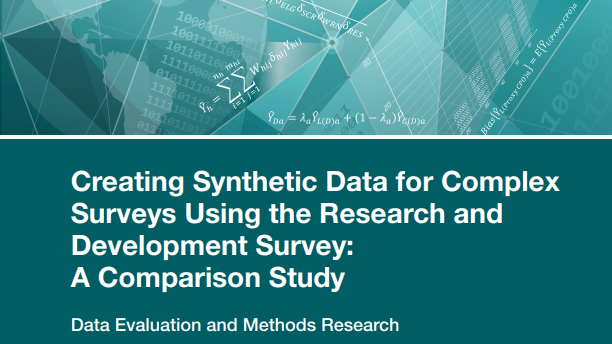
To fill these data gaps and still maintain privacy, the National Center for Health Statistics is exploring use of "synthetic" data—developed through statistical models to represent actual characteristics and outcomes without revealing identifying information. A new report—"Creating Synthetic Data for Complex Surveys Using the Research and Development Survey: A Comparison Study"—looks at three survey design methods for creating synthetic data to determine their effect on how useful the data are (data utility) and how likely the data could identify a survey participant (disclosure risk).
2025
- Hu LYR, He Y, Irimata KE, Beresovsky V. Much Ado About Survey Tables: A Comparison of Chi-Square Tests and Software to Analyze Categorical Survey Data. The American Statistician, 1-12. 2025. DOI: 10.1080/00031305.2025.2501800.
- Zhang G, He Y, Oganian A, Cai B. Creating synthetic data for complex surveys using the Research and Development Survey: A comparison study. Vital Health Stat 2. 2025 Apr;(212):1–17. DOI: https://dx.doi.org/10.15620/cdc/17458
2024
- Scanlon, PJ. A Comparative study of approaches to collecting intimate partner violence data: Results from the National Center for Health Statistics' Research and Development Survey, Round 5. Findings-from-RANDS5-DRM-Research-Memo
- Scanlon, PJ. Findings from a series of National Survey of Family Growth (NSFG)-related experiments on the National Center for Health Statistic's Research and Development Survey, Round 6. Findings-from-RANDS6-DRM-Research-Memo
2023
- Zhang G, He Y, Cai B, Moriarity C, Shin H-C, Parsons V, Irimata KE. Multiple imputation of missing data with skip-pattern covariates: a comparison of alternative strategies. J Stat Comput Simul. 2023. DOI: 1080/00949655.2023.2293124
- Irimata KE, Scanlon P, Moriarity C, Cai B, Beresovsky B, Wei R. Findings from RANDS 7. DRM Research Memo. 2023-04E
- Hu LYR, Scanlon P, Miller K, He Y, Irimata KE, Zhang G, Hibben KC. National Center for Health Statistics' 2019 Research and Development Survey, RANDS 3. National Center for Health Statistics. Vital Health Stat 1(65). 2023. DOI: https://dx.doi.org/10.15620/cdc:13027
- Moron LP, Irimata KE, Parker JD. Comparison of mental health estimates by sociodemographic characteristics in the Research and Development Survey 3 and the 2019 National Health Interview National Health Statistics Reports; no 188. Hyattsville, MD: National Center for Health Statistics. 2023. DOI: https://dx.doi.org/10.15620/cdc:128964
- Smith Z, Cibelli Hibben K, Rogers B, Scanlon P, Hoppe T. Towards high-quality open-ended data: A Semi-Automated Nonresponse Detection model [news release]. April 12, 2023. Available from: https://aapor.org/news-releases/towards-high-quality-open-ended-data-a-semi-automated-nonresponse-detection-model/
- Irimata KE, He Y, Parsons VL, Shin H-C, Zhang G. Calibration weighting methods for the National Center for Health Statistics Research and Development Survey. National Center for Health Statistics. Vital Health Stat 2(199). 2023. DOI: https://dx.doi.org/10.15620/cdc:123463
- Cibelli Hibben K, Smith Z, Rogers B, Ryan V, Scanlon P, Miller K, Hoppe T. Semi-Automated Nonresponse Detection for Open-Text Survey Data. 2023. DOI: 57967/hf/0414
- He Y, Zhang G. Multiple imputation analysis of missing complex survey data using SAS®: A brief overview and an example based on the Research and Development Survey (RANDS). The Survey Statistician (newsletter) 87. 2023.
- Irimata KE, Pleis JR, Heslin KC, He Y. Reduced access to preventive care due to the COVID-19 pandemic, by chronic disease status and race and Hispanic origin, United States, 2020-2021. Public Health Reports 138(2): 341-348. 2023. DOI: 1177/00333549221138855
2022
- Shin H-C, Parker J, Parsons V, He Y, Irimata K, Cai B, Beresovsky V. Propensity-score adjusted estimates for selected health outcomes from the Research and Development Survey. National Center for Health Statistics. Vital Health Stat 2(196). 2022. DOI: https://dx.doi.org/10.15620/cdc:121708.
- Li Y, Irimata K, He Y, Parker J. Variable inclusion strategies through directed acyclic graphs to adjust health surveys subject to selection bias for producing national estimates. J Off Stat 38(3):875–900. 2022.
- Irimata KE, Scanlon P. The Research and Development Survey (RANDS) during COVID-19. Stat J IAOS 38(1):13–21. 2022.
2020
- Irimata KE, He Y, Cai B, Shin H-C, Parsons VL, Parker JD. Comparison of quarterly and yearly calibration data for propensity score adjusted web survey estimates. Surv Methods Insights Field. 2020. DOI: 10.13094/SMIF-2020-00018.
- Parker J, Miller K, He Y, Scanlon P, Cai B, Shin H-C, et al. Overview and initial results of the National Center for Health Statistics' Research and Development Survey. Stat J IAOS 36(4):1199–1211. 2020. DOI: 3233/SJI-200678.
- He Y, Cai B, Shin H-C, Beresovsky V, Parsons V, Irimata K, et al. The National Center for Health Statistics' 2015 and 2016 Research and Development Surveys. National Center for Health Statistics. Vital Health Stat 1(64). 2020.
- Scanlon P. Cognitive evaluation of the National Center for Health Statistics' 2018 Research and Development Survey. National Center for Health Statistics Q-Bank. 2020.
2019
- Scanlon P. The effects of embedding closed-ended cognitive probes in a web survey on survey response. Field methods 31(4):328–43. 2019. DOI: 10.1177/1525822X19871546.
- Scanlon P. Using targeted embedded probes to quantify cognitive interviewing findings. In: Beatty PC, Collins D, Kaye L, Padilla JL, Willis GB, Wilmot A, editors. Advances in questionnaire design, development, evaluation, and testing. Hoboken, NJ: John Wiley & Sons, 427–50. 2019. DOI: 10.1002/9781119263685.ch17.
2018
- He Y, Shin H-C, Cai B, Beresovsky V, Scanlon P, Parsons V, et al. The utility of using web surveys to provide official estimates for major health outcomes: A pilot study. In: 2018 Statistics Canada International Methodology Symposium Proceedings. Ottawa, Canada: Statistics Canada. 2018.
2017
- Scanlon P. Cognitive evaluation of the 2015–2016 National Center for Health Statistics' Research and Development Survey. National Center for Health Statistics Q-Bank. 2017.
- Beresovsky V. Imputation classes as a framework for inferences from nonrandom samples. In: 2017 Proceedings of the Joint Statistical Meetings. Alexandria, VA: American Statistical Association, 2918–32. 2017.
- Singh AC, Beresovsky V, Ye C. Estimation from purposive samples with the aid of probability supplements but without data on the study variable. In: 2017 Proceedings of the Joint Statistical Meetings. Alexandria, VA: American Statistical Association, 3324–45. 2017.