


Key points
- PEP is used to prevent HIV after a potential exposure.
- Start PEP as soon as possible, ideally within 24 hours and no later than 72 hours after exposure.
- Any licensed prescriber can prescribe PEP.
- Baseline assessment is required for people beginning PEP, but do not delay the first dose while waiting for results.
- Follow CDC’s updated nPEP recommendations for prescribing, follow-up care, and transition to PrEP.

Recommendations
PEP (post-exposure prophylaxis) is using antiretroviral medication to prevent HIV infection in someone who may have been recently exposed to HIV. Exposure typically occurs through sex or sharing syringes (or other injection equipment) with someone who has or might have HIV. Nonoccupational post-exposure prophylaxis (nPEP) is a term used to specify that the exposure was not work-related.
Did you know?
Exposure to HIV is a medical emergency
HIV establishes infection very quickly, often within 24 to 36 hours after exposure123. Patients should start PEP as soon as possible, ideally within 24 hours, and no later than 72 hours after exposure. Evaluate patients rapidly for PEP when someone seeks care ≤72 hours after their vagina, penis, rectum, eye, mouth or other mucous membrane, nonintact skin, or perforated skin (e.g., needle stick) came into contact with body fluids from a person who has or might have HIV.
Determine baseline HIV status in patients being considered for PEP by using a rapid HIV test (also called a point-of-care test), if available, and a laboratory-based antigen/antibody combination HIV test. If rapid HIV blood test results are unavailable and PEP is indicated, administer the first dose of PEP immediately. PEP can be stopped later if the person has HIV or if the source of the exposure is determined not to have HIV4.
PEP is not recommended >72 hours after exposure
Consider PEP for patients who were potentially exposed to HIV within 72 hours before seeking care. If you do not know the exposure source's HIV status, make a case-by-case determination.
Evaluate people who may have repeated HIV exposures through sex or injection drug use for pre-exposure prophylaxis (PrEP). If the most recent exposure occurred within the past 72 hours, PEP may still be appropriate. Although evidence is insufficient to recommend nPEP initiation later than 72 hours after exposure, certain experts have argued that risk versus benefit considerations could favor a longer initiation window. People who continue to have HIV exposures can start PrEP after finishing the 28-day PEP course. No gap is needed between PEP and PrEP.
Any licensed prescriber can prescribe PEP
Emergency medicine physicians are among the most frequent prescribers of PEP, given the need for immediate treatment after exposure. If you work in an ambulatory care practice, ensure that your patients who do not have HIV and report HIV risk factors are aware of PEP and know how to access it after-hours.
Algorithms for evaluation and treatment of possible nonoccupational HIV exposures
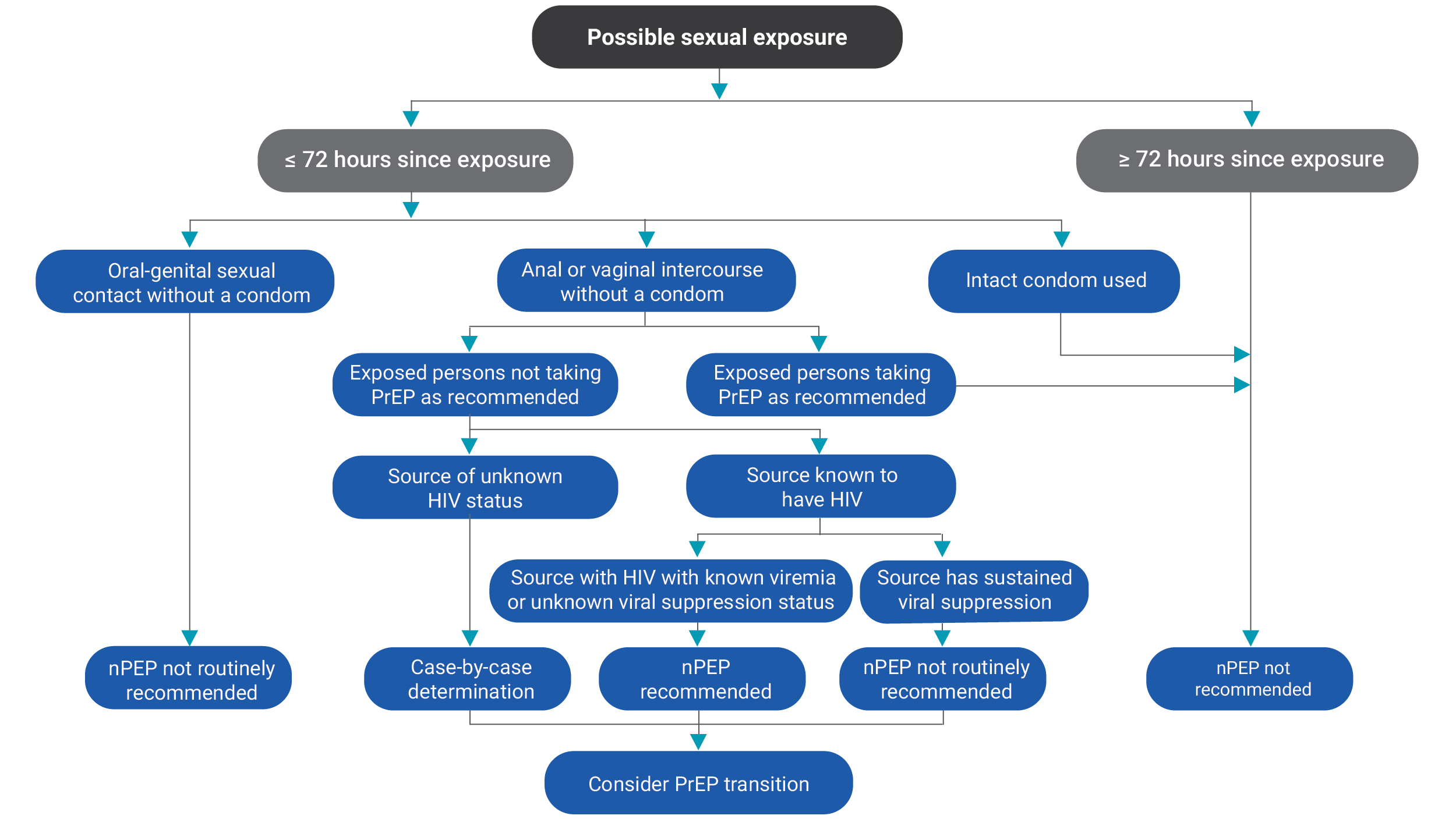
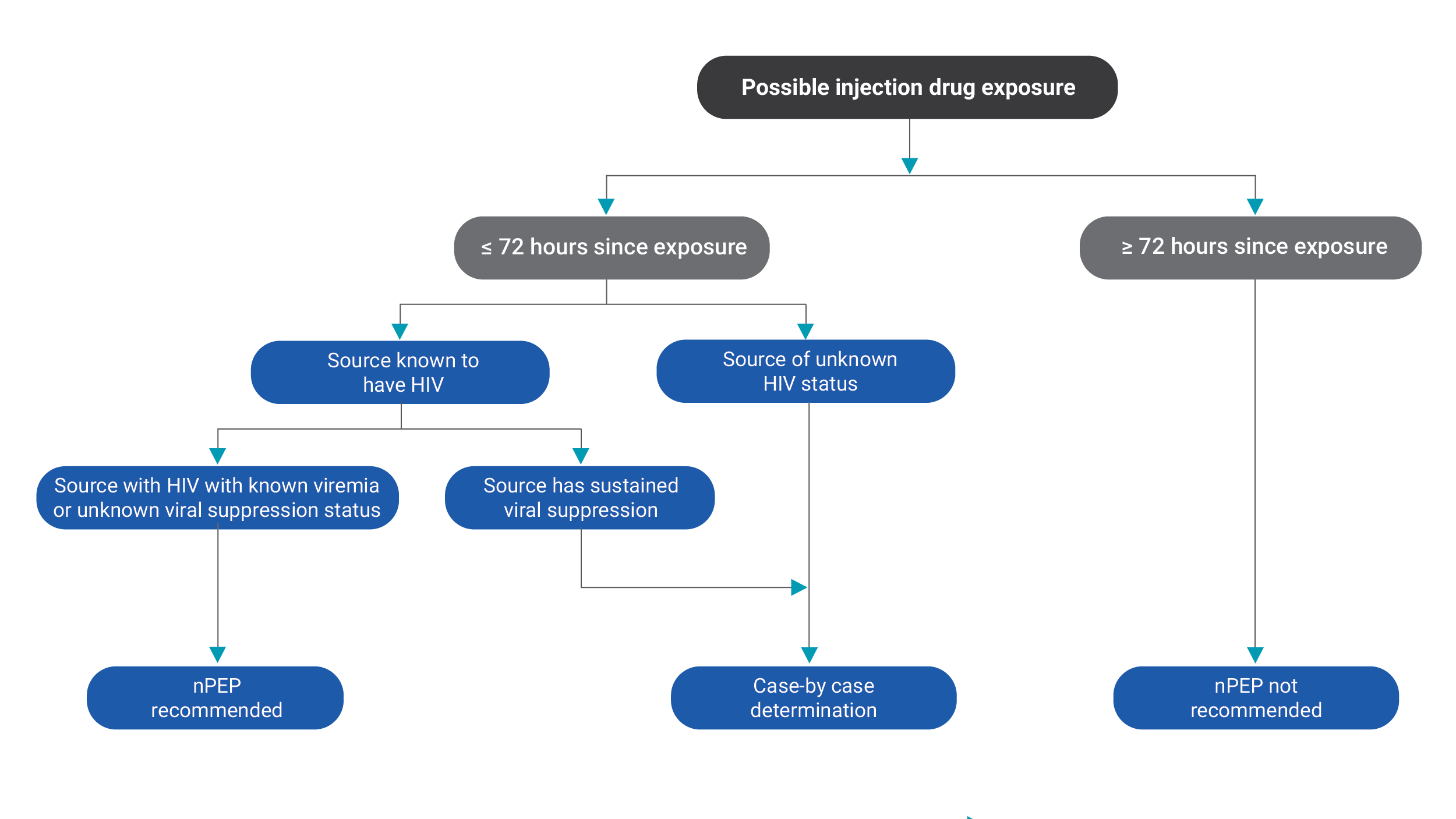
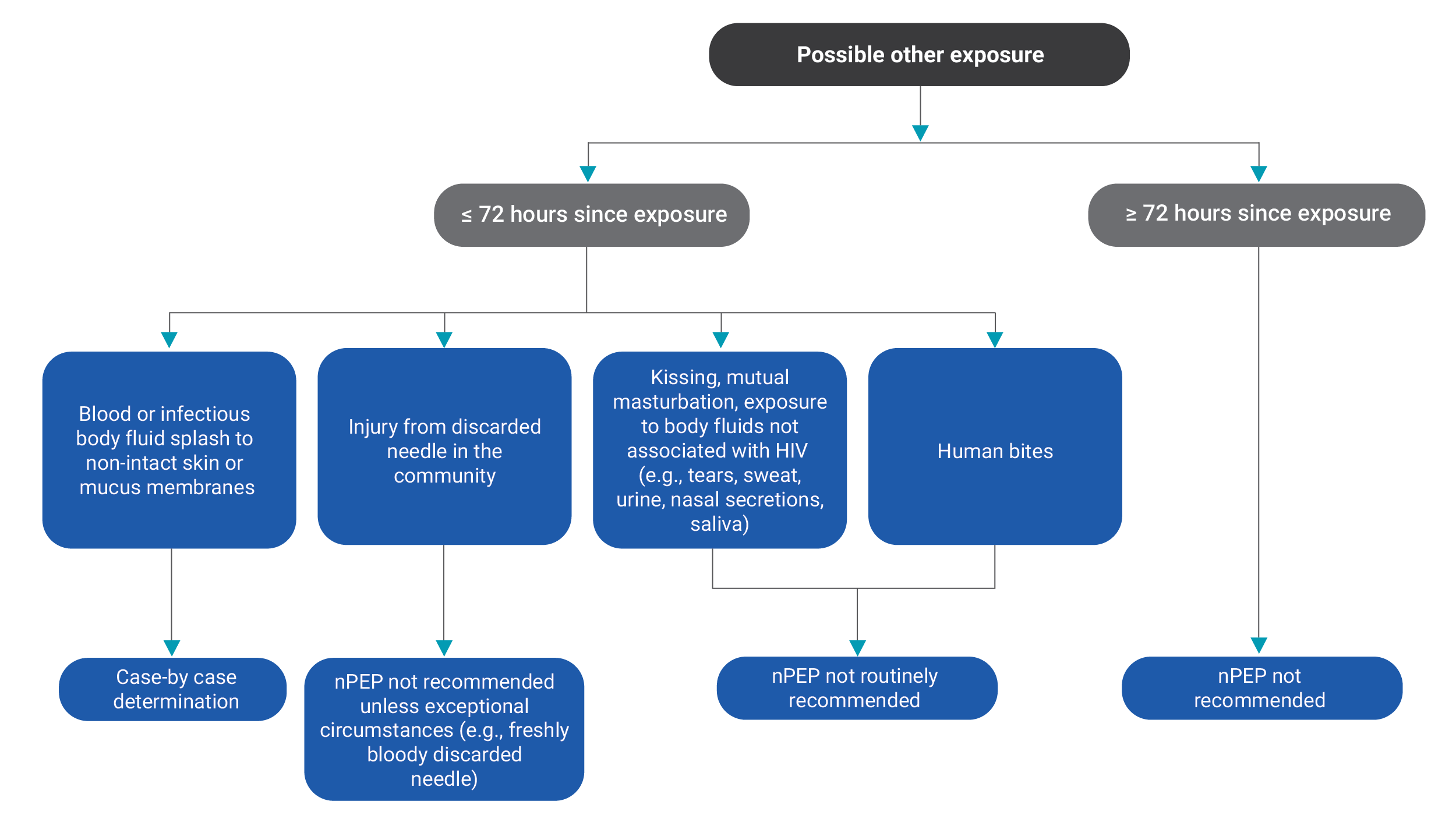
Consult a PEP Expert
Additional resources are available to assist with specific exposure scenarios. CDC's newly updated nPEP recommendations include some common examples: Appendix A: Known or Possible HIV Exposure Scenarios and Associated Nonoccupational Postexposure Prophylaxis Considerations
Expert consultation may be helpful:
- For clinicians who are inexperienced with prescribing or managing antiretroviral (ART) medications,
- If the patient's exposure source may have ART-resistant HIV, or
- When prescribing PEP in situations involving pregnancy, nursing, pediatric care, or kidney disease.
If expert consultation is not immediately available, start PEP promptly and revise the regimen later if needed.
Evaluation
Baseline assessment is required for people beginning PEP. CDC's updated nPEP recommendations (Table 3) include the following baseline evaluation before starting PEP:
| HIV Ag/Ab test (laboratory-based) | OR | Rapid HIV test (point-of-care) AND HIV Ag/Ab test (laboratory-based) |
If the baseline rapid test indicates the person has HIV, do not initiate PEP. If the HIV test result is not immediately available, start PEP right away. Oral HIV tests are not recommended for PEP evaluation.
For people who have received long-acting injectable Cabotegravir PrEP within the past 6 months: perform a diagnostic HIV nucleic acid test (NAT) in addition to an Ag/Ab test. Do not delay PEP if a NAT is not available.
Additional baseline testing includes:
- Pregnancy test
- Alanine aminotransferase (ALT) and aspartate aminotransferase (AST)
- Serum creatinine
- Sexually transmitted infections testing — chlamydia, gonorrhea, and syphilis
- Hepatitis B and Hepatitis C testing
See Table 3 for more detailed information on baseline testing.
Administer PEP if indicated, even before all test results are available. The recommended PEP regimens have few absolute contraindications. In almost all cases, you should prescribe the first dose of a PEP regimen before obtaining further consultation.
Treatment options
Preferred PEP regimens are available
Prescribe a 28-day course of a three-drug antiretroviral regimen for all people starting PEP. To support adherence, select regimens that minimize side effects, dosing frequency, and pill burden.
The preferred PEP regimens for otherwise healthy adults and adolescents are:
| bictegravir (BIC)/emtricitabine (FTC)/tenofovir alafenamide (TAF) | OR | dolutegravir (DTG) plus (tenofovir alafenamide [TAF] OR tenofovir disoproxil fumarate [TDF]) plus (emtricitabine [FTC] OR lamivudine [3TC]) |
Alternative PEP regimens
Use alternative regimens when preferred regimens may not be appropriate based on individual factors such as drug resistance, side effects, pregnancy, kidney or liver disease, medication availability, and potential drug interactions.
See Table 4 and Table 5 of CDC's updated nPEP recommendations for guidance on regimen selection for different populations and clinical situations.
PEP is a safe method for HIV prevention
The preferred PEP regimens are generally safe and well-tolerated567. Most people experience only mild side effects. Most importantly, PEP is only taken for 28 days. In almost all cases, the benefits of HIV prevention outweigh any other risks posed by the medications.
CDC's updated nPEP guidelines include information on formulations, cautions, and the most common side effects for antiretroviral medications in the recommended regimens (see Table 6). Some antiretroviral medications can affect hepatitis B infection when started or stopped. Consider expert consultation when managing patients with hepatitis B.
Check for drug–drug interactions with both prescription and over-the-counter products by using an interactive web-based resource, such as the one from the University of Liverpool.
PEP isn't right for every patient
People who are already using PrEP typically do not need PEP if they experience a potential sexual exposure to HIV while taking their PrEP medication as prescribed. However, PEP may be considered in certain scenarios, including:
- Persons who have recently started PrEP and might not have yet reached maximum protection,
- Persons who have missed PrEP doses,
- Persons using an intermittent regimen outside of current CDC PrEP guideline recommendations, and
- Persons with exposure to someone with HIV who does not have sustained viral suppression and has resistance to PrEP components89.
PEP is not recommended for people whose exposure occurred more than 72 hours before they sought treatment. PEP is unlikely to be effective after this time.
PEP is not recommended for people who were exposed to non-blood-contaminated secretions, such as urine, saliva, sweat, tears, or nasal secretions, as their risk of getting HIV is extremely low.
CDC has comprehensive guidelines for prescribing PEP
CDC's Antiretroviral Postexposure Prophylaxis After Sexual, Injection Drug Use, or Other Nonoccupational Exposure to HIV — CDC Recommendations, United States, 2025 provides guidance for how to prescribe antiretroviral medications for PEP, as well as evidence about its effectiveness.
These guidelines also include considerations and resources for specific groups, such as pregnant patients, victims of sexual assault (including children), and patients without health insurance, as well as a suggested procedure for transitioning patients between PEP and HIV PrEP as appropriate4.
Special considerations for prescribing PEP
Pregnancy and Breastfeeding
Pregnancy and the postpartum period may increase the likelihood of acquiring HIV through sex. Acute or recent HIV infection during pregnancy or breastfeeding is associated with an increased risk of perinatal HIV transmission.
Pregnancy and breastfeeding are not contraindications to PEP, but medication selection and counseling may require additional considerations, and expert consultation may be helpful.
The preferred PEP regimens remain the same during pregnancy. See Table 4 of CDC's updated nPEP recommendations for guidance on regimen selection for pregnant patients.
Kidney impairment
In people with impaired kidney function, choose PEP medications and dosing based on kidney function. See Table 5 of CDC's updated nPEP recommendations for more information.
Supporting patients on PEP
Connect patients with resources to pay for PEP
In many states, PEP is covered by insurance, including Medicaid. If your patient does not have insurance, you can help them access assistance programs run by various manufacturers.
Help your patients pay for PEP by applying for assistance with the medication co-pay if the patient is insured, or applying for complete coverage of the medication if the patient does not have insurance or needs financial assistance. Note that the paperwork must be signed and submitted by a licensed clinical provider.
Provide ongoing support to patients on PEP
The health care provider or a support staff member should follow up with patients on PEP within 24 hours to confirm they have access to the medications and assess tolerability and adherence. If the patient does not tolerate the recommended regimen, consider switching to an alternative regimen to improve continuation of treatment.
Stay in touch with your patients on PEP, either by telephone or with clinic visits, for the entire duration of their treatment. This is especially important within the first 24 hours as it helps support patients taking their PEP medication as prescribed and facilitates follow-up HIV testing at 4–6 weeks and 12 weeks.
Counsel patients on PEP to take steps to reduce the chances of transmitting HIV during the 12-week follow-up period. These steps include using condoms consistently, avoiding pregnancy or breastfeeding, not sharing needles, and not donating blood, plasma, organs, tissue, or sperm.
Transitioning to PrEP After PEP
People who may have ongoing or repeated exposures to HIV should be evaluated for PrEP. No gap is needed between completing PEP and starting PrEP. Refer to CDC's updated nPEP recommendations for details on starting PrEP after PEP.
This page was last updated on this date. Updates may include minor edits, image changes, or other modifications to page content.
The information on this page was last reviewed by subject matter experts to ensure accuracy.
- Tsai CC, Follis KE, Sabo A, et al. Prevention of SIV infection in macaques by (R)-9-(2-phosphonylmethoxypropyl) adenine. Science. 1995;270(5239):1197-1199. https://www.science.org/doi/10.1126/ science.270.5239.1197
- Otten RA, Smith DK, Adams DR, et al. Efficacy of postexposure prophylaxis after intravaginal exposure of pig-tailed macaques to a human-derived retrovirus (human immunodeficiency virus type 2). J Virol. 2000;74(20):9771-9775. https://www.ncbi.nlm.nih.gov/pmc/articles/PMC112413/
- Wade NA, Birkhead GS, Warren BL, et al. Abbreviated regimens of zidovudine prophylaxis and perinatal transmission of the human immunodeficiency virus. N Engl J Med. 1998;339(20):1409-1414. https://www.nejm.org/doi/full/10.1056/NEJM199811123392001
- Antiretroviral Postexposure Prophylaxis After Sexual, Injection Drug Use, or Other Nonoccupational Exposure to HIV — CDC Recommendations, United States, 2025, https://www.cdc.gov/mmwr/volumes/74/rr/rr7401a1.htm
- Mayer KH, Gelman M, Holmes J, Kraft J, Melbourne K, Mimiaga MJ. Safety and tolerability of once daily coformulated bictegravir, emtricitabine, and tenofovir alafenamide for postexposure prophylaxis after sexual exposure. J Acquir Immune Defic Syndr 2022;90:27–32. https://doi.org/10.1097/QAI.0000000000002912
- Liu A, Xin R, Zhang H, et al. An open-label evaluation of safety and tolerability of coformulated bictegravir/emtricitabine/tenofovir alafenamide for post-exposure prophylaxis following potential exposure to human immunodeficiency virus-1. Chin Med J (Engl) 2022;135:2725–9. https://doi.org/10.1097/CM9.0000000000002494
- McAllister JW, Towns JM, Mcnulty A, et al. Dolutegravir with tenofovir disoproxil fumarate-emtricitabine as HIV postexposure prophylaxis in gay and bisexual men. AIDS 2017;31:1291–5. https://doi.org/10.1097/QAD.0000000000001447
- Preexposure Prophylaxis for the Prevention of HIV Infection in the United States – 2021 Update, https://stacks.cdc.gov/view/cdc/112360
- Clinical Recommendation for the Use of Injectable Lenacapavir as HIV Preexposure Prophylaxis - United States, 2025, https://www.cdc.gov/mmwr/volumes/74/wr/mm7435a1.htm