



Key points
- Folic acid is a type of folate (vitamin B9) found in fortified foods and vitamins.
- Eat healthy, balanced meals with folate-rich foods and include fortified foods or a vitamin to help you get 400 mcg of folic acid daily.
- Read nutrition and supplement labels on products to ensure they contain folic acid.

Overview
CDC recommends all women capable of becoming pregnant get 400 micrograms (mcg) of folic acid daily. Getting 400 mcg of folic acid each day helps prevent some serious birth defects called neural tube defects (NTDs).
There are many ways to meet this recommendation. You can get folic acid from supplements, such as vitamins, or from foods where folic acid has been added, such as enriched bread. It is also important to eat a balanced diet with folate-rich foods such as leafy green vegetables, beans, or oranges.
Terms to know
Fortification is a way to add vitamins or minerals, or both, to foods. Flours, pastas, breads, rice, and breakfast cereals fortified with folic acid are labeled "enriched."
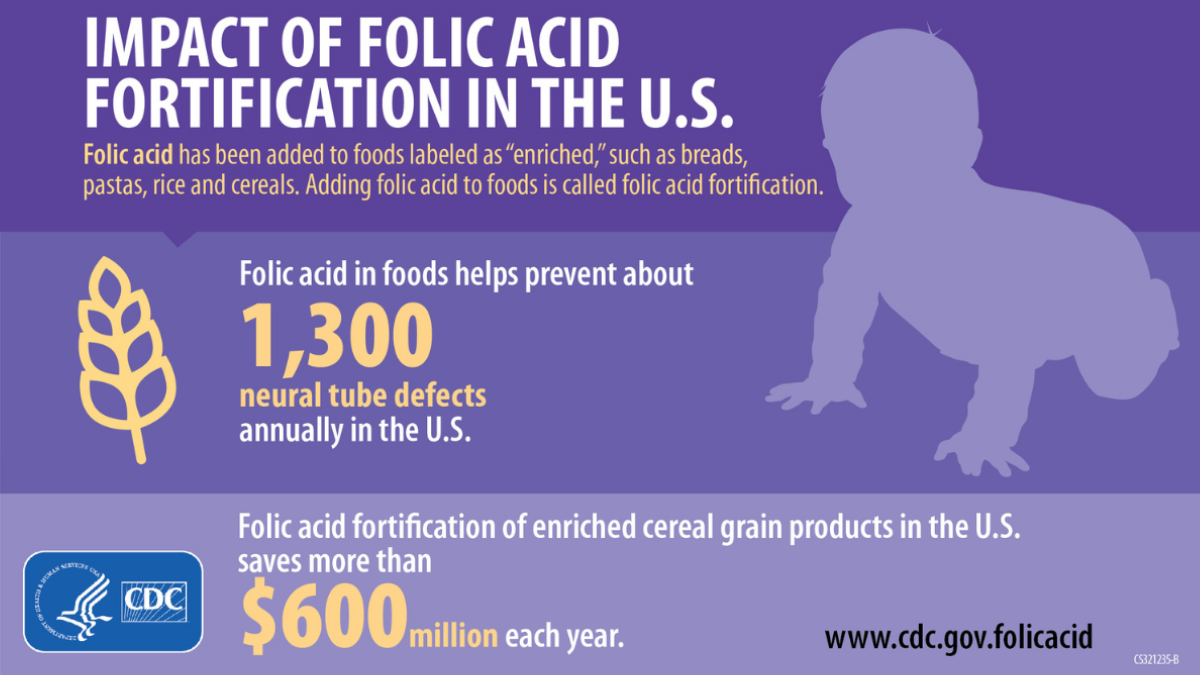
Mandatory fortification requires food manufacturers to add certain vitamins or minerals, or both, to specified foods. This is done to address a significant public health need. For example, fortification of cereal grains with folic acid is mandated in the United States to help prevent NTDs.
Voluntary fortification allows food manufacturers to add vitamins or minerals, or both, to foods. Manufacturers need to follow the Food and Drug Administration (FDA) food additive regulations.
Dietary supplements are products taken by mouth that contain ingredients intended to add nutrients to your diet.
Vitamins are a type of dietary supplement that can contain folic acid.
Sources of folic acid
Fortified foods
Fortified foods provide an important source of folic acid. Folic acid is added to some staple foods to help people meet their daily needs. Foods fortified with folic acid include some flours, breads, pastas, rice, and breakfast cereals. These products are labeled as "enriched."1
Supplements
Taking a daily vitamin with 400 mcg of folic acid helps ensure you're getting enough to prevent NTDs. Generally, vitamins contain folic acid and have 400 to 800 mcg of folic acid. However, some vitamins now list other types of folate (such as 5-MTHF) instead of folic acid. These types of folate found in supplements are called "natural," but they are not the same as food folate found in leafy greens and beans.
It's important to check the Supplement Facts label to ensure your vitamins contain folic acid. Folic acid is the only type of folate shown to help prevent NTDs. No scientific studies exist that show that supplements containing other types of folate can prevent these conditions.
What the science shows
Folic acid fortification and supplementation have proven effective in preventing NTDs. Since mandatory fortification began in 1998, about 1,300 babies are born each year without an NTD who might otherwise have been affected.2
However, certain groups remain at higher risk for having a pregnancy affected by NTDs. Research shows Hispanic/Latina women still have lower folate levels.34 In an effort to help more women get the nutrients they need, the FDA allowed voluntary folic acid fortification of corn masa flour in 2016.
National surveys in the United States show daily multivitamin use has declined among women aged 18–44 years. Specifically, daily use declined among women aged 25-44 years and among Hispanic/Latina and non-Hispanic White women, while use among other groups remained unchanged.5
A CDC study found that about half of women report eating enriched cereal grain products as their only source of folic acid.6 Consuming folic acid from both supplements and fortified foods could help more women meet the recommended 400 mcg daily. This could potentially prevent up to 700 additional NTDs annually.
Tips for getting enough folic acid
Here are some tips to help ensure you're getting enough folic acid:
1. Take a vitamin with folic acid. When taking supplements, more is not better. Look for vitamins that have 400 mcg of folic acid. You can find them at pharmacies, grocery stores, or discount stores.
If taking a vitamin upsets your stomach, try taking it with food or just before bed. If you have trouble taking pills, try a chewable vitamin. Also, be sure to take it with a full glass of water.
2. Eat fortified foods. Some flours, breads, pastas, rice, and breakfast cereals have folic acid added. These products are labeled as "enriched."
3. Combine both approaches. You can take a vitamin with folic acid and eat fortified foods to ensure you are getting enough folic acid. It is also important to eat folate-rich foods as part of a balanced diet.
Checking the label
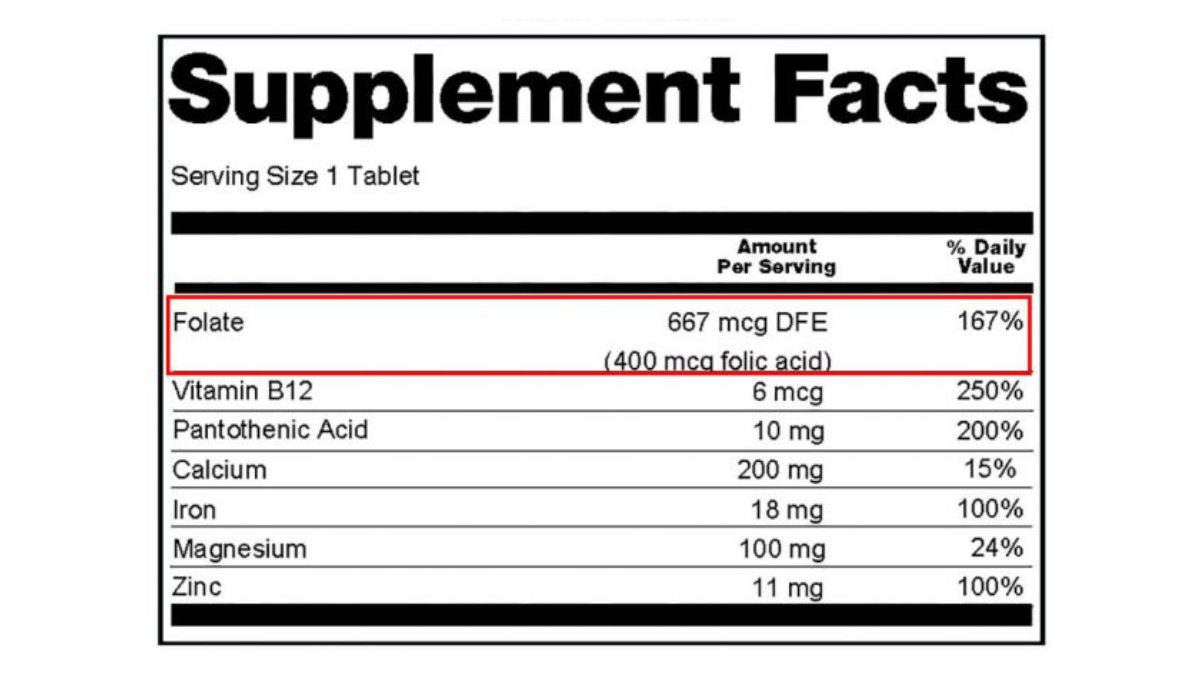
Nutrition and supplement labels show folate content in mcg dietary folate equivalent (DFE) and mcg folic acid per serving. For example, the label below shows "667 mcg DFE (400 mcg folic acid)." This means that 400 mcg of folic acid is part of the total folate (667 mcg DFE) per serving. It's important to check your vitamins and food labels to ensure they contain folic acid.
- U.S. Food and Drug Administration. Food Standards: Amendment of Standards of Identity for Enriched Grain Products to Require Addition of Folic Acid: Final Rule. 21 CFR Parts 136, 137, and 139. Federal Register 1996;61(44):8781-97.
- Williams J, Mai CT, Mulinare J, Isenburg J, Flood TJ, Ethen M, Frohnert B, Kirby RS, Centers for Disease C, Prevention. Updated estimates of neural tube defects prevented by mandatory folic Acid fortification — United States, 1995–2011. MMWR Morb Mortal Wkly Rep 2015;64(1):1-5.
- Centers for Disease Control and Prevention (CDC). Racial/ethnic differences in the birth prevalence of spina bifida — United States, 1995–2005. MMWR Morb Mortal Wkly Rep. 2009;57(53):1409–1413.
- MA, Mai CT, Wang Y, et al. The association between race/ethnicity and major birth defects in the United States, 1999–2007. Am J Public Health. 2014;104(9):e14–23.
- Wong, EC, Rose CE, Flores AL, and Yeung LF. Trends in Multivitamin Use Among Women of Reproductive Age: United States, 2006–2016. Journal of Women's Health. 2019;28(1): https://doi.org/10.1089/jwh.2018.7075.
- KS, Qi YP, Devine O, Tinker SC, Berry RJ. Modeling the impact of folic acid fortification and supplementation on red blood cell folate concentrations and predicted neural tube defect risk in the United States: Have we reached optimal prevention? Am J Clin Nutr. 2018;107(6):1027–1034.
- Hendler SS, Rorvik DR. PDR for Nutritional Supplements. Montvale: Medical Economics Company, Inc., 2001.