



At a glance
Use this practice to educate people about swimming safely in public pools and spas. Ohio used posters, interactive activities, and safety videos to educate public pool visitors about safe swimming practices.
Background
A review of voluntarily submitted injury incident reports at Ohio's public swimming pools revealed the need for public education on pool safety and for enhanced training for local health department pool inspectors.
The Ohio Department of Health worked with city and county health districts to disseminate safety information to the public and help ensure healthy swimming at public pools. Reporting became mandatory beginning July 25, 2024.
Key actions
The Ohio Department of Health made safety information readily available to public pool swimmers. They created the Swim Safely program to raise awareness of pool-side safety features and promote healthier swimming behaviors. This effort included the following actions:
- Convening a workgroup of local health department pool inspectors to identify high-risk pool activities and operations
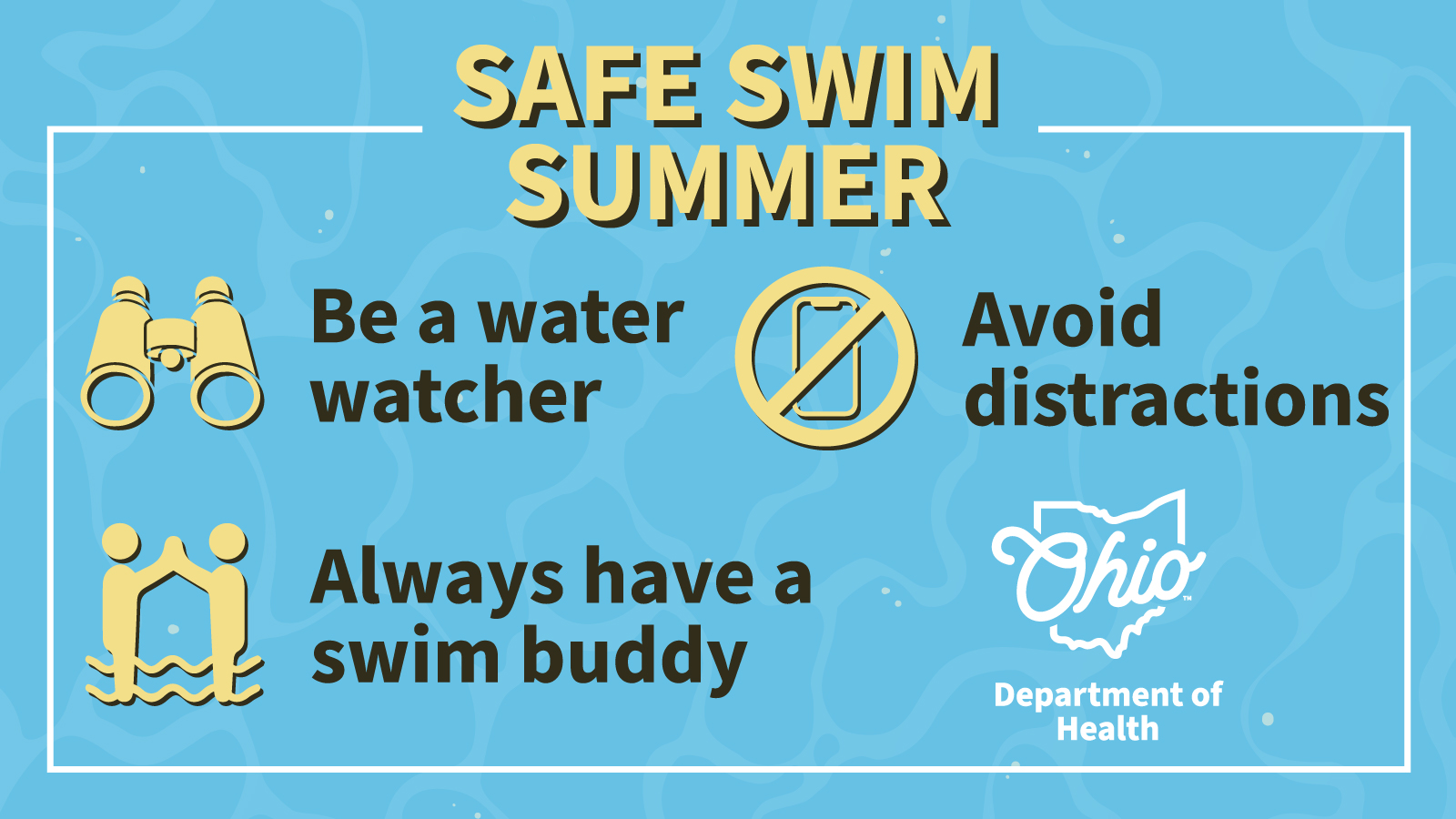
- Developing and distributing posters (with a QR code to licensed pools) to inform visitors about safe swimming practices and drowning prevention
- Creating a QR code that linked to the following resources:
- An educational video showing the availability of required pool safety equipment and general pool safety guidelines
- A scavenger-hunt activity that encouraged swimmers to walk around the pool deck and learn about safety equipment, general safety precautions, safe swimming practices, and fun facts to reinforce personal safety responsibilities while swimming
- A swimmer education survey to help identify bather needs
- Using survey results to better understand public health needs and safety gaps among swimmers in the state who use public pools
- Creating standardized swimming pool training for local inspectors based on survey results
Using this practice
We selected this practice as an example of environmental public health successfully applied in the field. We based our selection on the following four domains:
- Effectiveness: Did it solve or help solve the environmental health problem?
- Feasibility: What conditions and resources are needed to use it?
- Sustainability: Is it realistically able to continue going forward?
- Transferability: Could other health departments use it with little to no changes?
Effectiveness
- The campaign had 185 swimmers across 35 counties participate in the QR code-driven Swim Safely scavenger hunt.
- Information from the survey gave a snapshot of the public's knowledge of safe swimming practices and revealed gaps where more educational information was needed, such as swimming lessons.
- The state health department also acted on the findings by creating standardized training on public swimming pools for local health department inspectors.
- The state health department's public swimming pools webpage garnered over 39,000 clicks.
Feasibility
The public swimming pool program conducts plan reviews and evaluates newly constructed aquatic venues. It also tracks incidents, including drowning, and trains 111 local health departments on how to license and inspect public pools. The local health departments implement and enforce Ohio's pool regulations to protect public health through operational facility inspections and community engagement.
Based on Ohio's experience, other health departments interested in this practice may need the following capacity:
- Access to reports on pool incidents
- An established communications team to create educational materials based on identified needs
- Software and associated service fees to support social media messaging, capturing and managing data and survey results, web graphics, charting and demonstrating findings
- Skills in communicating and engaging with pool operators about pool safety, swimming-related risks, and prevention strategies
- Flexibility to meet specific swimming safety needs of the jurisdiction
It took two full-time staff more than one year to implement this practice. Two contributing programs shared the cost for the campaign.
Sustainability
To maintain this practice, health departments may need the following support:
- Public participation and local health department buy-in to commit to distributing posters
- Strong partnerships between state and local health departments to engage with pool operators and enforce regulations
- Buy-in from pool operators to display the Swim Safely posters
- An effective communications team for public outreach and to promote the practice to local health departments
Transferability
Programs interested in this practice might want to consider the following activities:
- Reviewing incident reports to identify public education gaps
- Using a social media video to help promote resources and expand reach
Successes and challenges
- The Swim Safely QR code provided a user-friendly way to direct swimmers to pool safety resources and a fun interactive scavenger hunt.
- Local health officials distributed Swim Safely posters to more than 8,000 licensed pools across the state.
- Results from the survey helped identify public concerns, including inattentive lifeguards, lack of barrier between wading pool and deeper sections, debris on pool deck (for example, glass), and small font on signage that made it difficult to read.
- The health department used insights from the survey to guide stronger signage requirements during inspections, focused-operator training, and broader hazard-prevention strategies.
- Findings from the campaign supported development of an all-encompassing public standardized swimming pool training for local health department inspectors.
- The state created a new rule that pool operators submit reports to the licensor when an injury occurs at a public pool (previously, these reports were voluntary).
- Some pool operators were hesitant to post the informational posters at their facilities because it was not required.
Connections to Essential Services
Documenting how programs contribute to Essential Public Health Services may help health departments in the accreditation process with the Public Health Accreditation Board. The activities in this practice support and align with these services:
- Educate (3)
- Strengthen communities and partnerships (4)
- Support the workforce (8)
- Improve or innovate (9)
Resources
Ohio Department of Health
- Safe swim summer (poster)
- Swim safely (video)
- Public swimming pool incidents (dashboard)
- Public swimming pools
- Safe swimming and drowning prevention
CDC
- Aquatics professionals toolkit
- Healthy swimming communication resources
- MAHC tools and training
- Pool inspection toolkit
- Pool inspection training for environmental health professionals (in partnership with the National Environmental Health Association)
Citation
In citing this practice in articles, presentations, or elsewhere, we suggest the following citation:
Centers for Disease Control and Prevention. National Center for Environmental Health. Environmental Public Health Practices Gateway. Promoting safe swimming at public pools: A practice from Ohio Department of Health. U.S. Department of Health and Human Services, CDC, 2026, https://www.cdc.gov/environmental-health-practice/php/gateway/promoting-safe-swimming-at-public-pools.html.