Youth and Tobacco Use
Youth use of tobacco products in any form is unsafe.
Preventing tobacco product use among youth is critical to reducing tobacco use among the nation’s youth.
- Tobacco product use is started and established primarily during adolescence.1,2
- Nearly 9 out of 10 adults who smoke cigarettes daily first try smoking by age 18.
- Flavorings in tobacco products can make them more appealing to youth.4,5
- In 2021, 80.2% of high school students and 74.6% of middle school students who used tobacco products in the past 30 days reported using a flavored tobacco product during that time.6
- In 2023, 90.3% of high school students and 87.1% of middle school students who used e-cigarettes in the past 30 days reported using a flavored e-cigarette during that time.7
Electronic cigarettes (E-cigarettes)
- E-cigarettes have been the most commonly used tobacco product among youth since 2014.
- In 2023, about 1 out of every 22 middle school students (4.6%) reported that they had used electronic cigarettes in the past 30 days.7
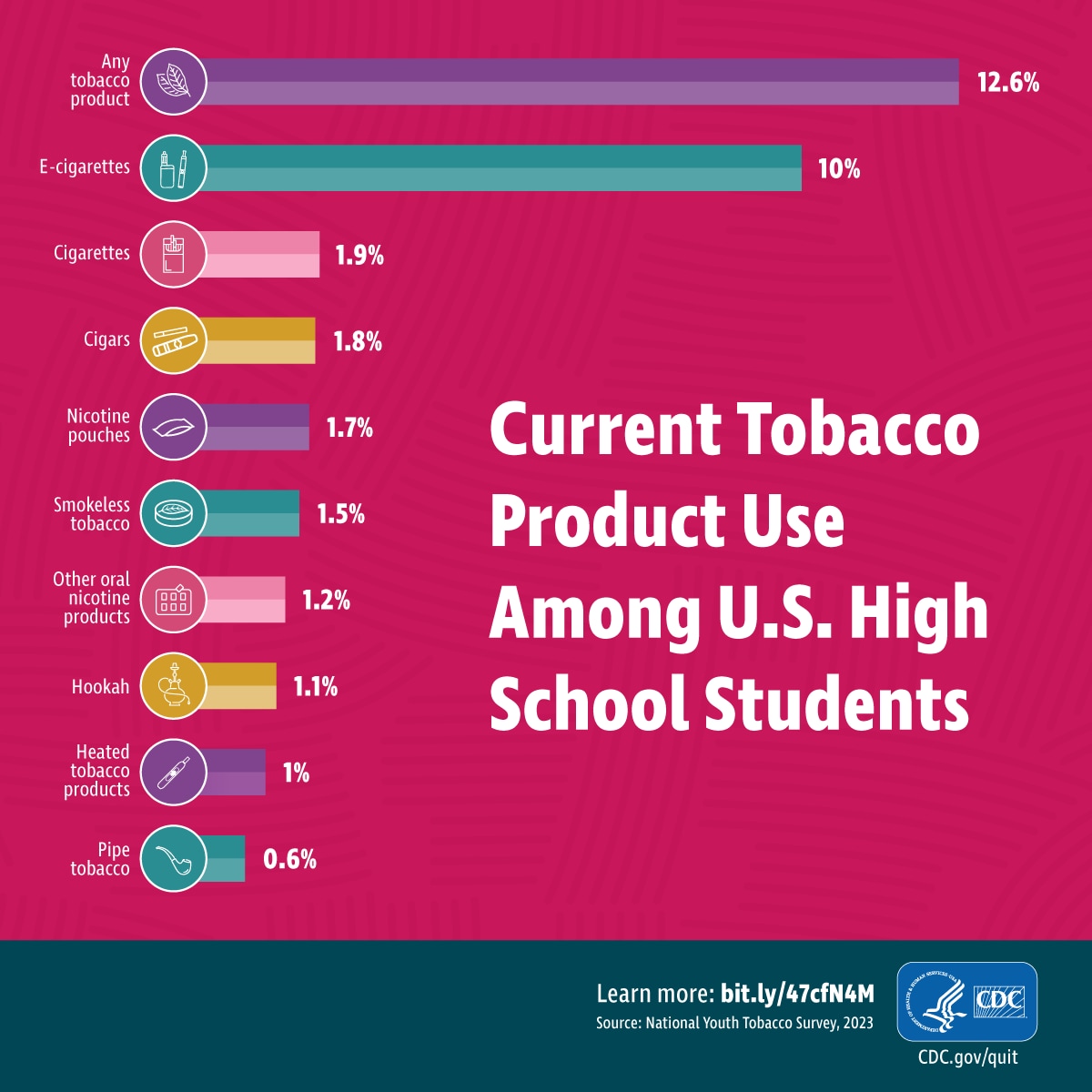
- In 2023, 1 of every 10 high school students (10.0%) reported that they had used electronic cigarettes in the past 30 days.7
Cigarettes
- In 2023, about 1 of every 100 middle school students (1.1%) reported that they had smoked cigarettes in the past 30 days.7
- In 2023, nearly 2 of every 100 high school students (1.9%) reported that they had smoked cigarettes in the past 30 days.7
Cigars
- In 2023, nearly 1 of every 100 middle school students (1.1%) reported that they had smoked cigars in the past 30 days. 7
- In 2023, nearly 2 of every 100 high school students (1.8%) reported that they had smoked cigars in the past 30 days. 7
Smokeless Tobacco
- In 2023, nearly 1 of every 100 middle school students (0.7%) reported that they had had used smokeless tobacco in the past 30 days. 7
- In 2023, nearly 2 of every 100 high school students (1.5%) reported that they had had used smokeless tobacco in the past 30 days. 7
Hookah
- In 2023, less than 1 of every 100 middle school students (1.0%) reported that they had smoked hookah in the past 30 days. 7
- In 2023, about 1 of every 100 high school students (1.1%) reported that they had smoked hookah in the past 30 days. 7
Heated Tobacco Products
- In 2023, less than 1 of every 100 middle school students (0.8%) and about 1 of every 100 high school students (1.0%) reported using heated tobacco products in the past 30 days.7
- Heated tobacco products, also known as “heat-not-burn” products, deliver nicotine to the user by heating tobacco leaves rather than a nicotine-containing liquid like e-cigarettes.
Nicotine Pouches
- In 2023, about 1 of every 100 high school students (1.7%) reported using nicotine pouches in the past 30 days. 7
- Nicotine pouches are microfiber pouches with flavored nicotine powder that users dissolve in the mouth without spitting. Sales of nicotine pouches have increased rapidly in the U.S.8

All Tobacco Product Use
- In 2023, more than 6 of every 100 middle school students (6.6%) and about 1 of every 8 high school students (12.6%) reported current use of a tobacco product.7
- In 2023, nearly 15 of every 100 middle school students (14.7%) and nearly 28 of every 100 high school students (27.9%) said they had ever tried a tobacco product.7
Many young people use multiple tobacco products.
- In 2023, more than 2 of every 100 middle school students (2.5%) and about 1 of every 30 high school students (3.9%) reported current use of multiple tobacco products in the past 30 days.7
- In 2023, about 6 of every 100 middle school students (6.1%) and more than 12 of every 100 high school students (12.7%) reported they had ever tried multiple tobacco products.7
Youth who use multiple tobacco products are at higher risk for developing nicotine dependence and might be more likely to continue using tobacco into adulthood.1, 2
| Tobacco Product | Overall | Girls | Boys |
|---|---|---|---|
| Any tobacco product† | 12.6% | 14.1% | 11.2% |
| Electronic cigarettes | 10.0% | 12.2% | 8.0% |
| Cigarettes | 1.9% | 1.5% | 2.3% |
| Cigars | 1.8% | 1.4% | 2.3% |
| Smokeless tobacco | 1.5% | — | 2.1% |
| Hookah | 1.1% | 1.4% | 0.9% |
| Nicotine Pouches | 1.7% | — | 2.6% |
| Heated tobacco products | 1.0% | 0.7% | 1.4% |
| Pipe tobacco | 0.6% | 0.5% | 0.7% |
Notes:
*“Current use” is determined by respondents indicating that they have used a tobacco product on at least 1 day during the past 30 days.
†In 2023, any tobacco product includes e-cigarettes, cigarettes, cigars, smokeless tobacco (composite), pipe tobacco, bidis (small brown cigarettes wrapped in a leaf), hookahs, heated tobacco products, nicotine pouches, and other oral nicotine products.
| Tobacco Product | Overall | Girls | Boys |
|---|---|---|---|
| Any tobacco product† | 6.6% | 7.5% | 5.7% |
| Electronic cigarettes | 4.6% | 5.6% | 3.5% |
| Cigarettes | 1.1% | 1.1% | — |
| Cigars | 1.1% | 1.2% | 1.0% |
| Smokeless tobacco | 0.7% | 0.6% | — |
| Hookah | 1.0% | — | 0.8% |
| Nicotine Pouches | — | — | — |
| Heated tobacco products | 0.8% | 0.8% | — |
| Pipe tobacco | 0.4% | — | — |
Factors associated with youth tobacco product use include the following:
- Social and physical environments2,10,11
- The way mass media show tobacco product use as a normal activity can make young people want to try these products.
- Youth are more likely to use tobacco products if they see people their age using these products.
- High school athletes are more likely to use smokeless tobacco than those of the same age who are not athletes.11
- Young people may be more likely to use tobacco products if a parent uses these products.
- Biological and genetic factors1,2,10
- There is evidence that youth may be sensitive to nicotine and that teens can feel dependent on nicotine sooner than adults.
- Genetic factors may make quitting smoking harder for young people.
- Smoking during pregnancy may increase the likelihood that the child will smoke cigarettes regularly in the future.
- Mental health: There is a strong relationship between youth smoking and depression, anxiety, and stress.2
- Personal views: When young people expect positive things from smoking, such as coping with stress better or losing weight, they are more likely to smoke.2,10
- Other influences that affect youth tobacco use include:2,10
- Lower socioeconomic status, including lower income or education
- Not knowing how to say “no” to tobacco product use
- Lack of support or involvement from parents
- Accessibility, availability, and price of tobacco products
- Doing poorly in school
- Low self-image or self-esteem
- Seeing tobacco product advertising in stores, on television, the Internet, in movies, or in magazines and newspapers

National, state, and local program activities have been shown to reduce and prevent youth tobacco product use when implemented together.2,12,13 These activities include:
- Higher costs for tobacco products (for example, through increased taxes)2,13
- Prohibiting smoking in indoor areas of workplaces and public places2,13
- Raising the minimum age of sale for tobacco products to 21 years2,12
- TV and radio commercials, posters, and other media messages aimed at kids and teens in order to counter tobacco product ads2,13
- Community programs and school and college policies that encourage tobacco-free places and lifestyles2,12
- Community programs that lower tobacco advertising, promotions, and help make tobacco products less easily available2,13
Some social and environmental factors are related to lower smoking levels among youth. Among these are:2
- Being part of a religious group or tradition
- Racial/ethnic pride and strong racial identity
- Higher academic achievement
It is important to keep working to prevent and reduce the use of all forms of tobacco product use among youth.
- Flavored Tobacco Product Use Among Middle and High School Students—United States, 2014U.S. Department of Health and Human Services. The Health Consequences of Smoking—50 Years of Progress: A Report of the Surgeon General. Atlanta: U.S. Department of Health and Human Services, Centers for Disease Control and Prevention, National Center for Chronic Disease Prevention and Health Promotion, Office on Smoking and Health, 2014 [accessed 2019 Feb 28].
- U.S. Department of Health and Human Services. Preventing Tobacco Use Among Youth and Young Adults: A Report of the Surgeon General. Atlanta: U.S. Department of Health and Human Services, Centers for Disease Control and Prevention, National Center for Chronic Disease Prevention and Health Promotion, Office on Smoking and Health, 2012 [accessed 2019 Feb 28].
- Substance Abuse and Mental Health Services Administration. 2018 National Survey on Drug Use And Health: Detailed Tables. Substance Abuse and Mental Health Data Archive [accessed 4 Dec 2019].
- Centers for Disease Control and Prevention. Flavored Tobacco Product Use Among Middle and High School Students—United States, 2014. Morbidity and Mortality Weekly Report, 2015;64(38):1066–70 [accessed 2019 Feb 28].
- Wang TW, Gentzke AS, Neff LJ, et al. Characteristics of e-Cigarette Use Behaviors Among US Youth, 2020. JAMA Netw Open. 2021;4(6):e2111336. doi:10.1001/jamanetworkopen.2021.11336
- Gentzke AS, Wang TW, Cornelius M, Park-Lee E, Ren C, Sawdey MD, Cullen KA, Loretan C, Jamal A, Homa DM. Tobacco Product Use and Associated Factors Among Middle and High School Students – National Youth Tobacco Survey, United States, 2021. Morbidity and Mortality Weekly Report, 2022; 71(No. SS-5):1–29.
- Birdsey J, Cornelius M, Jamal A, et al. Tobacco Product Use Among U.S. Middle and High School Students — National Youth Tobacco Survey, 2023. MMWR Morb Mortal Wkly Rep 2023; 72(44);1173–1182.
- Gentzke AS, Wang TW, Jamal A, Park-Lee E, Ren C et al. Tobacco Product Use Among Middle and High School Students, United States, 2020. Morbidity and Mortality Weekly Report 2020;69(50);1881–1888 [accessed 2020 Dec 17].
- Marynak KL, Wang X, Borowiecki M, et al. Nicotine Pouch Unit Sales in the US, 2016-2020. JAMA. 2021;326(6):566–568. doi:10.1001/jama.2021.10366
- U.S. Department of Health and Human Services. Reducing Tobacco Use: A Report of the Surgeon General. Atlanta: U.S. Department of Health and Human Services, Centers for Disease Control and Prevention, National Center for Chronic Disease Prevention and Health Promotion, Office on Smoking and Health, 2000 [accessed 2019 Feb 28].
- Centers for Disease Control and Prevention. Combustible and Smokeless Tobacco Use Among High School Athletes—United States, 2001–2013. Morbidity and Mortality Weekly Report, 2015;64(34):935–9 [accessed 2019 Feb 28].
- Gentzke AS, Glover-Kudon R, Tynan M, Jamal A. Adults’ attitudes toward raising the minimum age of sale for tobacco products to 21 years, United States, 2014-2017. Prev Med. 2020 Feb 3;133:106012. doi: 10.1016/j.ypmed.2020.106012. Epub ahead of print. PMID: 32027916.
- Centers for Disease Control and Prevention. Best Practices for Comprehensive Tobacco Control Programs—2014. Atlanta: U.S. Department of Health and Human Services, Centers for Disease Control and Prevention, National Center for Chronic Disease Prevention and Health Promotion, Office on Smoking and Health, 2014 [accessed 2019 Feb 28].


