Fast Facts
Fact Sheets
Morbidity and Mortality (Related to Tobacco Use)
Tobacco and Disease
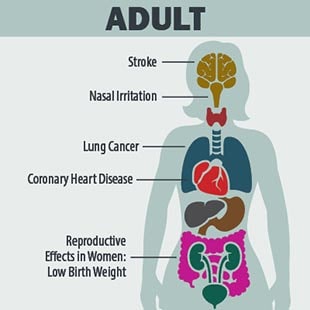
- Tobacco use causes—
- Cancer
- Heart disease
- Lung diseases (including emphysema, bronchitis, and chronic airway obstruction)1
- Cigarette smoking increases the length of time that people live with a disability by about 2 years.2
- For every person who dies from a smoking-related disease, 20 more people suffer with at least one serious illness from smoking.3
Tobacco and Death
| Worldwide |
|
|
| In the United States |
|
Tobacco-Related Costs and Expenditure in the United States
Costs of Smoking
- Annually, in the United States, cigarette smoking costs more than $193 billion:1
| $193 billion = | + |
|
- Annually, in the United States, secondhand smoke costs more than $10 billion in health care expenditures.6
State Spending on Tobacco Control
States have billions of dollars available to them—from tobacco excise taxes and tobacco industry legal settlements—for preventing and controlling tobacco use. States currently use a very small percentage of these funds for tobacco control programs:
- $24.9 billion was available to states in 2007 from tobacco taxes and legal settlements7
- States spent less than 3% of the $24.9 billion in 2007 on tobacco control programs8
- Investing only 15% (i.e., $3.7 billion) of the $24.9 billion would have funded every state tobacco control program at CDC-recommended levels7
Cigarette Industry Spending
The cigarette industry spends billions each year on advertising and promotions:9
- $13 billion total spent in 2005 (latest available data)
- $36 million spent a day in 2005 (latest available data)
Tobacco Use in the United States
Numbers of Smokers
Millions of people in the United States smoke cigarettes.
|
19.8% |
of |
U.S. adults (43.4 million people 18 years of age and older)10 |
are current* smokers |
|
|
20.0% |
of |
high school students11 |
||
|
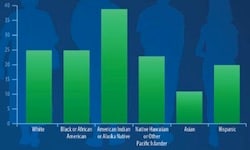
36.4% |
of |
American Indian/Alaska Native adults10 |
||
|
21.4% |
of |
white adults10 |
||
|
19.8% |
of |
African American adults10 |
||
|
13.3% |
of |
Hispanic adults10 |
||
|
9.6% |
of |
Asian American adults (excluding Native Hawaiians and other Pacific Islanders)10 |
*Current smokers are defined as persons who reported smoking at least 100 cigarettes during their lifetime and who, at the time of interview, reported smoking every day or some days.
Starting to Smoke
Thousands of young people and adults begin smoking every day:
- Each day, about 1,000 persons younger than 18 years of age become regular smokers (i.e., begin smoking on a daily basis).12
- Each day approximately 1,800 adults 18 years of age and older become daily smokers (i.e., begin smoking on a daily basis).13
Quitting
Many adult smokers want or try to quit smoking:
- Approximately 70% of smokers want to quit completely.14
- Approximately 40% of smokers try to quit each year.10
Cessation treatments found to be effective include the following:15,16
- Brief clinical interventions
- Counseling
- Over-the-counter and prescription nicotine replacement products (e.g., nicotine gum, inhaler, nasal spray, lozenge, or patch)
- Prescription nonnicotine medications, such as bupropion SR (Zyban®) and varenicline tartrate (Chantix®)
References
- Centers for Disease Control and Prevention. Smoking-Attributable Mortality, Years of Potential Life Lost, and Productivity Losses—United States, 2000–2004. Morbidity and Mortality Weekly Report [serial online]. 2008;57(45):1226–1228 [accessed 2009 Mar 31].
- . Smoking and the Compression of Morbidity. Journal of Epidemiology and Community Health. 2000;54:566–74 [cited 2009 Mar 31].
- Centers for Disease Control and Prevention. Cigarette Smoking-Attributable Morbidity—United States, 2000. Morbidity and Mortality Weekly Report [serial online]. 2003;52(35) [accessed 2009 Mar 31].
- World Health Organization.
WHO Report on the Global Tobacco Epidemic, 2008
.
Geneva: World Health Organization; 2008 [accessed 2009 Mar 31]. - Centers for Disease Control and Prevention. Annual Smoking-Attributable Mortality, Years of Potential Life Lost, and Productivity Losses—United States, 1995–1999. Morbidity and Mortality Weekly Report [serial online]. 2002;51(14):300–303 [accessed 2009 Mar 31].
- .
Economic Effects of Environmental Tobacco Smoke Report
[paper on the Internet]. Schaumburg, IL: Society of
Actuaries; 2005 [accessed 2009 Mar 31]. - Centers for Disease Control and Prevention. Best Practices for Comprehensive Tobacco Control Programs—2007. Atlanta: U.S. Department of Health and Human Services, Centers for Disease Control and Prevention, National Center for Chronic Disease Prevention and Health Promotion, Office on Smoking and Health; October 2007. [accessed 2009 Mar 31].
- Campaign for Tobacco Free Kids.
A Broken Promise to Our Children: The 1998 State Tobacco Settlement
Nine Years Later
(PDF–1.82 MB).
Washington, DC: Campaign for Tobacco Free Kids; 2007 [updated 2007 Dec 12; accessed 2009 Mar 31]. - Federal Trade Commission.
Cigarette Report for 2004 and 2005
(PDF–880 KB).
Washington, DC: Federal Trade Commission; 2007 [accessed 2009 Mar 31]. - Centers for Disease Control and Prevention. Cigarette Smoking Among Adults—United States, 2007. Morbidity and Mortality Weekly Report [serial online]. 2008;57(45):1221–1226 [accessed 2009 Mar 31].
- Centers for Disease Control and Prevention. Cigarette Use Among High School Students—United States, 1991–2007. Morbidity and Mortality Weekly Report [serial online]. 2008;57(25):689–691 [accessed 2009 Mar 31].
- Substance Abuse and Mental Health Administration.
Results from the 2008 National Survey on Drug Use and Health: Detailed Tables
.
(PDF–26.04 KB)
Rockville (MD): Office of Applied Studies [accessed 2009 Sept 23]. - Substance Abuse and Mental Health Services
Administration.
Results from the 2006 National Survey on Drug Use and Health
(PDF–25 KB):
(Office of Applied Studies, NSDUH Series H-32, DHHS Publication No.
SMA 07–4293). Rockville, MD [accessed 2009 Mar 31]. - Centers for Disease Control and Prevention. Cigarette Smoking Among Adults—United States, 2000. Morbidity and Mortality Weekly Report [serial online]. 2002;51:642–5 [accessed 2009 Mar 31].
- Fiore MC, Bailey WC, Cohen SJ, Dorfman SF, Goldstein MG, Gritz ER, et al.
Treating Tobacco Use and Dependence: 2008 Update—Clinical Practice Guidelines
. Rockville (MD): U.S. Department of Health and Human Services, Public Health Service, Agency for Healthcare Research and Quality, 2008 [accessed 2009 Feb 6]. - U.S. Food and Drug Administration.
The FDA Approves New Drug for Smoking Cessation
. FDA
Consumer; July–August 2006 [accessed 2009 Feb 06].
For Further Information
Centers for Disease Control and Prevention
National Center for Chronic Disease Prevention and Health Promotion
Office on Smoking and Health
E-mail: tobaccoinfo@cdc.gov
Phone: 1-800-CDC-INFO
Media Inquiries: Contact CDC's Office on Smoking and Health press line at 770-488-5493.
Contact Us:
- CDC/Office on Smoking and Health
4770 Buford Highway
MS K-50
Atlanta, Georgia 30341-3717 - 800-CDC-INFO
(800-232-4636)
TTY: (888) 232-6348
24 Hours/Every Day - tobaccoinfo@cdc.gov