



At a glance
A cigar is a roll of tobacco wrapped in leaf tobacco or in a substance that contains tobacco. Get the facts about cigars, their health effects, how to prevent cigar use, and how to help people quit.
The bottom line
Cigar smoke contains toxic compounds and chemicals that can cause cancer. Cigar smoke is harmful to people who smoke cigars and to people exposed to cigar smoke.
Using any commercial tobacco product is unsafe. Quitting smoking is very important to protect health.
We can help reduce cigar use and help people quit using tobacco products by:
- Increasing equitable access to evidence-based quitting resources, including counseling and medication.
- Implementing policies that decrease the use of cigars.
Cigars overview
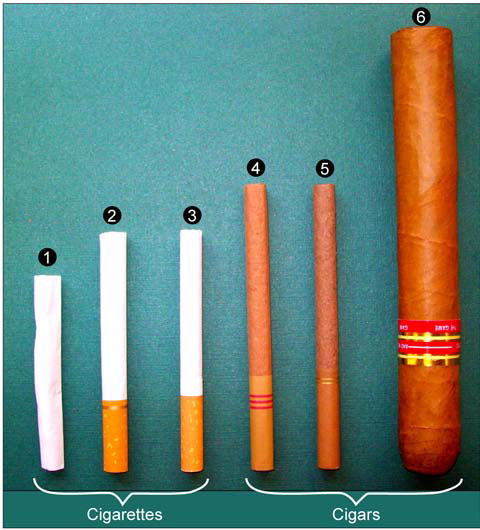
A cigar is a roll of tobacco wrapped in leaf tobacco or in a substance that contains tobacco. This is different from cigarettes. A cigarette is a roll of tobacco wrapped in paper or other substance that does not contain tobacco.1
Health effects of using cigars
Cigar smoke contains the same toxic compounds and chemicals that can cause cancer that are found in cigarette smoke. Cigar smoke is harmful to people who smoke cigars. It is also harmful to people who do not smoke but breathe in secondhand smoke from cigars.
Cigars contain nicotine, which is highly addictive. Nicotine addiction makes it hard to quit using tobacco. Nicotine can also harm brain development.
People who smoke cigars are exposed to nicotine and toxic chemicals, such as those that cause cancer. This is also true for people who report they do not inhale cigar smoke when using a cigar.12 The following are some of the health risks of smoking cigars:
- Cigar smoking can cause lung cancer.12
- Regularly smoking cigars can increase the risk of cancers of the throat and mouth. These include cancers of the esophagus, larynx (voice box), pharynx (throat), and oral cavity (lip, tongue, mouth).12
- Cigar smoking can increase the risk of gum disease and tooth loss.3
- Heavy cigar smoking and inhaling cigar smoke deeply may increase the risk of developing coronary heart disease.1
- Heavy cigar smoking increases the risk for lung diseases, such as chronic obstructive pulmonary disease (COPD).1
- Researchers estimate that regular cigar smoking is responsible for 9,000 premature deaths per year.2
- Researchers also estimate cigar-attributable annual health care expenditures to total $1.8 billion annually.4
Three major types of cigars are sold in the United States: large cigars, cigarillos, and little cigars.
Share Of Unit Sales By Cigar Type
Type
Description5
Share of Unit Sales (2016-2020)*6
Large cigar (unit equals a single large cigar)
A big cigar that is hand-rolled or machine-made. Large cigars typically contain 5 to 20 grams of tobacco, which is as much as a pack of cigarettes. Large cigars can take 1 to 2 hours to smoke.
2.7% of unit sales
Cigarillo (unit equals one pack of two cigarillos)
A cigar that is usually a little bigger than a little cigar or cigarette. Cigarillos typically contain about 3 grams of tobacco. They often do not have a filter.
94.2% of unit sales
Little cigar (unit equals one pack of 20 little cigars)
A small cigar that typically is about the same size as a cigarette and usually includes a filter.
3.1% of unit sales
*Percentage of U.S. market for cigar products.
Table references:
- National Cancer Institute. Cigars: Health Effects and Trends. Smoking and Tobacco Control Monograph No. 9. National Institutes of Health, National Cancer Institute; 1998. Accessed August 30, 2024. https://cancercontrol.cancer.gov/brp/tcrb/monographs/monograph-09
- U.S. Food and Drug Administration. Scientific Assessment of the Impact of Flavors in Cigar Products. U.S. Dept of Health and Human Services; 2022. https://www.fda.gov/media/157595/download
- Albandar JM, Streckfus CF, Adesanya MR, Winn DM. Cigar, pipe, and cigarette smoking as risk factors for periodontal disease and tooth loss. J Periodontol. 2000;71(12):1874–1881.
- Wang Y, Sung HY, Yao T, Lightwood J, Max W. Health care utilization and expenditures attributable to cigar smoking among US adults, 2000–2015. Public Health Rep. 2018;133(3):329–337.
- National Cancer Institute. Cigar smoking and cancer. October 27, 2010. Accessed August 30, 2024. https://www.cancer.gov/about-cancer/causes-prevention/risk/tobacco/cigars-fact-sheet
- Wang X, Kim Y, Borowiecki M, Tynan MA, Emery S, King BA. Trends in cigar sales and prices, by product and flavor type — United States, 2016–2020. Nicotine Tob Res. 2022;24(4):606–611.