Skip Navigation Links
Centers for Disease Control and Prevention
 CDC Home Search Health Topics A-Z

National Center for Chronic Disease Prevention and Health Promotion

Healthy Youth


Health Topics
Tobacco Use

ON THIS PAGE
Data & Statistics
Science-based Strategies
National, State, and Local Programs
References
SEE ALSO
Publications
Links

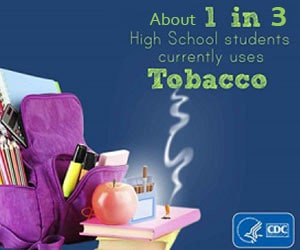
Tobacco use, including cigarette smoking, cigar smoking, and smokeless tobacco use, is the single leading preventable cause of death in the United States. Each year smoking causes approximately 435,000 premature deaths and over 5 million years of potential life lost.1 Every day, approximately 4,000 American youth aged 12-17 try their first cigarette.2 If current patterns of smoking behavior continue, an estimated 6.4 million of today's children can be expected to die prematurely from a smoking-related disease.3 In 2005, 23% of high schools students reported current cigarette use and 14% reported current cigar use. In addition, 8% of high school students and 18% of white male high school students reported current smokeless tobacco use.4

checkmarkTobacco Use and the Health of Young People  

checkmark

How CDC's Division of Adolescent and School Health is Addressing Tobacco Use and Addiction [pdf 803K]
 

Data & Statistics

School Health Policies and Programs Study
SHPPS is a national survey periodically conducted to assess school health policies and programs at the state, district, school, and classroom levels, including those related to preventing tobacco use.

Youth Risk Behavior Surveillance System
The YRBSS monitors behaviors that contribute markedly to the leading causes of death, disability, and social problems among youth and adults in the United States.

Science-based Strategies

See School Health Guidelines: Tobacco Use for strategies most likely to be effective in preventing tobacco use and addiction among young people.

The School Health Index can help schools implement school health guidelines and related strategies. This self-assessment and planning tool enables schools to identify the strengths and weaknesses of health promotion policies and programs and assists schools in developing an action plan for improving the school environment.

Registries of Programs Effective in Reducing Youth Risk Behaviors. Various federal agencies have identified youth-related programs that they consider worthy of recommendation based on expert opinion or a review of design and research evidence. These programs focus on different health topics, risk behaviors, and settings, including tobacco use.

National, State, and Local Programs

CDC's Division of Adolescent and School Health (DASH) supports the development and implementation of effective health promotion policies and programs that address priority health risks among youth. For information about the actions that state agencies can implement to address these health risks, see CDC's:

 Promising Practices in Chronic Disease Prevention and Control
[pdf 2MB, view abstract only]
  Ch.8: Advancing Tobacco Control Through Evidence-Based Programs [pdf 350K]
  Ch.9: Building a Healthier Future Through School Health Programs [pdf 400K]

Steps to a HealthierUS is an initiative from the U.S. Department of Health and Human Services (HHS) that advances the goal of helping Americans live longer, better, and healthier lives. The Steps Cooperative Agreement Program funds 40 communities nationwide to implement school and other community-based programs that address obesity, diabetes, and asthma, as well as their related risk behaviors: physical inactivity, poor nutrition, and tobacco use.

References

  1. Fellows JL, Trosclair A, Adams EK, Rivera CC. Annual smoking attributable mortality, years of potential life lost and economic costs: United States 1995-1999. Morbidity and Mortality Weekly Report 2002;51:300-303.
     
  2. Substance Abuse and Mental Health Services Administration. Summary of findings from the 2001 National Household Survey on Drug Abuse: Volume II. Technical appendices and selected data tables. Rockville, MD: U.S. Department of Health and Human Services, 2002;NHSDA Series H-18;DHHS publication no. (SMA) 02-3759.
     
  3. CDC. Office on Smoking and Health, 2002 calculations based upon: Smoking attributable mortality and years of potential life loss—United States, 1984. Morbidity and Mortality Weekly Report 1997;46:444-451.
     
  4. CDC. Youth Risk Behavior Surveillance—United States, 2005 [pdf 300K]. Morbidity & Mortality Weekly Report 2006;55(SS-5):1–108.

Back to Top

Documents on this page are available in Portable Document Format (PDF). Learn more about viewing and printing these documents with Acrobat Reader.


Healthy Youth Home | Contact Us

CDC Home | Search | Health Topics A-Z

Policies and Regulations | Disclaimers

Page last reviewed: November 07, 2007
Page last modified: December 12, 2007
Content source: National Center for Chronic Disease Prevention and Health Promotion, Division of Adolescent and School Health

Division of Adolescent and School Health
National Center for Chronic Disease Prevention and Health Promotion
Centers for Disease Control and Prevention
Department of Health and Human Services