



Purpose
- Salmonella Typhi and Paratyphi are bacteria that cause severe and occasionally life-threatening illnesses known as typhoid fever and paratyphoid fever, respectively.
- This report summarizes all cases of infection, including those that may be asymptomatic or have an atypical clinical presentation.
- Data include demographic and clinical characteristics, international travel, vaccination status, antimicrobial resistance, and more.
Surveillance
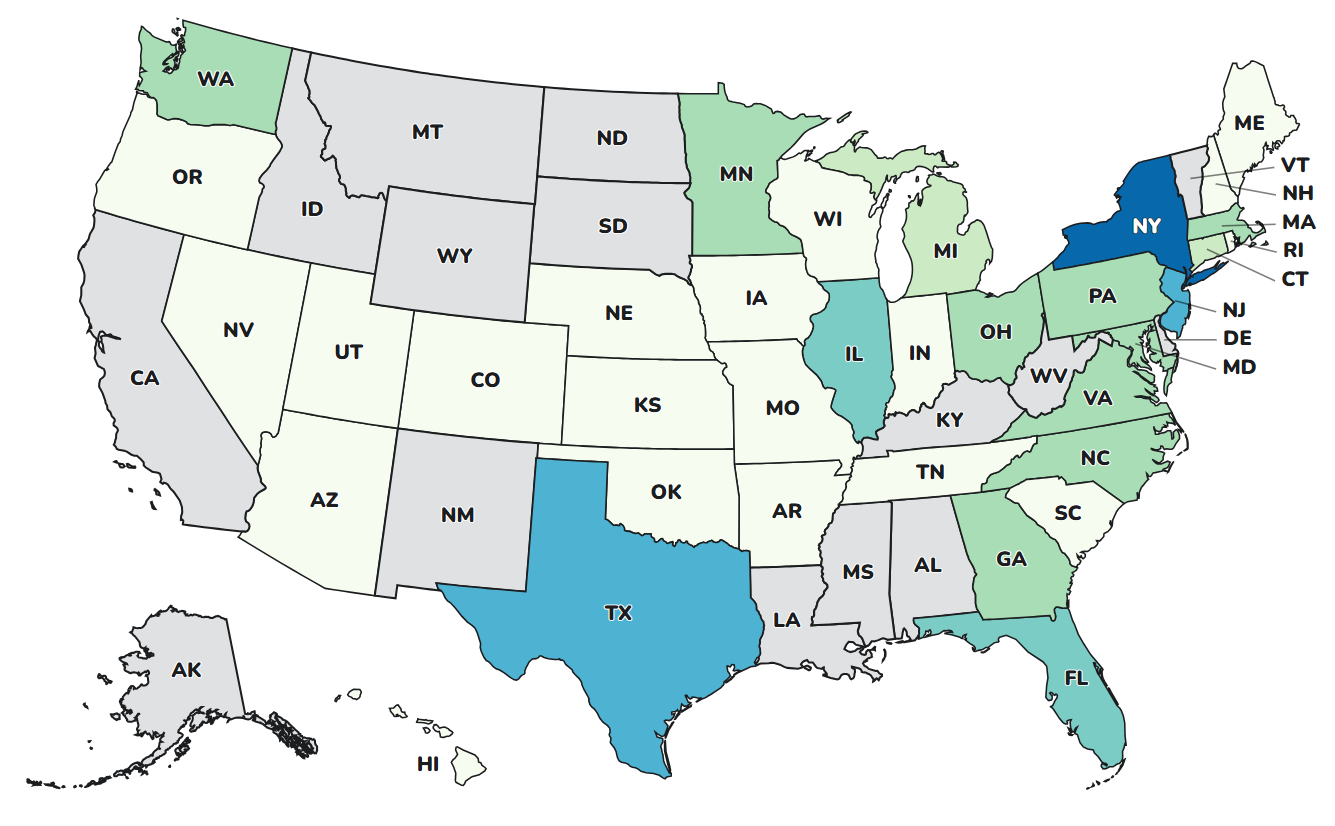
JurisdictionsA reporting at least one case of Salmonella enterica serotype Typhi, Paratyphi A, Paratyphi B [tartrate negative], or Paratyphi CB to the National Typhoid and Paratyphoid Fever Surveillance system (NTPFS) during 2024 are shown in the map below.
- 383 Salmonella Typhi cases were reported by 35 jurisdictions
- 109 Salmonella Paratyphi cases were reported by 26 jurisdictionsC
*Typhoid fever and paratyphoid fever cases among California residents in 2024 have not been reported to COVIS. These findings are limited to cases reported to NTPFS and therefore should be interpreted with caution. This report will be updated when new data become available.
Demographic and Clinical Characteristics
- The median age of patients with Salmonella Typhi infections was 25 years (range 0–76)
- The median age of patients with Salmonella Paratyphi infections was 31 years (range 1–78)
- There were no deaths among patients with Salmonella Typhi or Paratyphi infections.
| Characteristic (number with data) | Number | Percent |
|---|---|---|
| Age group, years (n =378) | ||
| <1 | 2 | <1 |
| 1–4 | 31 | 8 |
| 5–14 | 82 | 22 |
| 15–24 | 62 | 16 |
| 25–44 | 139 | 37 |
| 45–64 | 55 | 15 |
| 65+ | 7 | 2 |
| Female (n = 379) | 168 | 44 |
| Food handler (n = 349) | 8 | 2 |
| Outbreak-associated (n = 358) | 10 | 3 |
| International travel1 (n =377) | 313 | 83 |
| Vaccinated2 (n = 353) | 9 | 3 |
| Specimen source (n = 375) | ||
| Blood | 289 | 77 |
| Stool | 36 | 10 |
| Other | 5 | 1 |
| Hospitalizations3 (n = 383) | 308 | 80 |
| Deaths (n = 377) | 0 | 0 |
1Travel destinations are shown in Table 3a and include international destinations visited 30 days before illness onset.
2Received typhoid fever vaccination within five years before onset of illness; of the nine cases in vaccinated persons, two received only the Vi capsular polysaccharide vaccine (ViCPS), two cases reported receiving both ViCPS and the inactivated injection vaccine (Typhim Vi). Vaccine type was not reported for the other 5 cases.
3Median length of hospitalization was five days and ranged from 0–370 days
| Characteristic (number with data) | Number | Percent |
|---|---|---|
| Age group, years (n =109) | ||
| <1 | 0 | 0 |
| 1–4 | 4 | 4 |
| 5–14 | 18 | 17 |
| 15–24 | 18 | 17 |
| 25–44 | 43 | 40 |
| 45–64 | 18 | 17 |
| 65+ | 8 | 7 |
| Female (n = 379) | 168 | 44 |
| Female (n = 108) | 59 | 55 |
| Food handler (n = 103) | 0 | 0 |
| Outbreak-associated (n = 101) | 0 | 0 |
| International travel1 (n = 106) | 88 | 83 |
| Specimen source (n =103) | ||
| Blood | 80 | 78 |
| Stool | 7 | 7 |
| Other | 12 | 12 |
| Hospitalizations2 (n = 109) | 81 | 74 |
| Deaths (n = 108) | 0 | 0 |
1Travel destinations are shown in Table 3b and include international destinations visited 30 days before illness onset.
2Median length of hospitalization was five days and ranged from 0–39 days.
International Travel
Approximately 85% of typhoid fever and 80% of paratyphoid fever cases in the United States occur among international travelers. Salmonella Typhi and Paratyphi are endemic in Bangladesh, India, and Pakistan, which are frequently reported destinations.
- Among the 358 patients with Salmonella Typhi infections whose travel histories were reported, 313 (87%) reported traveling or living outside the United States in the 30 days before illness onset.
- Among the 105 patients with Salmonella Paratyphi infections whose travel histories were reported, 88 (84%) reported traveling or living outside the United States in the 30 days before illness onset.
- Among patients reporting international travel, 277 (88%) patients with Salmonella Typhi infections and 77 (85%) patients with Salmonella Paratyphi infections reported travel to a single destination (Tables 3a and 3b). More than 70% of patients with either pathogen reported travel to India or Pakistan.
- 178 (57%) patients with Salmonella Typhi infection and 48 (55%) patients with Salmonella Paratyphi infection reported visiting friends or relatives, the most commonly reported reason for international travel.
Table 3a. Travel destinations for patients with Salmonella Typhi infections who reported a single destination country, n=277 | NTPFS, 2024
1Afghanistan (4), Dominican Republic (3), Haiti (3), Peru (3), Ghana (2), Kenya (2), Kingdom of Saudi Arabia (2), Myanmar (2), Nepal (2), Senegal (2), The Bahamas (1), Bhutan (1), The British Indian Ocean Territory (1), Burkina Faso (1), Cameroon (1), Cote d'Ivoire (1), Guatemala (1), Indonesia (1), Iraq (1), Nigeria (1), Turks and Caicos (1)
Table 3b. Travel destinations for patients with Salmonella Paratyphi infections who reported a single destination country, n=77 | NTPFS, 2024
Typhoid Fever Vaccine
Among 31 patients with Salmonella Typhi infections reported from 2020 through 2024, between 1–6% reported receiving a typhoid fever vaccine in the five years before illness onset.
National Notifiable Diseases Surveillance System
The National Notifiable Diseases Surveillance System (NNDSS) collects and compiles reports of nationally notifiable infectious diseases, including Salmonella Typhi and Paratyphi cases.
The figure below presents a comparison of Salmonella Typhi case reports submitted to NTPFS and NNDSS in the past five years. Reports submitted to NNDSS, but not NTPFS, can include clinically compatible cases that are epidemiologically linked to a confirmed case but are not laboratory-confirmed.
Comparisons for Salmonella Paratyphi are not provided because, although it was nationally notifiable, NNDSS does not report subtyping information for this condition.
1Figure excludes NTPFS data from CA for reporting years 2021, 2023, and 2024.
Antimicrobial Resistance
The National Antimicrobial Resistance Monitoring System (NARMS) monitors antimicrobial resistance among enteric bacteria (including Salmonella enterica serotypes Typhi and Paratyphi A, Paratyphi B, and Paratyphi C) from humans.
Among Typhi isolates nonsusceptibility to ciprofloxacin—also known as decreased susceptibility to ciprofloxacin (DSC) (minimum inhibitory concentration ≥0.12 µg/mL)—has been associated with fluoroquinolone treatment failure. Multidrug-resistance (MDR) is defined as resistance to ampicillin, chloramphenicol, and trimethoprim-sulfamethoxazole.
Outbreaks
The National Outbreak Reporting System (NORS) is a web-based platform designed to support reporting to CDC by local, state, and territorial health departments in the United States of all waterborne disease outbreaks and enteric disease outbreaks transmitted by food, contact with environmental sources, infected persons or animals, or unknown modes of transmission. Data on outbreaks are available on the Data.CDC.gov catalog and the BEAM Dashboard.
In 2024, there were no outbreaks of typhoid fever or paratyphoid fever in the United States.
This page was last updated on this date. Updates may include minor edits, image changes, or other modifications to page content.
The information on this page was last reviewed by subject matter experts to ensure accuracy.
- Includes all 50 states and the District of Columbia
- Two pathotypes of Paratyphi B are recognized, differentiated by the ability to ferment tartrate. The pathotype designated serotype Paratyphi B is unable to ferment tartrate; it causes paratyphoid fever. The other pathotype is designated Paratyphi B var. L(+) tartrate+; it can ferment tartrate and causes uncomplicated gastroenteritis. Only isolates laboratory-confirmed as not able to ferment tartrate are considered cases captured by the National Typhoid and Paratyphoid Fever Surveillance System. Many reports of Paratyphi B detection do not include this information, and therefore are not included in this summary
- Three cases of Salmonella serotype Paratyphi C and two cases of Salmonella Paratyphi without a specified serotype are reported.
- Centers for Disease Control and Prevention (CDC). BEAM (Bacteria, Enterics, Ameba, and Mycotics) Dashboard. Atlanta, Georgia: U.S. Department of Health and Human Services. Accessed 05/04/2026.