



At a glance
- Spina bifida occurs among 1 in every 2,857 births in the US each year.
- Hispanic women have the highest rate of having a child with spina bifida in the US.
- Prevention efforts, like getting enough folic acid daily before and during early pregnancy, reduce the risk of spina bifida.
In the United States
Each year, about 1,251 babies are born with spina bifida, or 1 in every 2,857 births[1].
Hispanic women have the highest rate of having a child with spina bifida compared with non-Hispanic White and non-Hispanic Black women.
Data from 12 state-based birth defects tracking programs were used to estimate the total number of pregnancies affected by spina bifida. This was compared to the total number of live births (the prevalence of spina bifida) for each racial/ethnic group:
- Hispanic: 3.80 per 10,000 live births
- Non-Hispanic Black or African-American: 2.73 per 10,000 live births
- Non-Hispanic White: 3.09 per 10,000 live births
These estimates describe how many babies are born with spina bifida each year, but they do not show how many people are living with the condition today.
Spina bifida across the lifespan
Spina bifida affects people of all ages, not just babies at birth. While data on spina bifida has typically consisted of tracking birth prevalence, which is how many babies are born with spina bifida each year, this does not show how many people live with the condition.
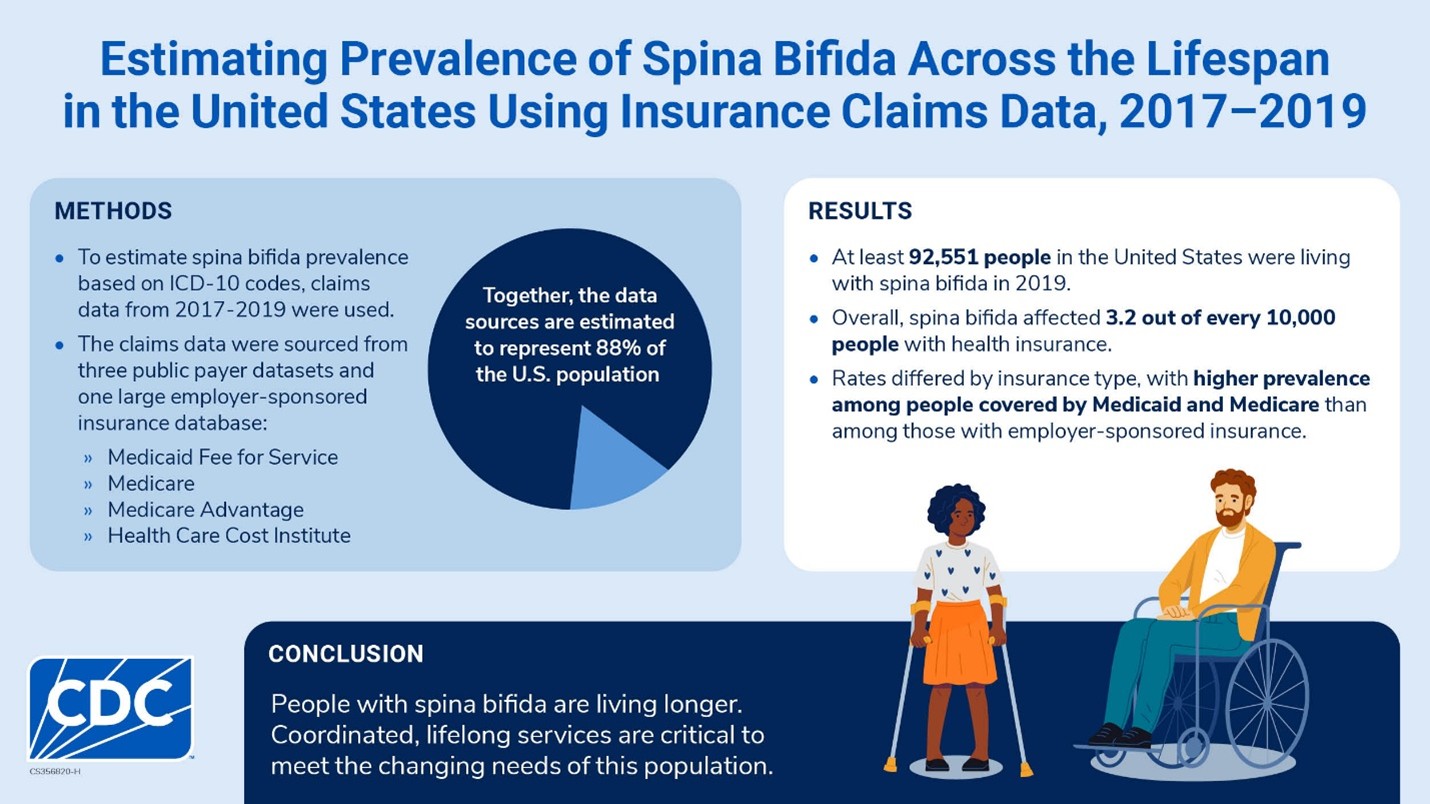
Analysis of insurance claims data, which included people with a spina bifida ICD code, not including spina bifida occulta, show:
- In 2019, at least 92,551 insured people in the United States were living with spina bifida.2
- This represents an overall prevalence of 3.20 per 10,000 insured individuals.2
These findings show spina bifida affects tens of thousands of people across the country. Knowing how many people live with spina bifida across the lifespan helps public health professionals, clinicians, and partners plan services.
Impact of folic acid fortification
Overview
Getting 400 micrograms (mcg) of folic acid daily before and during early pregnancy reduces the risk of neural tube defects (NTDs), including spina bifida. Effective 1998, the United States Food and Drug Administration (FDA) required that all grain products labeled 'enriched' (breads, cereals) have folic acid added. This is known as folic acid fortification and had the goal of helping to reduce the risk of NTDs.
Impact on prevalence
Using data from 19 state-based birth defects tracking programs, scientists observed a 28% reduction in prevalence of NTDs before and after the introduction of folic acid fortification1.

Impact on severity
Fortification has resulted in less severe spina bifida. Severity decreased by 70% when comparing studies published before and after fortification. Most of these differences were accounted for by a reduction in spina bifida lesions that occurred in the upper part of the spine (which are more severe)2.
Quality of life
A study published in 2015 looked at health-related quality of life in children and adolescents with spina bifida. Scientists found that children and young people with spina bifida reported
- Lower health-related quality of life (QOL) than youth with other chronic health conditions.
- Improvements in their social well-being over time.
Parents reported lower social and physical health-related QOL for their children compared to what the children reported themselves. This could mean that children with spina bifida may adapt to their limitations and parents of children with spina bifida may compare QOL to that of other children without chronic conditions3.
A 2022 study demonstrated a strong association between the child's psychosocial QOL, the parents' QOL, and family functioning. This suggests that supporting both patients and parents of patients may provide a synergistic effect on the family overall4.
This page was last updated on this date. Updates may include minor edits, image changes, or other modifications to page content.
The information on this page was last reviewed by subject matter experts to ensure accuracy.
- Bershadsky J, Riley C, Pettingell SL, Larson SA, Hall-Lande J, Hallas L, et al. Prevalence of spina bifida across the lifespan in the USA. Dev Med Child Neurol. 2026;00:1–7. https://doi.org/10.1111/dmcn.70161
- Williams J, Mai CT, Mulinare J, et al. Updated Estimates of Neural Tube Defects Prevented by Mandatory Folic Acid Fortification — United States, 1995–2011. Morb Mortal Weekly Rep MMWR. 2015;64(01):1-5.
- Mai CT, Evans J, Alverson CJ, et al. Changes in Spina Bifida Lesion Level after Folic Acid Fortification in the US. J Pediatr. 2022;249:59-66.e1.
- Murray CB, Holmbeck GN, Ros AM, Flores DM, Mir SA, and Varni JW. A Longitudinal Examination of Health-Related Quality of Life in Children and Adolescents With Spina Bifida. J Pediatr Psychol. 2015 May; 40(4): 419–430.
- Stallings EB, Isenburg JL, Rutkowski RE, et al. National population-based estimates for major birth defects, 2016–2020. Birth Defects Res. 2024;116(1):e2301. https://doi.org/10.1002/bdr2.2301
- Simpson TS, Grande LA, Kenny JJ, Wilson PE, and Peterson RL. Child, Parent, and Family Adjustment for Patients Followed in a Multidisciplinary Spina Bifida Clinic. Top Spinal Cord Inj Rehabil. 2022;28(3):41-58.