



At a glance
Incorporating MDN — Minimal Data Necessary — into routine data exchange means the nation is better prepared to address emerging health threats. An outbreak of NWS provided the first opportunity to use MDN in an emergency situation.
MDN and the Public Health Data Strategy
The Minimal Data Necessary for Public Health Emergency Response (MDN) is the subset of data elements needed to inform decisions in the early stages of a public health emergency. By identifying these elements before an emergency happens, and ensuring they are shared routinely, the public health response addressing emerging health threats will be more efficient and effective. MDN also serves as the starting point for creating new data collections in public health emergencies.
CDC's MDN initiative advances more seamless sharing of public health data — a key goal of the Public Health Data Strategy (PHDS) — and supports another primary public health data goal: speeding up data exchange. In 2025, several PHDS milestones focused on defining data elements for MDN that would support these goals and reduce the data reporting burden on public health partners, including state, tribal, local and territorial health departments, healthcare providers and public health laboratories.
MDN and the New World screwworm
MDN helps public health officials quickly focus on the essential information needed for action, using existing data standards. This allows data providers, including health departments and healthcare providers, to spend less time on data collection and reporting, and more on investigation and response.
Building on past emergency responses, CDC has established sets of MDN for different types of core data sources, including case, laboratory, syndromic surveillance and hospital bed capacity.
The potential spread of the New World screwworm (NWS) into the United States presented an opportunity to test the MDN for case data. NWS is a parasitic fly that lays eggs in the flesh of warm-blooded animals and people. The flies are typically found in South America and parts of the Caribbean. The larvae feed on the host, causing severe wounds that, if untreated, can result in death. NWS infestation can impact livestock, pets, wildlife and people.
Since 2023, an outbreak of NWS has been moving northward through countries in Central America and Mexico. The U.S. Department of Agriculture, CDC, other federal partners and state health departments began preparing for the possible appearance of NWS in the United States. In January 2026, CDC issued a Health Alert Network bulletin about NWS animal cases in the Mexican state of Tamaulipas, which shares a border with Texas.
On June 3, 2026, USDA confirmed the first U.S. animal case in the current outbreak of NWS.
The progress
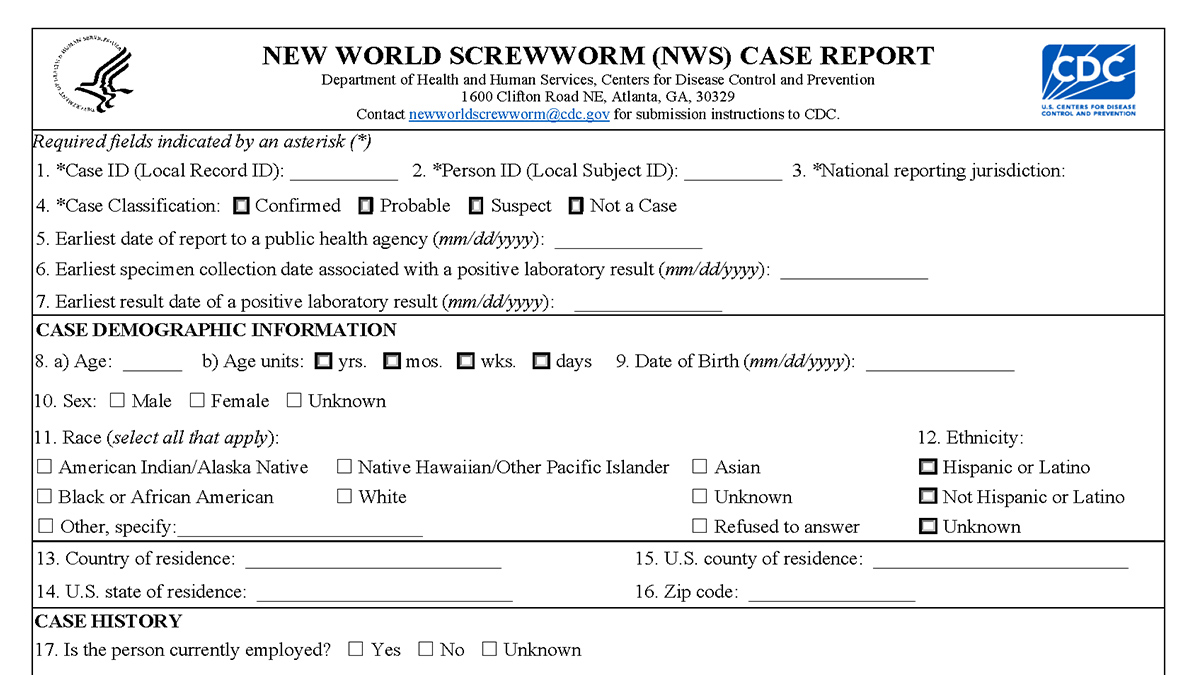
Preparing for a possible NWS public health response provided CDC's data scientists and epidemiologists with an opportunity to use MDN data elements to develop a human NWS case report form. The form used MDN data elements as a starting point for the data collection and added questions necessary for monitoring and controlling the spread of NWS. Scientists also prepared to use pre-developed data transmission mechanisms.
Using Case Notification MDN to create a new case report form for NWS ensures that public health partners will be able to seamlessly share an agreed upon set of essential information to fast track emergency response.
NWS is the first program to use Case Notification MDN outside of a routine data collection. The lessons learned from preparing for NWS allowed CDC to leverage MDN and be ready for future emergency responses.
What users are saying
"Having a set of standardized data elements and pre-developed data systems available meant we could focus our work on the data we needed to collect for NWS, rather than creating new standards and systems from scratch. Using MDN is a real benefit to a response, since it lets us move from creating the case report form to using the case report form to collect data quickly. Now we are ready to receive the data needed to understand and respond to this emerging threat." – CDC New World screwworm program
This page was last updated on this date. Updates may include minor edits, image changes, or other modifications to page content.
The information on this page was last reviewed by subject matter experts to ensure accuracy.