


Key points
- CDC is conducting an ongoing evaluation of the Preventive Health and Health Services (PHHS) Block Grant.
- Overall, findings show that the PHHS Block Grant helps state, tribal, local, and territorial agencies strengthen the public health system.
Overview
The PHHS Block Grant evaluation assesses the grant's value (i.e., benefits and contributions).
- The aim is to strengthen performance and accountability.
- The evaluation describes and measures outputs and outcomes.
- The evaluation assesses the grant as a whole—not individual recipient activities or outcomes.
Evaluation
The evaluation seeks to answer two overarching questions:
- How does the PHHS Block Grant support recipients addressing their jurisdictions' prioritized public health needs related to Healthy People 2030 objectives?
- How does the PHHS Block Grant contribute toward achieving organizational-, systems-, and health-related outcomes?
The evaluation consists of several key activities, including:
- Implementing a measurement framework to determine recipient achievements.
- Analyzing recipient allocation of funding to Healthy People 2030 objectives.
- Exploring the relationship between PHHS Block Grant funding and health outcomes.
Measurement Framework
The framework is an innovative measurement approach that allows for:
- More standardized collection of information
- Aggregation of health department outputs, outcomes, and achievements
- Tracking of grant funds
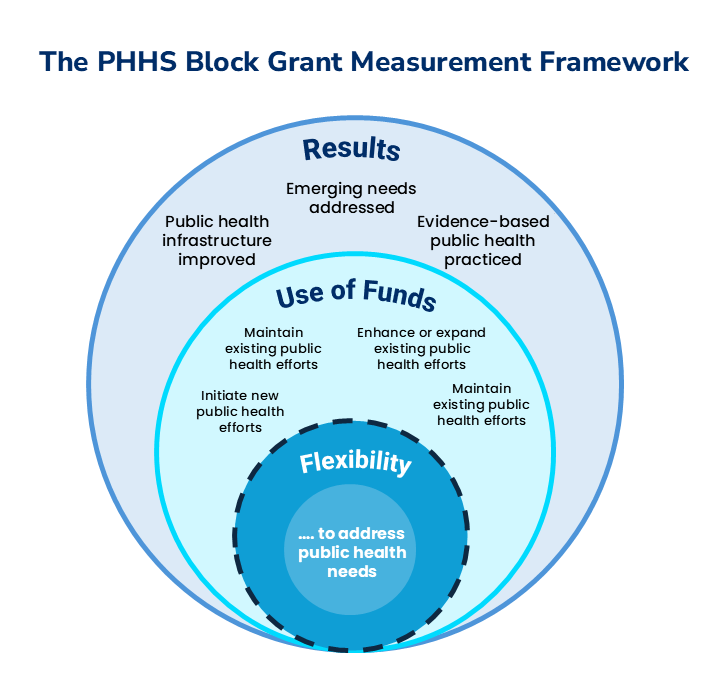
PHHS Block Grant Evaluation Framework
The framework consists of four key measures:
- Improvement of information systems to collect public health information
- Improvement in efficiency of operations, programs, or services
- Emerging public health needs addressed
- Evidence-based public health interventions implemented
About the findings
In fall 2025, 43 out of 61 PHHS Block Grant recipients (70%) completed surveys.
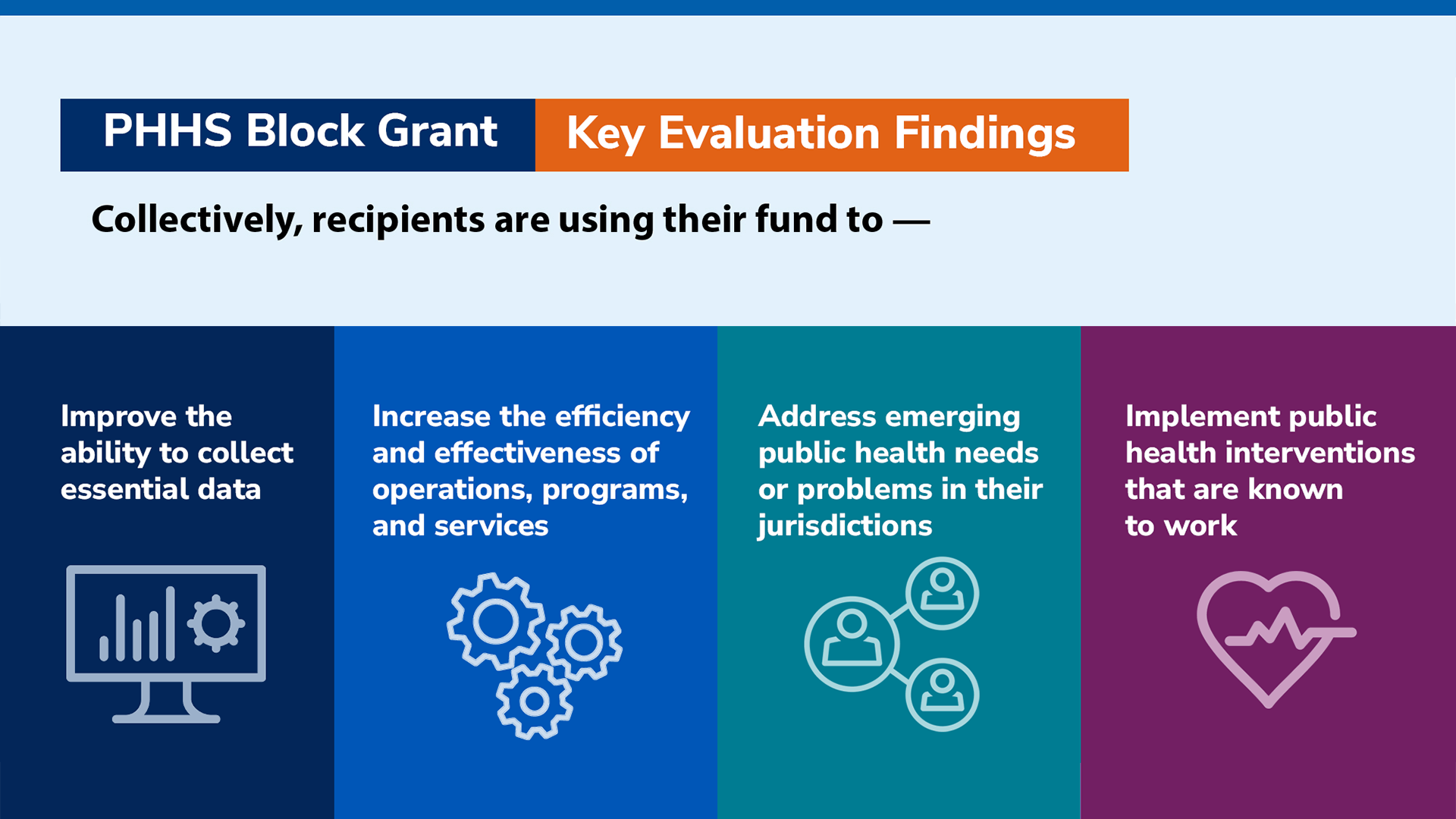
Overall findings show that the PHHS Block Grant helps strengthen public health systems by enabling state, tribal, local, and territorial agencies to use grant funds to improve public health infrastructure, address emerging public health needs, and implement evidence-based public health interventions.
For the purpose of this evaluation, public health interventions are defined as any type of planned activity, such as a program, service, or policy, designed to prevent disease or injury or promote health in a group of people.
- Over 760 agencies improved the capacity of their information systems—supporting faster, more accurate public health decisions.
- 175 agencies improved the efficiency and effectiveness of their operations, programs, and services—enhancing quality improvement efforts.
- Agencies addressed 140 emerging public health needs—with mental health, injury and violence prevention, and substance use among the top issues.
- Agencies implemented 880 evidence-based public health interventions—maximizing effectiveness and resource use.
Note: CDC conducted a fourth cycle of data collection in 2025 (previous cycles were in 2017, 2019, and 2022).
Previous Evaluation Reports & Executive Summaries
Resources
Centers for Disease Control and Prevention. Preventive Health and Health Services Block Grant Evaluation Report: Exploring how PHHS Block Grant recipients use funds to address social determinants of health and advance health equity. Atlanta, GA: US Department of Health and Human Services; 2023.
Association of State and Territorial Health Officials. Flexible Funding to Support Public Health Innovation. 2022 Aug 15. Retrieved from https://www.astho.org/globalassets/report/flexible-funding-to-support-ph-innovation.pdf.
Lamia TL, Lowry GF, McLees AW, Frazier CM, Young CF. Improving Outcome Accountability of Block Grants: Lessons Learned from the Preventive Health and Health Services Block Grant Evaluation. Am J Eval. 2020 Oct 14; 42(2): 185-200.
This page was last updated on this date. Updates may include minor edits, image changes, or other modifications to page content.
The information on this page was last reviewed by subject matter experts to ensure accuracy.