



At a glance
This fact sheet was designed to help employers and workers better understand the risk of opioid overdose as well as help them decide if they should establish a workplace naloxone availability and use program. It provides information regarding what opioids are and the types of opioids such as natural opioids, semi- synthetic opioids, and synthetic opioids. It also describes what naloxone is, the side effects that it may have, as well as the limitations of the medication.
Text equivalent
Introduction
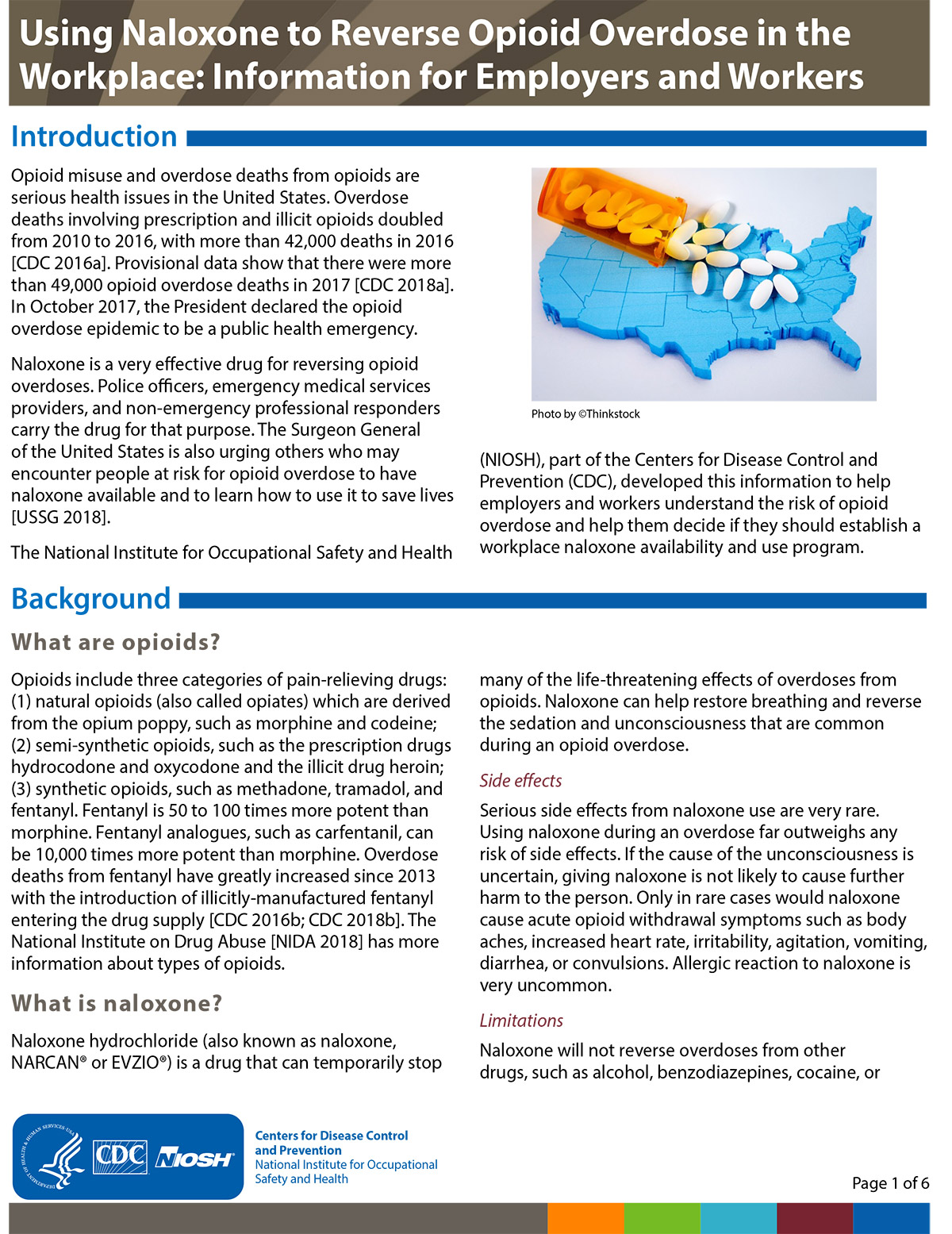
Opioid misuse and overdose deaths from opioids are serious health issues in the United States. Overdose deaths involving prescription and illicit opioids doubled from 2010 to 2016, with more than 42,000 deaths in 2016 [CDC 2016a]. Provisional data show that there were more than 49,000 opioid overdose deaths in 2017 [CDC 2018a]. In October 2017, the President declared the opioid overdose epidemic to be a public health emergency.
Naloxone is a very effective drug for reversing opioid overdoses. Police officers, emergency medical services providers, and non-emergency professional responders carry the drug for that purpose. The Surgeon General of the United States is also urging others who may encounter people at risk for opioid overdose to have naloxone available and to learn how to use it to save lives [USSG 2018].
The National Institute for Occupational Safety and Health (NIOSH), part of the Centers for Disease Control and Prevention (CDC), developed this information to help employers and workers understand the risk of opioid overdose and help them decide if they should establish a workplace naloxone availability and use program.
Background
What are opioids?
Opioids include three categories of pain-relieving drugs:
(1) natural opioids (also called opiates) which are derived from the opium poppy, such as morphine and codeine;
(2) semi-synthetic opioids, such as the prescription drugs hydrocodone and oxycodone and the illicit drug heroin;
(3) synthetic opioids, such as methadone, tramadol, and fentanyl.
Fentanyl is 50 to 100 times more potent than morphine. Fentanyl analogues, such as carfentanil, can be 10,000 times more potent than morphine. Overdose deaths from fentanyl have greatly increased since 2013 with the introduction of illicitly-manufactured fentanyl entering the drug supply [CDC 2016b; CDC 2018b]. The National Institute on Drug Abuse [NIDA 2018] has more information about types of opioids.
What is naloxone?
Naloxone hydrochloride (also known as naloxone, NARCAN® or EVZIO®) is a drug that can temporarily stop many of the life-threatening effects of overdoses from opioids. Naloxone can help restore breathing and reverse the sedation and unconsciousness that are common during an opioid overdose.
Side effects
Serious side effects from naloxone use are very rare. Using naloxone during an overdose far outweighs any risk of side effects. If the cause of the unconsciousness is uncertain, giving naloxone is not likely to cause further harm to the person. Only in rare cases would naloxone cause acute opioid withdrawal symptoms such as body aches, increased heart rate, irritability, agitation, vomiting, diarrhea, or convulsions. Allergic reaction to naloxone is very uncommon.
Limitations
Naloxone will not reverse overdoses from other drugs, such as alcohol, benzodiazepines, cocaine, or amphetamines. More than one dose of naloxone may be needed to reverse some overdoses. Naloxone alone may be inadequate if someone has taken large quantities of opioids, very potent opioids, or long acting opioids. For this reason, call 911 immediately for every overdose situation.