



What to know

Summary
Prevention through Design (PtD) aims to eliminate or mitigate hazards during planning and design to prevent incidents from happening in the first place. PtD aims to "design out" as many hazards as possible across all stages of a project's lifecycle. PtD can be applied to any industry or occupation and can reduce construction-related injuries and deaths.
The success of PtD depends on participation and buy-in from everyone involved at multiple levels of production. Worker safety shifts from the sole responsibility of safety professionals to the forethought of project design.
Protecting construction workers
The country's 12 million construction workers are part of one of the most dangerous industries in the U.S. In 2024, construction had approximately 1,000 workplace fatalities, the most of any sector. In a typical year, the top three causes of fatal injuries are falls, slips and trips; transportation incidents; and exposure to harmful substances or environments.
NIOSH observes the annual Stand-Down to Prevent Falls in Construction in partnership with the Occupational Safety and Health Administration (OSHA) and the Center for Construction Research and Training (CPWR). During the 2026 event, the webinar Fall Prevention Through Design, hosted by CPWR, highlighted how PtD can reduce construction-related injuries and deaths.
What follows are some of the insights from that webinar and NIOSH's' work in PtD.
Prioritizing prevention
PtD in construction asks architects, engineers, designers, owners, and contractors to explicitly consider construction worker and post-construction maintenance worker safety during all project phases. This includes during the design and bid processes before any work begins.
PtD ideally starts before the first draft, during the business concept and planning stage. Determining the scope of the project can change how it's built. However, PtD can be integrated into projects throughout any phase. The process continues through long-term maintenance and decommissioning phases.
Real-world examples of PtD for fall prevention in construction include:
- Installing permanent guardrails or parapet walls of sufficient height around the perimeter of a roof
- Ensuring HVAC and other systems are accessible without a ladder or scaffold
- Including the weight of multiple construction workers into the design of equipment support structures
- Adding embedded anchors to accommodate personal fall arrest systems
- Building temporary stairs instead of using ladders
- Assembling building components at ground level and lifting them into their installed position to minimize work performed at height
A few examples of PtD for reducing struck-by hazards include:
- Ensuring pedestrian routes on job sites are physically separated from heavy mobile equipment
- Designing a facility with enough space to adequately turn, operate, and observe equipment
- Designating loading/unloading zones to ensure uninvolved workers do not enter these areas
Planning
Planning is at the heart of every PtD effort. Hazard identification, worker input, collaboration across professional expertise, and creativity are essential.
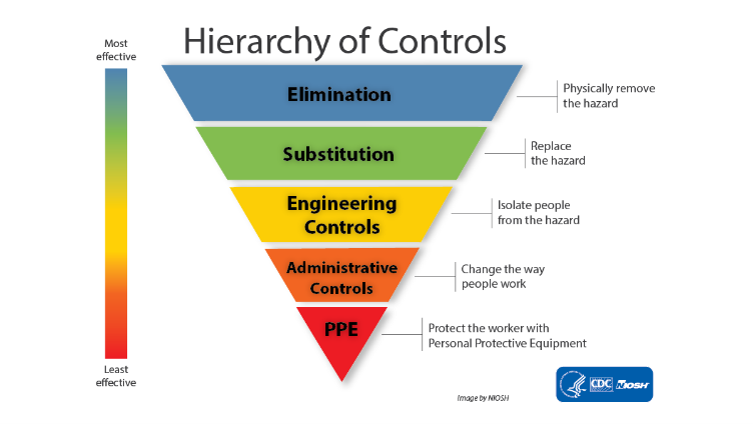
NIOSH prioritizes PtD by implementing prevention measures based on the hierarchy of controls. The hierarchy identifies a preferred order of actions to best control hazardous workplace exposures. Passive controls near the top of the hierarchy are preferred because they do not require any worker action to reduce risk. Active engineering, administrative, and PPE controls require workers' dedicated attention. And, ideally, if PPE is necessary, it would be used as part of a suite of protections but not be the default of what workers must depend on.
PtD fits in the hierarchy as part of "elimination" because it designs out a hazard early in a project's life cycle. Eliminating a hazard at its source is the safest, most preferred strategy and costs less to control at this stage. If elimination is not possible, subsequent levels can be utilized.
Here is an example of how each control can reduce exposure to respirable crystalline silica, based on NIOSH research that has eliminated, reduced, or controlled the hazard1:
- Eliminating dust-producing tasks (design openings and attachment points into the structure so concrete does not need to be drilled later)
- Substituting a material that produces less hazardous dust in place of more dusty material before work begins
- Engineering controls that may modify equipment (like pressurized or filtration cabs)
- Administrative controls like worker positioning or housekeeping practicesto reduce duration, frequency, or intensity of exposure to respirable silica
- Personal protective equipment like respiratory protection, that includes selection, use, and appropriate training
Addressing challenges
There are some challenges to implementing PtD in a construction project and common concerns within the construction community:
- Lack of regulatory requirements
- Reluctance to change standard contracts to enable PtD
- Resistance to adoption
- Worries about cost
- Less familiarity with occupational safety and health concepts
- Concern of greater liability2
To address these concerns, a good starting point for introducing PtD is in pre-construction planning when hazards can be identified and designed out prior to starting work. The NIOSH Prevention through Design Toolkit for the Construction Industry3 provides examples for specific hazards, such as falls and struck-by injuries, and ways to address these challenges:
- Add language about PtD controls to bids, contracts, and other plans
- Proactively identify equipment and building components that can reduce worker exposure to hazards throughout the project lifecycle
- Design and build permanent features to avoid workarounds
- Always consider worker safety when making design decisions
- Consider applying national guidance to pre-construction plan, such as the Manual on Uniform Traffic Control Devices from the Federal Highway Administration
- Communicate the business value of PtD and the return on investment to leadership to encourage buy-in
Additional takeaways
The webinar4 also focused on the role of communication and collaboration when it comes to PtD. For example, employers may provide continuing education credits to design teams and architects and engage subcontractors on decision making around PtD during review meetings. Formal "design-for-safety" reviews at regular intervals throughout the project can help keep contractors, safety managers, and other stakeholders aligned around PtD practices to protect workers. Explicitly educating on the business value of embedding PtD and the return on investment may also encourage additional buy-in and adoption of elimination methods at the onset of projects.
The webinar also acknowledged the role of PtD in the digitization of construction. More sophisticated digital design tools could recognize hazardous patterns and help designers correct them during the process.5 Returning to the hierarchy of controls as new systems and technologies come into play will be important.
Resources
- CPWR PtD Resources
- OSHA Construction Industry Resources
- ANSI / ASSP Z590.3 Prevention Through Design Standard
- AIHA Business Case in EHS Tool
Contact
To discuss PtD in your industry or find out more information, please contact NIOSH's PtD program at PtD@cdc.gov.
Author informaion
Donald R. Peterson, PhD, MS, FAIMBE, Director, Division of Safety Research, Acting Associate Director for Construction Safety and Health at NIOSH
Emily J. Haas, PhD, is Associate Director for Science in the NIOSH Division of Safety Research and Co-coordinator for the NIOSH Construction Program in the Office of Construction Safety and Health.
Jessica Bunting, MPH, Director of Research to Practice, The Center for Construction Research and Training (CPWR)
Chris Wendt, MPH, Prevention through Design Coordinator, NIOSH Division of Science Integration, Emerging Technologies Branch
Christina Socias-Morales, DrPH, is a Research Epidemiologist and Co-Coordinator for the Construction Program in the NIOSH Office of Construction Safety and Health.
Bill Wright, Director of Communications, The Center for Construction Research and Training (CPWR)
This page was last updated on this date. Updates may include minor edits, image changes, or other modifications to page content.
The information on this page was last reviewed by subject matter experts to ensure accuracy.
- Cecala AB, O'Brien AD, Schall J, Colinet JF, Franta RJ, Schultz MJ, Haas EJ, Robinson JE, Patts JR, Holen BM, Stein R, Weber J, Strebel M, Wilson L, Ellis M [2019]. Dust control handbook for industrial minerals mining and processing. Second edition. Pittsburgh, PA: U.S. Department of Health and Human Services, Centers for Disease Control and Prevention, National Institute for Occupational Safety and Health, DHHS (NIOSH) Publication No. 2019-124, RI 9701. https://doi.org/10.26616/NIOSHPUB2019124
- Al-Bayati AJ, Bazzi K, Karakhan AA, Jensen E. Clearing the path: overcoming barriers to Prevention through Design (PtD) utilization in the US construction industry. Safety. 2024;10(3):74.
- NIOSH [2024]. Prevention through Design Toolkit for the Construction Industry. Cincinnati, OH: U.S. Centers for Disease Control and Prevention, National Institute for Occupational Safety and Health, DHHS (NIOSH) Publication No. 2024-124, https://doi.org/10.26616/NIOSHPUB2024124
- Donald Peterson, May 6, 2026, Fall Prevention Through Design [Webinar] CPWR – The Center for Construction Research and Training, https://www.youtube.com/watch?v=GM_Box5Joj4
- Orviz-Martínez N, Pérez-Santín E, López-Sánchez JI. New trends in the use of artificial intelligence and natural language processing for occupational risks prevention. Safety. 2026;12(1):7. doi:10.3390/safety12010007.