



Key points
- The Healthy People 2030 initiative sets measurable, transparent, and data-driven targets for national health objectives.
- The National Center for Health Statistics developed statistical tools to support federal workgroups in setting targets.
- Targets were based on data, expert input, public health policies, and agency or national priorities.
Background
The National Center for Health Statistics (NCHS) developed statistical methods and analytical tools to help with the selection of objective targets for Healthy People 2030. The tools help guide federal subject-matter experts (SMEs) serving on the Healthy People 2030 topic area workgroups select targets for this decade.
These experts used data-driven approaches whenever possible. They also considered subject-matter expertise, public health policies, and agency or national priorities. These experts selected the target for each objective. These target selections are subject to U.S. Department of Health and Human Services approval and public comment.
To learn more about the statistical methods and analytical tools used for Healthy People 2030, refer to Target-Setting Methods in Healthy People 2030.
For a list and description of the six Healthy People 2030 target-setting methods, see the Healthy People 2030 website.
Flowchart
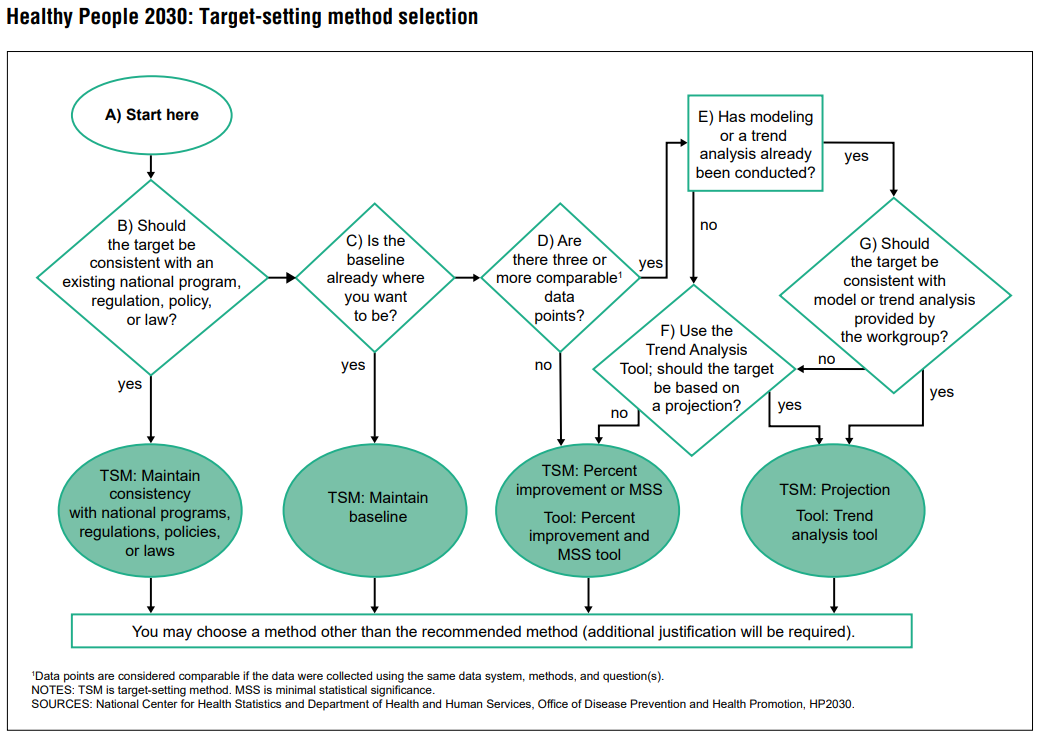
A flowchart was created to assist federal SMEs with selecting the best target-setting method for an objective. The flowchart guided target selection, but federal SMEs decided the final target-setting method selection.
The target-setting flowchart helps—
- Provide more transparency and consistency in the target-setting process
- Consider national programs, regulations, policies, or laws
- Ensure a trend analysis is conducted when historical data are available (three or more data points)
Trend analysis tool
The trend analysis tool provides candidate targets using a projection based on linear trend analysis. Specifically, weighted or ordinary least squares are used to fit a trend line based on historical data.
This results in predicted values (these can be used as candidate targets) using up to seven confidence levels.
Watch the following video to learn more.
Percent improvement and minimal statistical significance tool
The percent improvement and minimal statistical significance tool provides up to two candidate targets using the baseline (initial) value only to calculate a percent or percentage point improvement.
If the standard error is available, then an additional candidate target, based on minimal statistical significance, is provided.
Watch the following video to learn more.