



Key points
- Clinical laboratories can provide diagnostic testing for Legionella infections using urinary antigen testing (UAT), culture, or molecular methods.
- UAT typically detects only one type of Legionella, although infections with other types occur.
- CDC recommends Legionella UAT paired with lower respiratory specimen testing by culture or molecular methods for diagnosis of Legionnaires' disease.
- Learn the advantages and disadvantage of each diagnostic test.
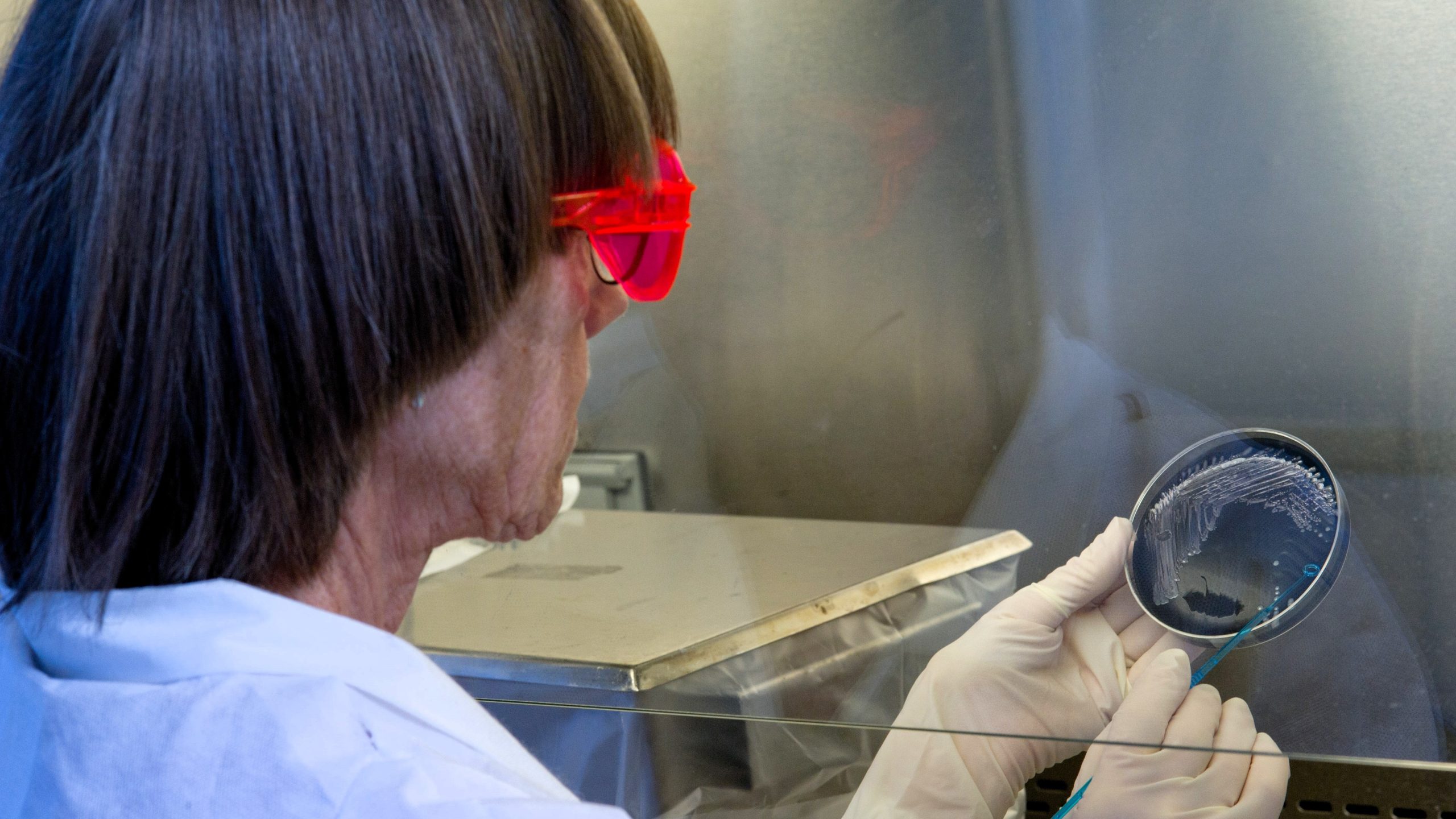
Preferred methods
The preferred diagnostic tests for Legionnaires' disease are both of the following paired together:
- Culture or molecular testing of lower respiratory specimens to detect a range of Legionella types
- Legionella UAT for Legionella pneumophila serogroup 1
Lower respiratory specimens include sputum, bronchoalveolar lavage, tracheal aspirate, and lung tissue.
Importance of testing a lower respiratory specimen
Collecting and testing lower respiratory specimens is important to enable detection of all species and serogroups of Legionella. Both culture and many molecular tests can detect Legionella species and serogroups that the UAT doesn't. UAT typically only detects L. pneumophila serogroup 1. Additionally, molecular tests may be more sensitive than culture for detecting Legionella infection after the start of antibiotic treatment.
Culture allows for comparison of clinical and environmental isolates during an outbreak investigation.
Benefits of the urinary antigen test
The UAT is the most commonly used laboratory test for diagnosis of Legionnaires’ disease. It detects a piece of the Legionella bacterium (known as an antigen) in urine. It can detect Legionella infection in some cases for days to weeks (or longer, under rare circumstances) after treatment.
Lab methods
Sensitivity and specificity
Sensitivity varies depending on the following:
- Quality and timing of clinical specimen collection
- Technical skill of the laboratory worker performing the test
The following table provides general ranges for the sensitivity and specificity of each diagnostic test.
Advantages and disadvantages
The following table describes advantages and disadvantages for each diagnostic test.
Nucleic Acid Amplification Test
- Can be performed on pathologic specimens (usually lung tissue)
- Rapid and sensitive
- Some tests detect species and serogroups other than Lp1
- Confirmatory laboratory evidence
Culture
- Detects all species and serogroups
- Yields clinical and environmental isolates that can be compared
- Confirmatory laboratory evidence
- Slow (up to 14 days to grow)
- Sensitivity is highly variable
- Affected by appropriate antibiotic treatment
- Requires specialized media, which some laboratories may not have readily available and can be difficult to obtain
Urinary Antigen
- Rapid
- Confirmatory laboratory evidence
- Can only be used to detect L. pneumophila serogroup 1A (Lp1)
- Does not allow for molecular comparison to clinical or environmental isolates
DFA
- Can be performed on pathologic specimens (usually lung tissue)
- May detect species and serogroups other than Lp1
- Supportive laboratory evidence
- Technically difficult
- Reagents may be difficult to obtain
Serology
- May detect species and serogroups other than Lp1
- Confirmatory laboratory evidence for Lp1; supportive for other types of Legionella
Specimen collection
Best practice is to obtain both lower respiratory specimens and urine concurrently.
It's ideal to obtain the lower respiratory specimens prior to antibiotic administration. However, antibiotic treatment shouldn't be delayed to facilitate this process. Lower respiratory specimen collection can occur after antibiotic administration begins.
Submitting specimens
Public health department laboratory staff can forward approved specimens or isolates to CDC or the Legionella Reference Center for specialized testing.
Bacteria detection
Incorrect rejection criteria
Laboratories sometimes reject lower respiratory specimens during a work-up for pneumonia based on specimen quality. Issues can include a lack of white blood cells in the sample or contamination with other
However, laboratories shouldn't reject lower respiratory specimens for these reasons when working-up Legionnaires' disease because Legionella can often be recovered1. Sputum produced by patients with Legionnaires' disease may not have many white blood cells2. Contaminating bacteria don't negatively impact isolation of Legionella on selective media (e.g., Buffered Charcoal Yeast Extract [BCYE] agar plus antibiotics)3.
Resources
Environmental Legionella Isolation Techniques Evaluation Program
Laboratories are able to test their proficiency at isolating Legionella from simulated environmental samples. This program issues documentation to those who pass the proficiency test.
Legionella Reference Center quick reference guide
This reference center accepts testing requests from governmental public health or environmental laboratories. It performs Legionella testing on clinical specimens and isolates, as well as environmental isolates and outbreak samples.
- Cross reactions with other species and serogroups have been documented.
- Avni T, Bieber A, Green H, et al. Diagnostic accuracy of PCR alone and compared to urinary antigen testing for detection of Legionella spp.: A systematic review. J Clin Micro. 2016;54(2):401–11.
- CDC labs don't perform serologic testing for legionellosis diagnosis due to inherent challenges in obtaining appropriate specimens. It's important to note that because paired sera are required, results are delayed and thus may not be useful for acute case diagnosis or during active outbreak investigations.
- Laboratories can develop, adopt, or use existing assays (known as laboratory developed tests) for in vitro diagnostic purposes. Labs do this by establishing and validating test performance under the Clinical Laboratory Improvement Amendments of 1988 (CLIA) requirements or equivalent regulations.
- Currently the U.S. Food and Drug Administration has cleared at least one nucleic acid-based molecular assay for Legionella pneumophila detection.
- McDade JE, Shepard CC, Fraser DW, Tsai TR, Redus MA, Dowdle WR. Legionnaires' disease: Isolation of a bacterium and demonstration of its role in other respiratory disease. N Engl J Med. 1977;297(22):1197–203.
- Ito A, Ishida T, Tachibana H, Nakanishi Y, Kawataki M, Yamazaki A, Washio Y. Identification rate of Legionella species in non-purulent sputum culture is comparable to that in purulent sputum culture in Legionel33la pneumonia. J Clin Microbiol. 2024;62(4):e0166523.
- Murdoch DR. Diagnosis of Legionella infection. Clin Infect Dis. 2003;36:64–9.
- Mercante JW, Winchell JM. Current and emerging Legionella diagnostics for laboratory and outbreak investigations. Clin Microbiol Rev. 2015;28:95–133.