



Purpose
The purpose of Preparedness and Safety Messaging for Hurricanes, Flooding, and Similar Disasters is to provide a preparedness and response resource for all jurisdictions to use before, during, and after a response.
Background
The right message at the right time from the right person can save lives. The Centers for Disease Control and Prevention (CDC) Joint Information Center (JIC), as part of CDC's Incident Management System (IMS), developed a key messages document while activated for the 2017 hurricane season response, covering health concerns related to disaster response and recovery. CDC communicators worked with subject matter experts to update it during the 2022 hurricane season.
The purpose of Preparedness and Safety Messaging for Hurricanes, Flooding, and Similar Disasters is to provide a preparedness and response resource for all jurisdictions to use before, during, and after a response. It includes information on disaster-related challenges including food safety, carbon monoxide poisoning, waterborne diseases, and mold. Jurisdictions can use the messaging document as a resource for their communication planning. Messages can be adapted for web, press releases, media talking points, social media, fact sheets, and other communications materials.
A key message document was also created specifically for response and recovery workers—Hurricane Key Messages for Employers, Workers, and Volunteers. English and other language versions (Spanish, Chinese, Vietnamese) of this document can be found on the National Institute for Occupational Safety and Health Storm, Flood, and Hurricane Response website.
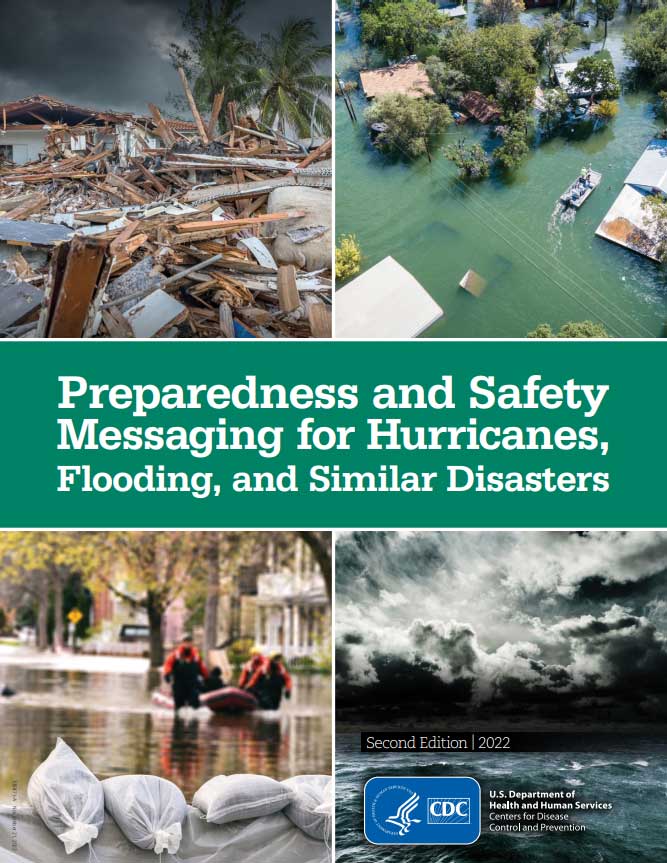
Preparedness and Safety Messaging for Hurricanes, Flooding, and Similar Disasters.
How to use this document
Public health and emergency management partners can add the key messages document as a resource to their communication plans that address hazards expected from extreme weather involving strong wind and high water. Partners can also use these messages to develop products with protective information for diverse audiences before, during, and after a hurricane, flood, or similar disaster.
On-demand virtual training
CDC is offering a continuing education eLearning course, "Preparedness and Safety Messaging for Hurricanes, Floods, and Similar Disasters Virtual Training." This training will help participants create and tailor public health disaster messages using CDC's messaging resources.
This free, on-demand virtual training teaches participants to use CDC's messaging resources for developing content across various communication channels, enhancing their knowledge and competency in Crisis and Emergency Risk Communication (CERC) practices. The training includes presentations and hands-on exercises to help participants create effective disaster messages. Upon completion, participants will be able to identify and apply CERC principles and adapt the Preparedness and Safety Messaging for Hurricanes, Flooding, and Similar Disasters (Second Edition | 2025) resource to tailor effective disaster messages for their communities. Continuing education credits are offered for the 30-minute virtual training. Register for the training via CDC TRAIN.
Training objectives
At the conclusion of the session, the participant should be able to:
- Identify key messages by topic within the Preparedness and Safety Messaging for Hurricanes, Floods, and Similar Disasters, Second Edition resource.
- Describe how to navigate the Preparedness and Safety Messaging for Hurricanes, Floods, and Similar Disasters, Second Edition to find topics for communication product development.
- Identify the six core Crisis and Emergency Risk Communication (CERC) principles.
- Describe the process for developing a communication product using the key messages document, using at least three different steps.
- Describe the importance of interprofessional collaboration in coordinating messages during an emergency response.
Intended audience
Administrators, Advanced Practice Nurses, Certified Health Educators, Epidemiologists, Laboratorians, Medical Assistants, Licensed Practical/Vocational Nurse (LPN/LVN), Other Health Educators, Pharmacists, Physicians (MD/DO), Physician Assistants (PA), Veterinarians, Data Entry Staff, Infection Preventionists.
Continuing education
Instructions for Obtaining Continuing Education (CE)
To receive continuing education (CE) for – WD4921-Preparedness and Safety Messaging for Hurricanes, Floods, and Similar Disasters Virtual Training please visit CDC TRAIN and search for the course in the Course Catalog using WD4921. Follow the steps below by September 26, 2027.
- Register for and complete the course.
- Pass the post-assessment at 80 %.
- Complete the evaluation at www.cdc.gov/GetCE.
- Visit Your Learning to access your certificates and transcript.
FEES: No fees are charged for CDC's CE activities.
Prerequisites
Participants should have prior knowledge of emergency response, recovery, Crisis and Emergency Risk Communication (CERC) principles, and a basic understanding of message and communication product development for an audience.
Faculty/Credentials
Bourey, Aimee
MHS, ScM, Environmental Health Communications Fellow, Oak Ridge Institute for Science and Education (ORISE)
Marshall, Janese
MPH, CHES, Crisis and Emergency Risk Communications Fellow, Oak Ridge Institute for Science and Education (ORISE)
Riera, Sabrina
MPH, Health Communications Specialist, CDC
Siegel, Vivi
MPH, Health Communications Specialist, CDC
Format
This activity is Web on Demand.
Contact information
Centers for Disease Control and Prevention (CDC)
National Center for Environmental Health (NCEH)
Office of Communication (OC)
Email: eocevent486@cdc.gov
Accreditation Statements

In support of improving patient care, The Centers for Disease Control and Prevention is jointly accredited by the Accreditation Council for Continuing Medical Education (ACCME), the Accreditation Council for Pharmacy Education (ACPE), and the American Nurses Credentialing Center (ANCC), to provide continuing education for the healthcare team.
CME: The Centers for Disease Control and Prevention designates this enduring activity for a maximum of 0.5 AMA PRA Category 1 Credits™. Physicians should claim only the credit commensurate with the extent of their participation in the activity.
AAPA CME: Credit Designation Statement – Enduring Materials
The Centers for Disease Control and Prevention has been authorized by the American Academy of PAs (AAPA) to award AAPA Category 1 CME credit for activities planned in accordance with AAPA CME Criteria. This activity is designated for 0.5 AAPA Category 1 CME credits. Approval is valid until 9/26/2027. PAs should only claim credit commensurate with the extent of their participation.
CNE: The Centers for Disease Control and Prevention designates this activity for 0.5 nursing contact hours.
CPE: The Centers for Disease Control and Prevention designated this knowledge-based event for pharmacists to receive 0.05 CEUs in pharmacy education. The Universal Activity Number is JA4008229-0000-25-069-H01-P.
After credit is claimed, an unofficial statement of credit is immediately available on CDC TRAIN. Official credit will be uploaded within 60 days on the NABP/CPE Monitor.
CEU: The Centers for Disease Control and Prevention is authorized by IACET to offer 0.1 CEU's for this program.
CECH: Sponsored by the Centers for Disease Control and Prevention, a designated provider of continuing education contact hours (CECH) in health education by the National Commission for Health Education Credentialing, Inc. This program is designated for Certified Health Education Specialists (CHES®) and/or Master Certified Health Education Specialists (MCHES®) to receive up to 0.5 total Category I continuing education contact hours. Maximum advanced level continuing education contact hours available are 0.5. Continuing Competency credits available are 0.5 CDC provider number 98614.
AAVSB/RACE: This program was reviewed and approved by AAVSB RACE program for 0.5 hours of continuing education. Participants should be aware that some boards have limitations on the number of hours accepted in certain categories or restrictions on certain methods of delivery of continuing education. Please contact the AAVSB RACE program if you have any comments or concerns regarding this program's validity or relevancy to the veterinary profession.
Disclosure
In compliance with continuing education requirements, all planners and presenters must disclose all financial relationships, in any amount, with ineligible companies during the previous 24 months as well as any use of unlabeled product(s) or products under investigational use.
- CDC, our planners, and content experts wish to disclose they have no financial relationship(s) with ineligible companies whose primary business is producing, marketing, selling, reselling, or distributing healthcare products used by or on patients.
- Content will not include any discussion of the unlabeled use of a product or a product under investigational use.
CDC did not accept financial or in-kind support from ineligible companies for this continuing education activity.
The Centers for Disease Control and Prevention (CDC) complies with applicable Federal civil rights laws and does not discriminate based on race, color, national origin, age, disability, religion, or sex. To learn more visit: https://www.hhs.gov/civil-rights/for-individuals/nondiscrimination/index.html.