



At a glance
Use this practice to monitor freshwater harmful algal blooms (HABs) and prevent toxin exposure. Rhode Island provided timely health advisories, which helped beach managers protect the public and reduce risks in recreational waterbodies.
Background
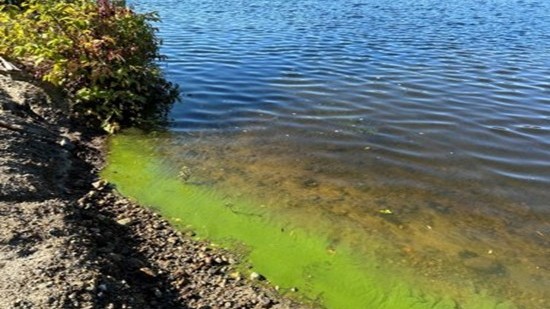
Rhode Island has 237 freshwater lakes, ponds, rivers, and beaches that residents and visitors swim, boat, fish, or play in. HABs, caused by cyanobacteria, are a growing environmental and public health concern in Rhode Island.
These blooms can produce toxins that can cause harmful health effects in both people and animals. Some common symptoms in people include stomach pain, rash, and headache. With certain blooms occurring more often, lasting longer because of warmer summer temperatures, and nutrient overloading from runoff, more people are at a higher risk. Rhode Island sought to monitor HABs and inform residents about them.
Key actions
The Rhode Island Department of Health addressed the need with routine freshwater HABs monitoring, timely public health advisories, and increased communication to protect community members throughout the state. They took the following key actions:
- Partnered with Rhode Island Department of Environmental Management to strengthen capacity to monitor and respond to HABs in inland recreational waters, including lakes, ponds, and reservoirs
- Prioritized monitoring freshwater bodies that have historically had blooms, as well as sites identified from public reports and environmental field observations
- Collected and tested water samples for cyanobacteria cell counts and cyanotoxin concentrations
- Issued public health advisories for identified blooms and recommended notices focusing on reducing recreational exposure
- Collaborated with local environmental organizations and trained volunteers to help expand monitoring coverage, increase early detection of blooms, and promote public reporting of suspected HABs
- Created a rapid-response notification process for when the lab identifies elevated cyanobacteria cell counts or toxin concentrations exceeding the U.S. Environmental Protection Agency's advisory thresholds
- The state health department notifies waterbody managers within one hour of obtaining lab results.
- Notifications include an interpretation of results, recommended public health actions, advisory signage, and a copy of a press release.
Using this practice
We selected this practice as an example of environmental public health successfully applied in the field. We based our selection on the following four domains:
- Effectiveness: Did it solve or help solve the environmental health problem?
- Feasibility: What conditions and resources are needed to use it?
- Sustainability: Is it realistically able to continue going forward?
- Transferability: Could other health departments use it with little to no changes?
Effectiveness
This practice reduced exposures to HABs in recreational waters through improved water quality monitoring efforts. The health department identified 50 freshwater beaches and sites for targeted monitoring.
By building relationships with partner organizations, the health department was able to monitor certain locations, more often, resulting in faster public health notifications and more daily waterbodies monitored and public health notifications sent.
Feasibility
Other health departments interested in this practice may need the following capacity:
- Infrastructure to build an internal database to store site information and water quality results
- Dedicated staff, interns, or trained volunteers to collect water samples at designated freshwater sites
- Field equipment specific to HABs, such as test strips and mobile analyzers
- A risk-based framework to prioritize sites and monitoring efforts to ensure timely assessments of potential health threats
- Skills in communicating and engaging with the community about HAB risks and advisories
Sustainability
Health departments can help sustain this practice through the following actions:
- Monitoring waterbodies with infrequent blooms less often
- Partnering with a laboratory with the capacity to analyze water samples for cyanobacteria cell counts and cyanotoxin concentrations
- Annually reviewing monitoring data and lab results and revising risk classification for sites and adjusting sampling plans as needed
- Using existing Geographic Information System (GIS) software and tools for mapping sampling locations
Transferability
Programs interested in this practice might want to consider the following factors:
- Scaling the number of sampling and monitoring activities in response to available resources
- Receiving training, such as from partner-led workshops and the U.S. Environmental Protection Agency
- Partnering with regional labs or contracted labs
Successes and challenges
- This practice resulted in the health department's ability to issue HABs advisories and public health notices more quickly.
- Program staff identified waterbodies suitable for volunteer-based monitoring. These lists were shared with partner organizations to guide surveillance efforts.
- Program staff updated site managers and partners with new monitoring data showing changes in HABs risk for sites.
- The health department was able to increase its monitoring efforts each year due to stronger partnerships and improved internal operational processes.
- The health department learned the importance of maintaining consistent HAB monitoring for public health protection. This was critical during spring and summer seasons, which have heavy recreational use of waterbodies.
Connections to Essential Services
Documenting how programs contribute to the Essential Public Health Services may help health departments in the accreditation process with the Public Health Accreditation Board. The activities in this practice support and align with these services:
- Assess and monitor (1)
- Investigate and address hazards (2)
- Educate (3)
- Strengthen communities and partnerships (4)
Resources
Rhode Island Departments of Health and Environmental Management
- Beach monitoring program (Rhode Island Department of Health)
- Cyanobacteria (blue-green algae (Rhode Island Department of Environmental Management, RIDEM)
- Harmful algal blooms (HABs) (RIDEM)
- RIDEM Freshwater cyanobacteria bloom dashboard (RIDEM)
CDC and partners
- Detecting and preventing exposure to harmful algal blooms in recreational waters: A quick guide for health departments and operators (National Association of County and City Health Officials)
- Harmful algal bloom communication resources (CDC)
- Harmful algal blooms (HABs) in water bodies (U.S. Environmental Protection Agency)
- Harmful algal blooms: Public health toolkit (CDC)
Citation
In citing this practice in articles, presentations, or elsewhere, we suggest the following citation:
Centers for Disease Control and Prevention. National Center for Environmental Health. Environmental Public Health Practices Gateway. Recreational harmful algal blooms monitoring: A practice from the Rhode Island Department of Health. U.S. Department of Health and Human Services, CDC, 2026, https://www.cdc.gov/environmental-health-practice/php/gateway/recreational-harmful-algal-blooms-monitoring.html.