



At a glance
Use this practice to make pool inspection data available to the public. Pueblo County, Colorado, used electronic reports, an online platform, and a QR code to educate people about public swimming pools.
Background
Colorado's Pueblo County Department of Environment and Health regulates 75 pools at 48 facilities. This includes 56 swimming pools, 14 spas, and five splash fountains. Their pool inspection program protects public health through regular inspections and educational guidance.
Swimming pool inspection reports allow agencies to issue timely warnings or advisories. However, the public and operators lacked easy access to reports. This created a barrier to their understanding and taking action on safety and sanitation issues.
Key actions
Pueblo County requires that pool inspection reports be displayed and readily available to the public. Sharing these reports online helps pool operators meet this regulatory requirement and helps the public make informed decisions about using the pools. The health department took the following key actions:
- Transitioned from paper to electronic reports
- Created an online platform with the inspection reports and a violation library to make data available to the public
- Created an easy-to-understand format for inspection reports to help the public understand a facility's strengths (such as posting safety messaging) and deficiencies (such as not maintaining proper pH)
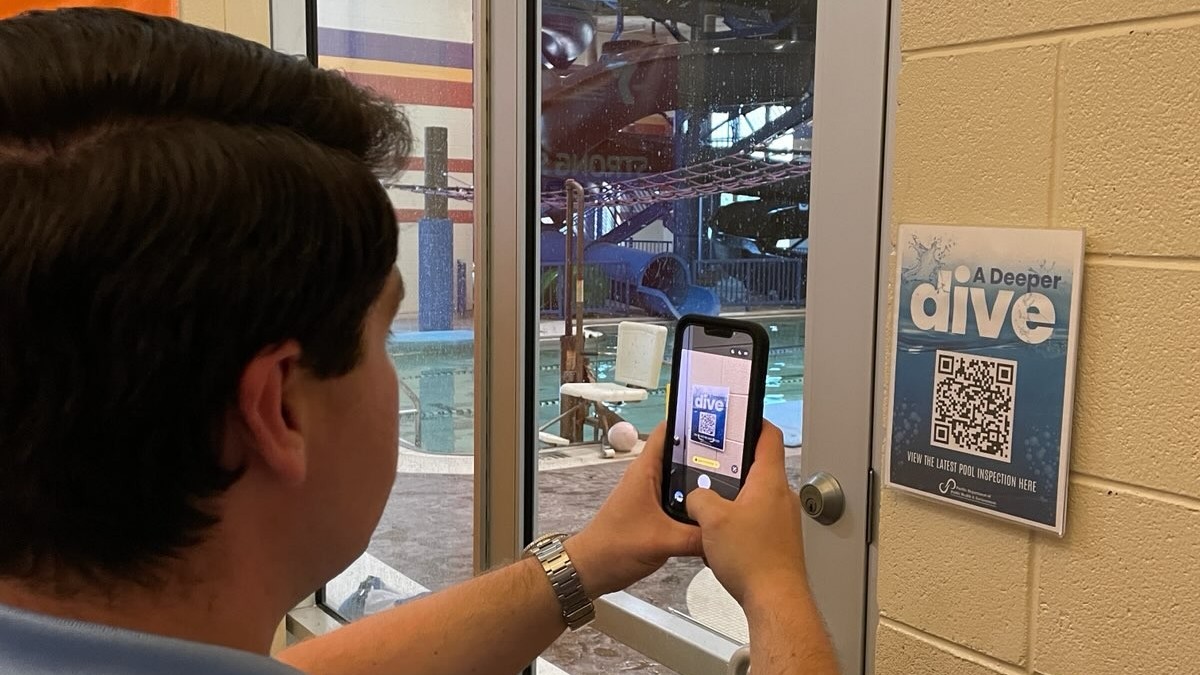
- Created a QR code for each pool, which was posted in that facility to provide easy, timely access to inspection reports
- Empowered the public to make evidence-based decisions on where to swim
Using this practice
We selected this practice as an example of environmental public health successfully applied in the field. We based our selection on the following four domains:
- Effectiveness: Did it solve or help solve the environmental health problem?
- Feasibility: What conditions and resources are needed to use it?
- Sustainability: Is it realistically able to continue going forward?
- Transferability: Could other health departments use it with little to no changes?
Effectiveness
- The online platform increased public access to and use of inspection reports (over 300 views).
- The QR codes provided a more direct, timely, and user-friendly way for swimmers to access inspection results.
- The practice resulted in 100% compliance with health department requirements that inspection results be posted at facilities and readily available for patron viewing.
- This practice helped empower the public to use inspection data, including information on potential health hazards, to decide where to swim.
Feasibility
Other health departments interested in this practice may need the following capacity:
- Infrastructure to build an internal database of aquatic facility site information and inspection results (could involve using an external development company to create and code the system)
- Trained staff dedicated to inspecting aquatic facilities
- Field equipment and test kits analyze on-site water quality during pool inspections
- Internal recreational water and information technology expertise and an established partnership with a software company specializing in public health inspections
- Leadership support for transparency with the public and partners regarding program results and outcomes, and for using inspection data to identify trends, needs, and gaps
- Software and associated service fees for electronic inspection field tools, web visualization, and reporting
- Skills in communicating and engaging with pool operators about swimming-related risks, advisories, and corrective actions
Sustainability
- Programs already using an electronic inspection and reporting system may find the practice easier to sustain.
- For health departments without such a program, partnering with a software company specializing in public health inspection software could help develop and maintain this practice.
- The health department received external funding to support this practice. Software, IT costs, and dedicated staff time represent ongoing costs.
Transferability
Health departments already using electronic inspection and reporting platforms can likely create an online customer portal to display reports for less cost and staff time than a department starting from scratch.
Programs interested in this practice might want to consider the following factors:
- Number of public pool facilities in their jurisdiction
- Current pool program practices, including inspection frequency, data collection and accessibility, and corrective actions
- Scaling the number of inspection activities to available resources, needs, and legal requirements
- Software licenses for pool inspectors, administrative support staff, and managers, as well as ongoing maintenance costs
Successes and challenges
- The health department was able to use the practice to make pool inspection data easier for the public to access.
- QR codes were easy to create internally at little to no cost.
- In the first four months of the 2025 swim season, the public used the QR codes 342 times to visit the online platform.
- Access to pool inspection data made the program more transparent and visible among pool operators and the public.
- Availability of past inspection reports (and violations) incentivized operators to address identified deficiencies and proactively prevent violations.
- As a result of the practice, 100% of facilities became compliant with conspicuously posting inspection reports at their entrances.
- The health department obtained a new way to increase and measure public viewing of inspection findings.
Connections to Essential Services
Documenting how programs contribute to the Essential Public Health Services may help health departments in the accreditation process with the Public Health Accreditation Board. The activities in this practice support and align with these services:
- Investigate and address hazards (2)
- Educate (3)
- Improve or innovate (9)
Resources
Pueblo County Department of Public Health and Environment
- Imminent health hazards sign
- Inspector checklist for lifeguard facilities
- Inspector checklist for non-lifeguard facilities
- Operator daily inspection items
- Recreational water inspection report
- Safety equipment checklist for lifeguard facilities
- Safety equipment checklist for non-lifeguard facilities
CDC
- Aquatics professionals toolkit
- Healthy swimming communication resources
- MAHC tools and training
- Pool inspection toolkit
Citation
In citing this practice in articles, presentations, or elsewhere, we suggest the following citation:
Centers for Disease Control and Prevention. National Center for Environmental Health. Environmental Public Health Practices Gateway. Availability of pool inspection findings: A practice from the Pueblo County Department of Environment and Health, Colorado. U.S. Department of Health and Human Services, CDC, 2026, https://www.cdc.gov/environmental-health-practice/php/gateway/availability-of-pool-inspection-findings.html.