



Key points
- Facilities make screening decisions based on factors like patient exposure and local epidemiology.
- CDC recommends using a composite skin swab of the armpit and groin to screen for C. auris.
- Follow label and shipping instructions and send swabs to a testing laboratory immediately.
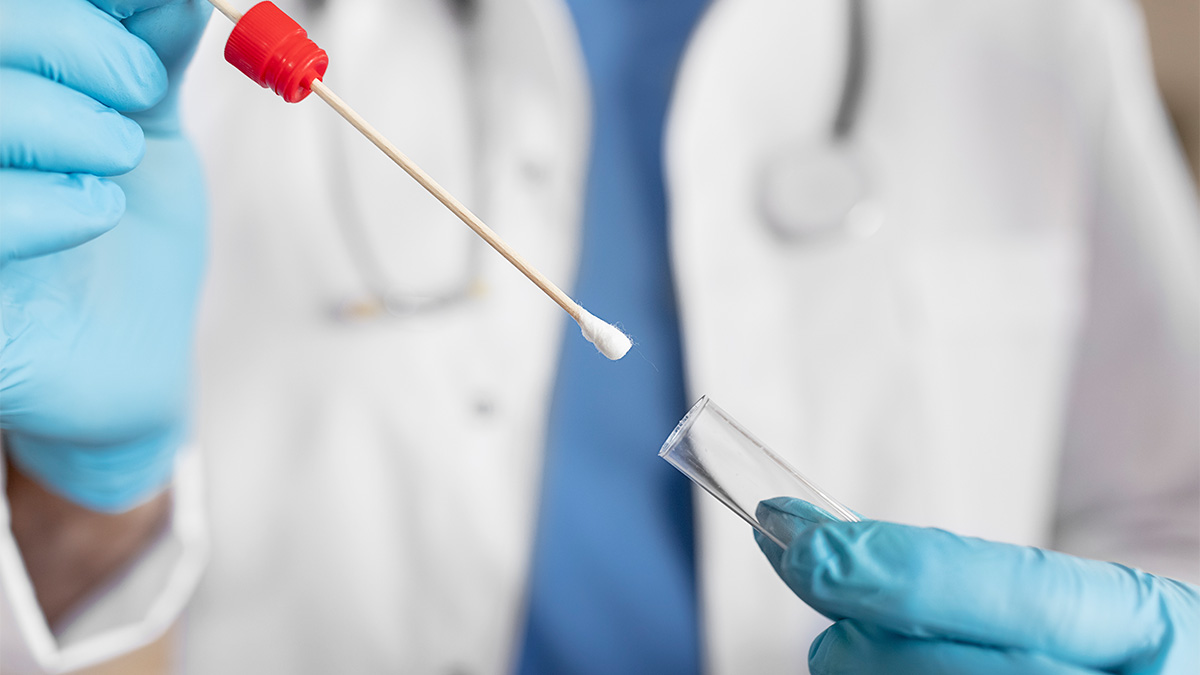
Use of swabs for screening
Importance of screening patients
CDC recommends using a composite swab of the patient's axilla (armpit) and groin (one swab is used to swab both areas). C. auris has also been isolated from the oropharynx, nares (nostril), external ear canal, hand, vagina, and rectum. Recent data suggest that screening at body sites such as the nares and palms may offer benefits such as more consistent results over time in patients known to be colonized. 12345 Screening methods should be selected based on laboratory availability and implementation logistics.
Facilities determine screening approaches in collaboration with local public health departments based on factors such as potential patient exposure and level of C. auris spread in the area or facility.
Culture collection and transport system
Patient swabs are taken using a culture collection and transport system. One example is the Nylon-flocked swab (BD ESwab collection and transport system; Becton Dickinson and Company, Sparks, MD).A
Procedure for collecting swabs
- Open swab package by grasping plastic at opposite end from the soft tip. Leave swab tip enclosed in the package to prevent contamination.
- Carefully remove tube from its packaging without touching the soft tip. Use the same swab to:
- Swipe all sides of swab tip back and forth 5 times over left axilla skin surface. Target the crease where the arm meets the body. Repeat on the right.
- Swipe all sides of swab tip back and forth 5 times over left groin skin surface (inguinal crease in the skin where the leg meets the pelvic region). Repeat on the right.
- Remove cap from swab collection tube and place soft end of collection swab into the tube. Prevent cap from touching any materials to avoid contamination.
- Snap off end of the swab at the marked line on plastic handle by bending it against the edge of the transport media.
- Screw on tube cap, adjusting until snapped end of the swab slides into place in the center of cap.
- Follow specific product instructions for labeling, packing, and shipping specimen.
- Send or ship immediately to a testing laboratory.B
Specimens can be submitted and tested through CDC's AR Lab Network.
This page was last updated on this date. Updates may include minor edits, image changes, or other modifications to page content.
The information on this page was last reviewed by subject matter experts to ensure accuracy.
- Mention of a specific commercial product does not qualify as an endorsement of the product by CDC.
- This test has not been cleared or approved by the FDA. The performance characteristics have been established by CDC Mycotic Diseases Laboratory.
- Hayden, M. K., Dangana, T. E., Yelin, R. D., Schoeny, M., Bell, P. B., II, Stanley, M., Preite, N., Khan, N., Edomwande, O., Black, S. R., Pacilli, M., Huang, X., Deming, C., Lin, M. Y., & Segre, J. A. (2019). 897. Prevalence of Candida auris at body sites, characterization of skin microbiota, and relation of chlorhexidine gluconate (CHG) skin concentration to C. auris detection among patients at a high-prevalence ventilator-capable skilled nursing facility (vSNF) with established CHG bathing. Open Forum Infectious Diseases, 6 (Suppl 2), S25–S26. https://doi.org/10.1093/ofid/ofz359.056
- López, L. F., Arenas, S., Jimenez, A., Ferreira, T. B. D., Parekh, D. J., Bracho Rincon, O., Farinas, M., Lyman, M., Litvintseva, A. P., Shukla, B. S., & Sexton, D. J. (2025). Improved consistency of Candida auris colonization screening with an anterior nares and hands composite sample. Clinical Infectious Diseases, 81(6), e523–e530. https://doi.org/10.1093/cid/ciaf365
- Proctor, D. M., Dangana, T., Sexton, D. J., Fukuda, C., Yelin, R. D., Stanley, M., Bell, P. B., Baskaran, S., Deming, C., Chen, Q., Conlan, S., Park, M., NISC Comparative Sequencing Program, Welsh, R. M., Vallabhaneni, S., Chiller, T., Forsberg, K., Black, S. R., Pacilli, M., . . . Hayden, M. K. (2021). Integrated genomic, epidemiologic investigation of Candida auris skin colonization in a skilled nursing facility. Nature Medicine, 27(8), 1401–1409. https://doi.org/10.1038/s41591-021-01383-w
- Sansom, S. E., Gussin, G. M., Schoeny, M., Singh, R. D., Adil, H., Bell, P., Benson, E. C., Bittencourt, C. E., Black, S., Villanueva Guzman, M. D. M., Froilan, M. C., Fukuda, C., Barsegyan, K., Gough, E., Lyman, M., Makhija, J., Marron, S., Mikhail, L., Noble-Wang, J., . . . Hayden, M. K. (2024). Rapid environmental contamination with Candida auris and multidrug-resistant bacterial pathogens near colonized patients. Clinical Infectious Diseases, 78(5), 1276–1284. https://doi.org/10.1093/cid/ciad752
- Zhu, Y., O'Brien, B., Leach, L., Clarke, A., Bates, M., Adams, E., Ostrowsky, B., Quinn, M., Dufort, E., Southwick, K., Erazo, R., Haley, V. B., Bucher, C., Chaturvedi, V., Limberger, R. J., Blog, D., Lutterloh, E., & Chaturvedi, S. (2020). Laboratory analysis of an outbreak of Candida auris in New York from 2016 to 2018: Impact and lessons learned. Journal of Clinical Microbiology, 58(4), e01503-19. https://doi.org/10.1128/JCM.01503-19