



At a glance
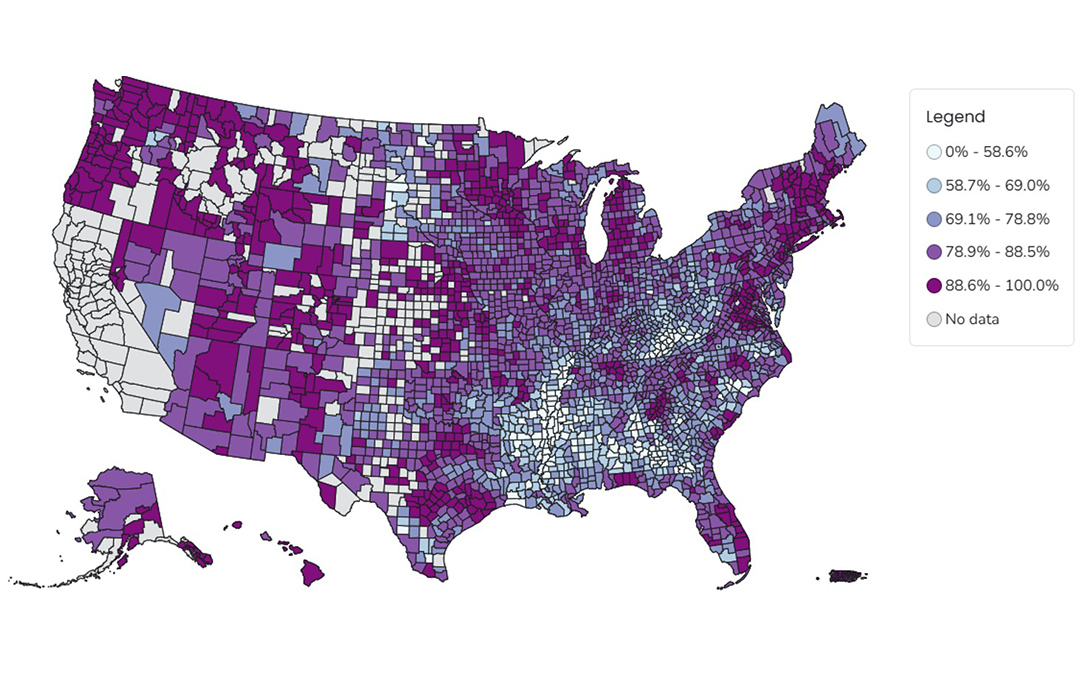
Breastfeeding initiation rates by county
Breastfeeding initiation rates by county varied widely within states and ranged from 24% to 100% across the nation. The tables and maps on Data, Trends, and Maps present National Vital Statistics System data from 3,167 counties or county equivalents in 49 states, the District of Columbia, Puerto Rico, Guam, American Samoa, the U.S. Virgin Islands, and the Commonwealth of the Northern Mariana Islands. For states and territories that were included, data from 2023 through 2024 were used, except for American Samoa, which only had data available for 2024.
These rates can be used to celebrate where breastfeeding initiation rates are high and to identify locations that might benefit from focused interventions. Community-level strategies to support breastfeeding can focus on populations facing barriers that lead to low breastfeeding rates.
View the full county level details.
Information being collected
Birth certificate data from 2023 through 2024 National Vital Statistics System were used to determine the percentage of infants who initiated breastfeeding. Breastfeeding initiation was defined as receiving any breast milk or colostrum between delivery and discharge from the birth facility or birth certificate completion for home births. These rates are available by county or county equivalent (e.g., independent cities, parishes, boroughs) of the mother's residence.
How and when data are collected
Birth certificate data are collected from information the mother provides and medical records from delivery through discharge from the birth facility or birth certificate completion for home births.
Who is included in these data
All infants born during 2023 or 2024 were included except infants who:
- Were transferred to another facility within 24 hours of delivery.
- Died before birth certificate completion.
- Were missing breastfeeding initiation data.
- Were born to foreign residents.
- Were born to residents of or born in California.
Why some data are not shown
Birth certificate breastfeeding initiation data were not available for California.
In addition, to prevent identification of individuals:
- For counties or county equivalents that reported less than 100 births:
- Data are not shown if 1–9 infants initiated breastfeeding.
- Data are not shown if 1–9 infants did not initiate breastfeeding.
- For counties or county equivalents that reported 100 or more births:
- Data are not shown if 1–9 infants initiated breastfeeding.
- Data are shown as "≥90%" instead of the exact value if 1–9 infants did not initiate breastfeeding.
How counties or county equivalents are categorized on the maps
They are categorized by quintiles of breastfeeding initiation.
How can I find more data on breastfeeding practices
In addition to reporting data on breastfeeding initiation from birth certificates, CDC also reports data on many breastfeeding practices in the United States using the National Immunization Survey-Child (NIS-Child). The two data sources have several differences. Birth certificate data include all infants born and only measure breastfeeding initiation. NIS-Child data measure ever breastfeeding, duration, and exclusivity. These data are collected by cell phone among a nationally representative sample of people with children aged 19 to 35 months. Each NIS-Child survey year represents children born over 3 years. CDC reports breastfeeding based on birth year.
This page was last updated on this date. Updates may include minor edits, image changes, or other modifications to page content.
The information on this page was last reviewed by subject matter experts to ensure accuracy.