



At a glance
Overview
The Dietary Guidelines for Americans, American Academy of Pediatrics, and the World Health Organization recommend exclusive breastfeeding for about the first 6 months. They also recommend introducing appropriate complementary foods around 6 months of age while continuing to breastfeed until children are 2 years or older.
Most infants receive some breast milk. However, most infants are not exclusively breastfed or continue to breastfeed as long as recommended.
Healthy People 2030 breastfeeding objectives*
| Exclusively through 6 months. |
• Baseline - 24.9%† • Target - 42.4%* |
|---|---|
| At 1 year. |
• Baseline - 35.9%† • Target - 54.1%* |
*Healthy People 2030 Breastfeeding Objectives
†Baseline rates represent infants born in 2015, National Immunization Survey – Child.
Key breastfeeding indicators for infants born in 2023
Key breastfeeding indicators and current rates
| Ever.* | 86.1% |
|---|---|
| At 6 months.* | 62.8% |
| At 1 year.* | 40.8% |
| Exclusively through 3 months.* | 48.5% |
| Exclusively through 6 months.* | 29.8% |
| Receive formula supplementation within the first 2 days of life.* | 22.6% |
*Current rates represent infants born in 2023, National Immunization Survey – Child 2024–2025.
Rates of breastfeeding vary across states and regions
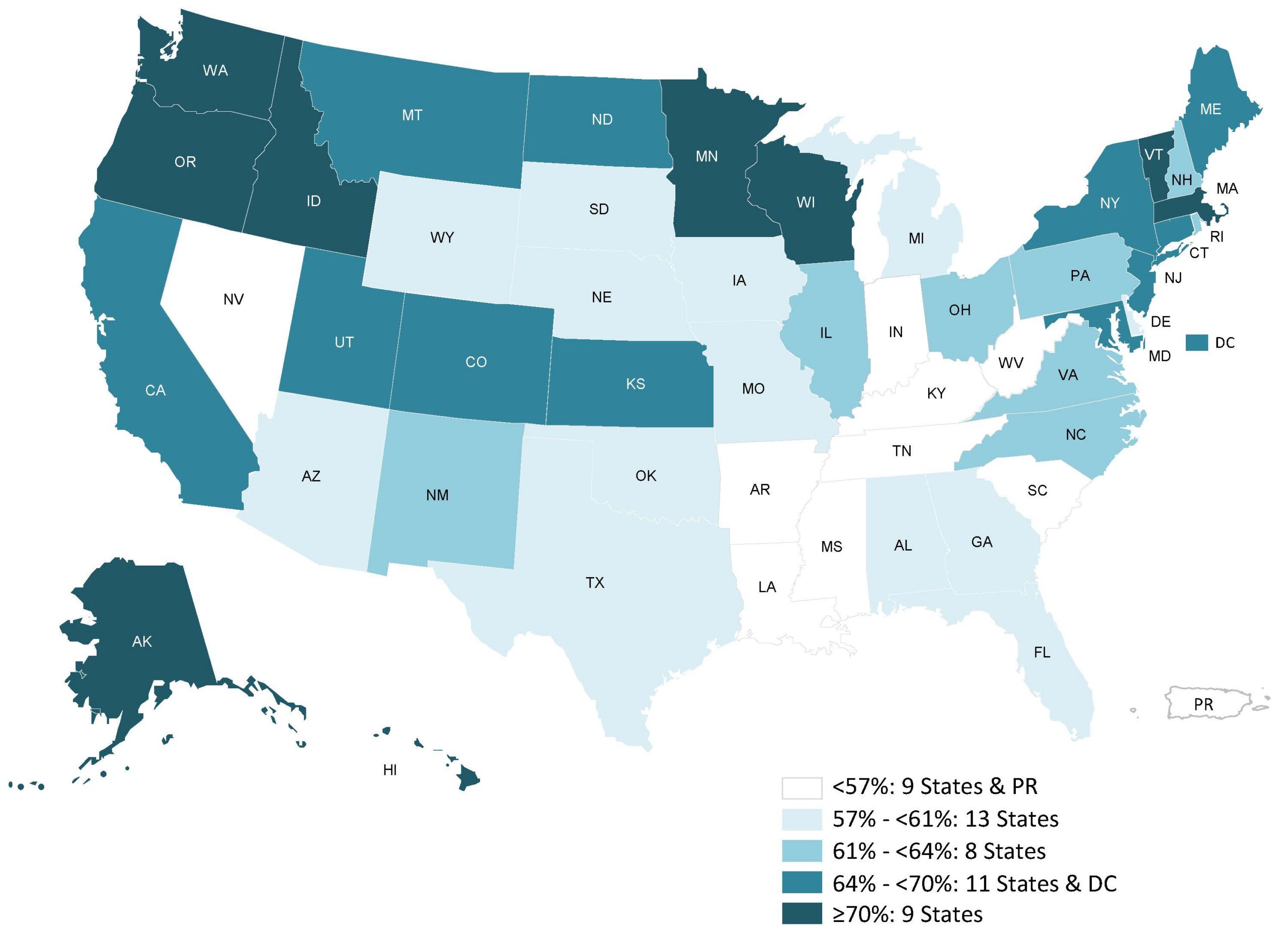
- Infants living in the Southeast United States are less likely to be breastfed at 6 months than infants living in other areas of the country (map below).1
- Infants in non-metropolitan areas are less likely to ever breastfeed than infants living in metropolitan areas.1
- For state-by-state breastfeeding rates, please visit the National and State Breastfeeding Rates: Data Results page. Historic data are also available in the Division of Nutrition, Physical Activity, and Obesity’s online Data, Trends, and Maps database.
Percentage of infants breastfed at 6 months
Breastfeeding disparities exist
- Fewer non-Hispanic Black infants (79.4%) are ever breastfed compared with non-Hispanic Asian infants (91.0%), non-Hispanic White infants (88.2%) and Hispanic infants (85.6%).1
- Infants receiving the Special Supplemental Nutrition Program for Women, Infants, and Children (WIC) are less likely to ever be breastfed (80.4%) than infants eligible, but not receiving WIC (86.6%), and infants ineligible for WIC (92.6%).1
- Younger mothers aged 20 to 29 years are less likely to ever breastfeed (83.9%) than mothers aged 30 years or older (87.5%).1
Why mothers stop breastfeeding early
Sixty percent of mothers do not breastfeed for as long as they intend.2 How long a mother breastfeeds her baby is influenced by many factors, including:
What you can do to support breastfeeding
State and local organizations can support breastfeeding by implementing organizational policies, systems, and environmental solutions. To learn more, visit:
What is being done to improve rates
Breastfeeding is important for the health of mothers and babies. CDC supports continuity of care in breastfeeding support through hospital initiatives, work site accommodation, and community support initiatives.
This page was last updated on this date. Updates may include minor edits, image changes, or other modifications to page content.
The information on this page was last reviewed by subject matter experts to ensure accuracy.
- Centers for Disease Control and Prevention. National Immunization Survey-Child (NIS-Child) website. Accessed April 16, 2026.
- Odom EC, Li R, Scanlon KS, Perrine CG, Grummer-Strawn L. Reasons for earlier than desired cessation of breastfeeding. Pediatrics. 2013;131(3):e726–732.
- Sriraman NK, Kellams A. Breastfeeding: What are the barriers? Why women struggle to achieve their goals. J Womens Health (Larchmt). 2016;25(7):714–722.
- Feltner C, Weber RP, Stuebe A, Grodensky CA, Orr C, Viswanathan M. Breastfeeding Programs and Policies, Breastfeeding Uptake, and Maternal Health Outcomes in Developed Countries. Agency for Healthcare Research and Quality (US); July 2018.