Skip directly to search Skip directly to A to Z list Skip directly to navigation Skip directly to site content Skip directly to page options
CDC Home

Diagnosis of Cyclosporiasis

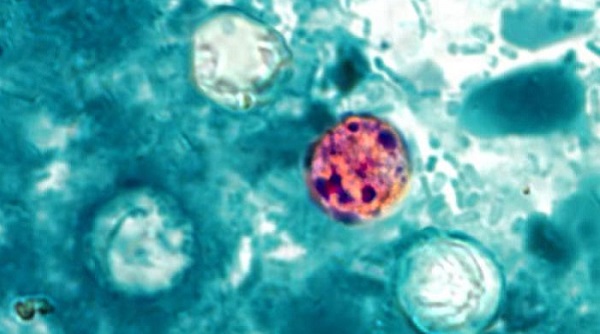
An image of Ultraviolet fluorescence microscopy.

Ultraviolet fluorescence microscopy is one method of examining stool specimens for Cyclospora oocysts. The oocyst wall is autofluorescent.

Health care providers should consider Cyclospora as a potential cause of prolonged diarrheal illness, particularly in patients with a history of recent travel to areas where the disease is endemic. Tests for Cyclospora are not routinely done in most laboratories, so health care providers need to specifically request testing for this parasitic infection.

Cyclospora infection is diagnosed by examination of stool specimens.
Diagnosis can be difficult because even persons experiencing symptoms may not "shed" enough oocysts in their stool to be readily detectable in laboratory tests. Therefore, patients may be asked to submit several stool samples over several days.

Microscopic methods for diagnosis involve looking for the parasite in stool under the microscope. Staining techniques, such as acid-fast staining, are often used to make Cyclospora oocysts more visible under the microscope. In addition, Cyclospora oocysts are autofluorescent, meaning that when stool containing oocysts is viewed under an ultraviolet (UV) microscope the oocysts appear blue or green (see image above) against a black background. Molecular diagnostic methods, such as the polymerase chain reaction (PCR), are used to look for the parasite’s DNA in the stool.

Additional perspective about laboratory testing for Cyclospora

  • Cyclospora oocysts are easily overlooked; low-level shedding (~1-2 logs lower than for Cryptosporidium species) is common. To maximize recovery of Cyclospora oocysts, first concentrate the stool specimen—such as by the formalin-ethyl acetate technique (centrifuge for 10 minutes at 500 x g)—and then examine a wet mount and/or a stained slide of the sediment.
  • Cyclospora oocysts are ~8-10 micrometers in diameter (in contrast, Cryptosporidium parvum/hominis oocysts are ~4-6 micrometers in diameter).
  • Ultraviolet fluorescence microscopy (UV excitation filter set at 330-365 nm or 450-490 nm) is a sensitive technique for rapidly examining stool sediments for Cyclospora oocysts, which stand out because they autofluoresce (Cryptosporidium parvum/hominis oocysts do not). If suspect Cyclospora oocysts are found, bright-field, phase contrast, or differential interference contrast microscopy can then be used to confirm that the structures have the characteristic morphologic features of Cyclospora oocysts (i.e., are nonrefractile spheres that contain undifferentiated cytoplasm or refractile globules).
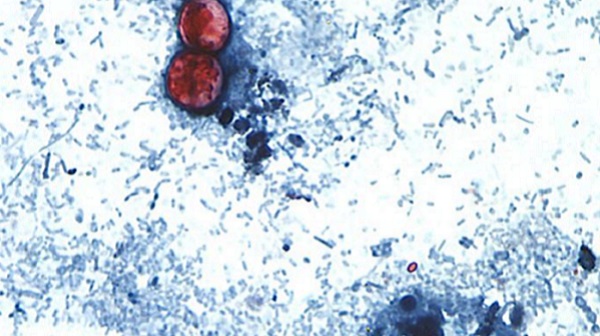
  • On a modified acid-fast—stained slide of stool, Cyclospora oocysts typically are variably acid fast (i.e., in the same field, oocysts may be unstained or stain from light pink to deep red). Unstained oocysts characteristically have a wrinkled (hyaline) appearance.
  • If a "hot" modified safranin technique is used, Cyclospora oocysts uniformly stain a brilliant reddish orange.

More on: Laboratory Methods

 
Contact Us:
  • Centers for Disease Control and Prevention
    1600 Clifton Rd
    Atlanta, GA 30333
  • General public:
  • 1-800-CDC-INFO (1-800-232-4636)
  • cdcinfo@cdc.gov
  • Health care professionals:
  • 1-404-718-4745 (M-F 7:30am-4pm EST)
  • After-hours emergencies: 1-770-488-7100
  • parasites@cdc.gov
  • Page last reviewed: November 2, 2010
  • Page last updated: November 2, 2010
  • Content source: Global Health - Division of Parasitic Diseases and Malaria
  • Notice: Linking to a non-federal site does not constitute an endorsement by HHS, CDC or any of its employees of the sponsors or the information and products presented on the site.
USA.gov: The U.S. Government's Official Web PortalDepartment of Health and Human Services
Centers for Disease Control and Prevention   1600 Clifton Rd. Atlanta, GA 30333, USA
800-CDC-INFO (800-232-4636) TTY: (888) 232-6348 - cdcinfo@cdc.gov
A-Z Index
  1. A
  2. B
  3. C
  4. D
  5. E
  6. F
  7. G
  8. H
  9. I
  10. J
  11. K
  12. L
  13. M
  14. N
  15. O
  16. P
  17. Q
  18. R
  19. S
  20. T
  21. U
  22. V
  23. W
  24. X
  25. Y
  26. Z
  27. #