The NIOSH Office of Compensation Analysis and Support (OCAS) conducts activities
to assist claimants and support the role of the Secretary
of Health and Human Services under the Energy Employees
Occupational Illness Compensation Program Act of 2000
(The Act).
Our Web site changes frequently as we update and add new information.
We encourage you to use the "refresh" or "reload" feature on your Web
browser to ensure that you are viewing the current version of our Web
site.
FAQ for November
Each month we will be featuring a FAQ that captures comments and concerns that we sometimes receive from claimants. Additional FAQs on a variety of topics similar to the one listed below can be found on our Frequently Asked Questions (FAQs) page.
- Does NIOSH determine/calculate the percent that determines the compensability of a claim?
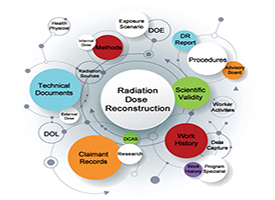
No. NIOSH reconstructs a worker's radiation dose and determines a final estimate of the worker's exposure to radiation. The results from a worker's dose reconstruction are sent to the Department of Labor (DOL). DOL determines the probability of causation - the likelihood that the worker's cancer was related to radiation exposure received while employed at a covered facility.
Top of Page
OCAS News
NIOSH has released the following two press releases:
- NIOSH UPDATE: NIOSH Honors National Day of Remembrance for America's Cold War Nuclear Workers
October 29, 2009; For more information regarding this update, please contact: Fred Blosser, (202) 245-0645.
The National Institute for Occupational Safety and Health (NIOSH) today invited its partners, stakeholders, and the public to join in honoring the National Day of Remembrance, Oct. 30, 2009, for the U.S. uranium and nuclear weapons workers who served their country during the Cold War Era.
The National Day of Remembrance was designated under U.S. Senate Resolution 151. The Resolution honors the men and women who built America's nuclear defense capability after World War II.
The Senate Resolution cites the service rendered by the nuclear weapons workers: "Whereas these dedicated American workers paid a high price for their service and have developed disabling or fatal illnesses as a result of exposure to beryllium, ionizing radiation, toxic substances, and other hazards that are unique to the production and testing of nuclear weapons; Whereas these workers were put at individual risk without their knowledge and consent in order to develop a nuclear weapons program for the benefit of all American citizens; Whereas these patriotic men and women deserve to be recognized for their contribution, service, and sacrifice towards the defense of our great Nation."
NIOSH conducts scientific and technical support under the Energy Employees Occupational Illness Compensation Program Act. The Act established a program of federal compensation for former nuclear weapons workers who suffered job-related cancer as a result of exposures to radiation during their employment.
"The National Day of Remembrance reminds us of the pivotal role that thousands of men and women, all across the United States, played in our national defense after World War II," said NIOSH Director John Howard, M.D. "We join with our fellow citizens to honor these Cold War heroes on the National Day of Remembrance, and we also take this opportunity to rededicate ourselves to our duties under the Energy Employees Occupational Illness Compensation Program Act."
- NIOSH UPDATE: NIOSH Announces Intention to Review Scientific, Administrative Issues Pertaining to EEOICPA Program Responsibilities
October 29, 2009; For more information regarding this update, please contact: Fred Blosser, (202) 245-0645.
The National Institute for Occupational Safety and Health (NIOSH) today announced new developments pertaining to its program of scientific and technical support under the Energy Employees Occupational Illness Compensation Program Act.
Enacted in 2000, the Energy Employees Occupational Illness Compensation Program Act (EEOICPA) established a program of federal compensation for former nuclear weapons workers who suffered job-related cancer as a result of exposures to radiation during their employment.
"As the tenth anniversary of the Act approaches, it is an appropriate time to evaluate our progress in carrying out our responsibilities under the Act, and to evaluate how we are poised to meet ongoing and potential future needs," said NIOSH Director John Howard, M.D.
NIOSH will:
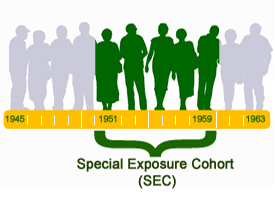
- Begin a scientific and administrative review of its responsibilities under the Energy Employees Occupational Illness Compensation Program Act. This review will include an evaluation of the performance of the three regulations adopted by the Institute to carry out the purposes of the Act; the scientific issues that have arisen during the past 10 years that have impacted the process for dose reconstruction for claimants, as well as those that have impacted the process for adding new members to the Special Exposure Cohort established by Congress under the Act; the administrative processes designed by NIOSH to carry out responsibilities under the Act; and other issues that have been brought to the attention of NIOSH by stakeholders of the Program.
- Initiate a national search for a new director of the NIOSH Office of Compensation Analysis and Support (OCAS), which administers
NIOSH's duties under the Act. Stuart Hinnefeld, Technical Program Manager in the NIOSH Office of Compensation Analysis and Support (OCAS), will
assume the duties of interim OCAS director effective Nov. 2, 2009, pending the selection of a new permanent director. He succeeds Larry Elliott,
who will serve in a new role as a NIOSH Associate Director with responsibilities for several high-priority projects, including projects related to
plans for combining NIOSH's Cincinnati, Ohio, laboratories, as well as additional duties pertaining to Institute-wide activities.
"I want to express my appreciation to Larry Elliott for his leadership over the past nine years as the founding director of OCAS," Dr. Howard said. "Larry established the NIOSH Radiation Dose Reconstruction Program, ensured state-of-the-art facilities for the Program, oversaw the important work of several contractors, developed and implemented the three Program regulations, fairly administered a staff of outstanding health physicists and other technical experts in OCAS, worked collaboratively with the Departments of Labor and Energy and the many stakeholders of the Program, made numerous outstanding presentations on behalf of the Program, and processed more than 30,000 Part B cases received from the U.S. Department of Labor since the Program's inception."
Dr. Howard added, "Larry carried out those duties with great dedication and skill, and his abilities will serve us well in addressing the challenges that we face as we plan for NIOSH's future. I also look forward to working with Stu as he follows Larry as the interim director of OCAS pending a national search for a new permanent director."
Top of Page
About Our Web Site
OCAS expects a wide variety of people to visit this Web
site. Therefore, we have included as much information
as possible on OCAS, our activities, and The Act. If you
have any questions or problems finding the information
you need, please contact us at 513-533-6800 (toll-free
at 1-877-222-7570) or by email at ocas@cdc.gov.
Our Web site changes frequently as we update and add new information. We encourage you to use the "refresh" or "reload" feature on your Web browser to ensure that you are viewing the current version of our Web site.
If you would like to receive email messages notifying you of when an update to our Web site has occurred, please email us at ocaswebupdates@cdc.gov with your request.
Top of Page
This Web site was last updated on Monday, November 23, 2009.
List of the specific items included in the update.
Page last updated: November 23, 2009
Page last reviewed: June 9, 2009
Content Source: National Institute for Occupational Safety and Health (NIOSH)
|