



About
This tip sheet outlines considerations for incorporating rural-urban variables into public health studies. As interest in understanding geographic health gaps grows, it is important that scientists move beyond simplistic rural-urban dichotomies and adopt more nuanced, contextually appropriate approaches.
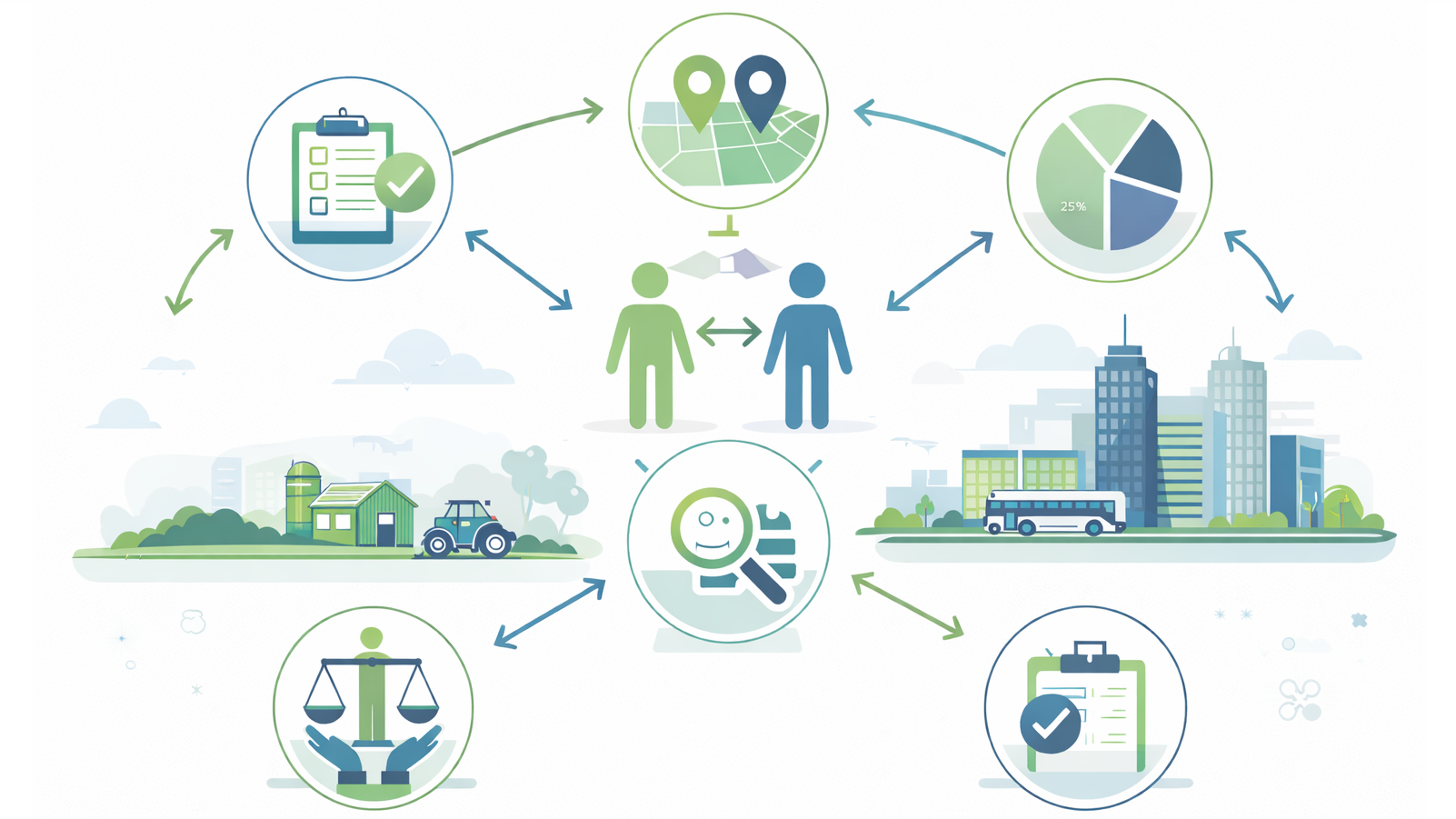
Overview
This resource highlights useful practices and provides practical tips to support the development of robust studies reflecting the diversity and complexity of rural communities across the United States. These considerations apply across topic areas and span a wide range of public health domains, including chronic disease surveillance, injury prevention, maternal and child health, environmental and occupational exposures, and emerging health threats.
Public health researchers can use this information as a reference when designing studies, conducting stratified analyses, reporting findings, and engaging rural stakeholders. The thoughtful application of these principles will strengthen the quality, relevance, and utility of rural health analyses and help advance health promotion in all communities, both urban and rural.
Why This Matters
How rural–urban variables are defined and applied directly affects the validity and usefulness of public health findings. Rural communities are diverse and relying on simplistic rural–urban dichotomies can mask variation, misclassify populations, and lead to incomplete or misleading conclusions.
Using fit-for-purpose, well-documented rural–urban measures improve analytic precision, interpretability, and comparability across studies. Thoughtful application of these approaches helps ensure rural populations are accurately represented in public health research and that findings can meaningfully inform decision-making, resource allocation, and effective interventions.
Considerations
1. Avoid Rural-Urban Dichotomies
Do not limit your analysis to a binary rural vs. urban distinction. Rural communities are diverse and exist on a continuum of geographic, economic, and healthcare access characteristics1.
2. Select the Right Classification Scheme
Assess which rural-urban classification system best fits your best fits your study (e.g., research question(s), data availability, and geographic scale), data availability, and geographic scale. Commonly used schemes include:
- NCHS Urban–Rural Classification Scheme for Counties 2– ideal for national mortality and surveillance data
- RUCA codes (Rural-Urban Commuting Area) 3– appropriate for ZIP code-level or sub-county analysis
- OMB Metropolitan/Nonmetropolitan definitions 4– suitable for policy-level or economic analyses.
3. Be Transparent About Geographic Scale and Resolution
Be sure to specify the geographic unit used in your analysis (e.g., county, ZIP code, census tract), as this can affect how rural–urban differences are interpreted. For example, using county-level data might hide important differences within a county, especially if it includes both rural and urban areas5.
4. Examine Rural-Specific Trends and Contexts
When possible, conduct stratified analyses or rural-specific deep dives to avoid generalizations that may obscure rural differences. Contextualize findings within rural-specific challenges such as workforce shortages, broadband gaps, or regional economies.
5. Consider Region-Rurality Interactions
Explore whether regional effects (e.g., South, Midwest) interact with rurality, as rural areas are not the same across the US. Including interaction terms or stratified models may yield more insights.
6. Report Limitations in Cross-Scheme Comparisons
If using more than one dataset with different rural–urban definitions, note the differences and interpret results carefully. Using inconsistent definitions can lead to confusion or misleading conclusions.
7. Use Visual Tools to Communicate Rurality
Leverage maps, infographics, and stratified charts can visually convey how outcomes vary by degrees of rurality6. For example, a bar chart stratified by rural–urban continuum (4 categories) and segmented by U.S. Census region can clearly show how health outcomes differ by degree of rurality and geographic region. This helps target audiences grasp the complexity of rural health.
8. Engage Rural Stakeholders in Interpretation
Collaborate with the CDC Office of Rural Health, state and local partners, rural health associations, and community stakeholders to ensure your interpretations reflect real-world conditions. This enhances the accuracy, relevance, and impact of your findings and promotes responsible use of data that avoids reinforcing stereotypes or overlooking rural strengths.
Key Takeaways
- Rural is not a binary. Rural–urban differences exist along a continuum, and using nuanced classifications leads to more accurate and meaningful analyses.
- Fit-for-purpose matters. Rural–urban classification schemes should be selected based on the research question, data source, and geographic scale.
- Transparency is essential. Clearly documenting classification choices, geographic units, and limitations strengthens credibility and reproducibility.
- Context improves interpretation. Incorporating regional, socioeconomic, and infrastructure-related factors help explain observed rural health patterns.
- Partnerships add value. Engaging rural stakeholders enhances interpretation, prevents misrepresentation, and improves relevance for practice and policy.
Conclusion
Thoughtful use of rural–urban variables is critical to producing high-quality public health research that accurately reflects the lived realities of rural communities. By moving beyond simplistic rural–urban dichotomies and applying contextually appropriate, well-documented approaches, public health researchers can improve analytic precision, interpretation, and communication of findings. These practices support more targeted public health surveillance, inform better decision-making, and have the potential to improve health outcomes across all communities, rural and urban alike.
- CMS. Advancing Health Equity in Rural, Tribal, and Geographically Isolated Communities: FY2023 Year in Review. Available online at https://www.cms.gov/files/document/fy-2023-advancing-rural-health-508.pdf
- NCHS. 2023 Urban-Rural Classification Scheme for Counties. Available online at https://www.cdc.gov/nchs/data-analysis-tools/urban-rural.html
- USDA. Rural-Urban Community Area Codes. Available online at https://www.ers.usda.gov/data-products/rural-urban-commuting-area-codes
- US Census Bureau. Metropolitan and Micropolitan Statistical Areas. Available online at https://www.census.gov/programs-surveys/metro-micro.html
- Danek, R., Blackburn, J., Greene, M. et al. Measuring rurality in health services research: a scoping review. BMC Health Serv Res 22, 1340 (2022). https://doi.org/10.1186/s12913-022-08678-9
- Weeks, William & Chang, Ji & Pagán, José & Lumpkin, Jeffrey & Michael, Divya & Salcido, Santiago & Kim, Allen & Speyer, Peter & Aerts, Ann & Weinstein, James & Lavista Ferres, Juan. (2023). Rural-urban disparities in health outcomes, clinical care, health behaviors, and social determinants of health and an action-oriented, dynamic tool for visualizing them. PLOS Global Public Health. 3. e0002420. 10.1371/journal.pgph.0002420.