



What to know
- American communities face diverse and evolving challenges in responding to public health emergencies, ranging from disease outbreaks to wildfires. To better address regional and local priorities and needs, the Centers for Disease Control and Prevention (CDC) created a network of Regional Centers for Public Health Preparedness and Response to support the use and uptake of suitable evidence-based emergency preparedness and response approaches to public health.

Background
In September 2024, CDC's Office of Readiness and Response (ORR) Division of Readiness and Response Science (DRRS) awarded ten five-year cooperative agreements - one academic public health institution in each of the ten U.S. Department of Health and Human Services (HHS) regions (see Funding Data). The Regional Centers are directed by congressional authorization (Section 2231 42 U.S.C. 247d-6: Enhancing Public Health Preparedness and Response) to play an essential role in advancing the uptake of evidence-based strategies and interventions across communities, enhancing their ability to prepare for and respond to public health threats. In addition to the core funding, CDC is supporting efforts for tribal, rural, and frontier communities to disseminate and implement tailored evidence-based strategies and interventions (see Funding Data).
The Regional Centers support efforts to enhance public health preparedness and response capabilities within and between jurisdictions by working with:
- State, tribal, local, and territorial health departments
- Non-profits
- Universities
- Hospitals
- Healthcare coalitions
Columbia University coordinates and provides technical assistance to the network of Regional Centers and maintains the Regional Network of Centers website, which serves as a repository for tools, resources, and materials developed and used by the Regional Centers and their partners.
Regional Map and Award Recipients
Each regional center hosted listening sessions and in-person and online meetings to collaborate with partners in discussing regional priorities to address cross-state needs. Centers engaged with:
- State public health emergency preparedness and response leaders
- Members of health care and healthcare coalitions
- Local public health and emergency management teams
- K-12 nurses and other staff
Based on these engagements, each Regional Center identified priority areas to guide its five-year workplan. While priorities varied by region, the most common focus areas were workforce development, partnerships and collaboration, and communication.
More information about the Regional Centers is available on the Network of PHPR Centers website, including an overview of the Centers, links to Center webpages, and contact information. The website will highlight priority areas and select interventions from the Regional Centers as they are developed and made available, along with news, events, and dissemination products.
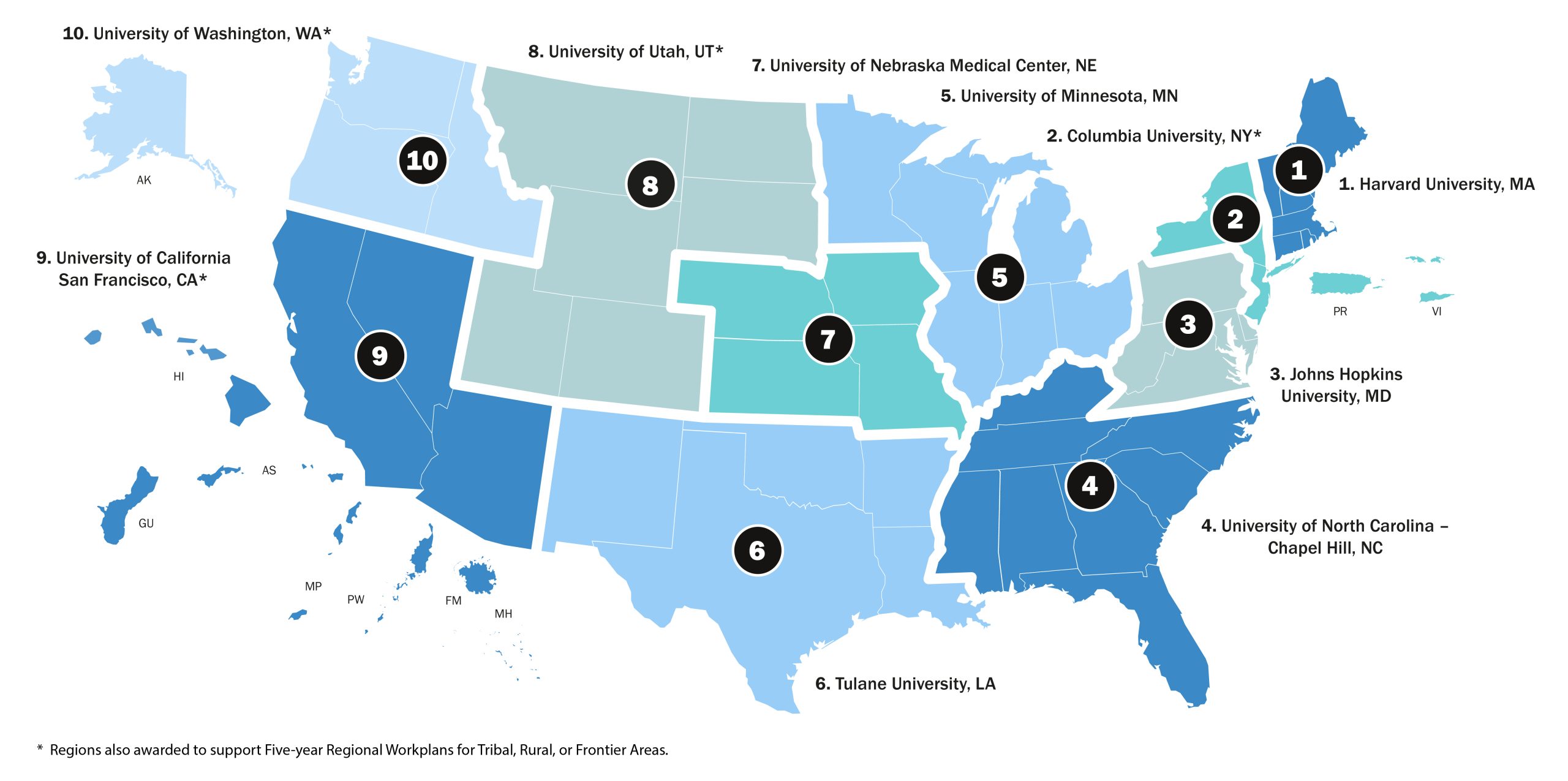
* Regional Centers also awarded to support five-year regional workplans for rural, tribal, or frontier areas.
† Columbia University, in Region 1, received an award to support coordination of all centers
Regional Centers for Public Health Preparedness and Response Recipients
- HHS Region 1†
- Award Recipient: Harvard College, MA
- Center Name: HHS Region 1 Center for Public Health Preparedness and Response
- States: Connecticut, Maine, Massachusetts, New Hampshire, Rhode Island, Vermont
- Focus Area: Workforce Development, Communications, Artificial intelligence
- HHS Region 2*
- Award Recipient: Columbia University, NY
- Center Name: Region 2 Center for Public Health Preparedness and Response (R2C)
- States: New Jersey, New York, Puerto Rico, Virgin Islands
- Focus Area: Workforce Development, Community-based Disaster Response, School Recovery
- HHS Region 3
- Award Recipient: Johns Hopkins University, MD
- Center Name: Region 3 Center for Public Health Preparedness and Response
- States: Delaware, District of Columbia, Maryland, Pennsylvania, Virginia, West Virginia
- Focus Area: Communications, Emergency Operations, Workforce Development
- HHS Region 4
- Award Recipient: The University of North Carolina at Chapel Hill, NC
- Center Name: Region 4 Center for Public Health Preparedness - UNC Gillings School of Global Public Health
- States: Alabama, Florida, Georgia, Kentucky, Mississippi, North Carolina, South Carolina, Tennessee
- Focus Area: Communications, Workforce Development, Responder Resilience
- HHS Region 5
- Award Recipient: University of Minnesota, MN
- Center Name: Upper Midwest Center for Public Health Preparedness and Response
- States: Illinois, Indiana, Michigan, Minnesota, Ohio, Wisconsin
- Focus Area: Communications, Partnerships and Coordination, Workforce Development
- HHS Region 6
- Award Recipient: Tulane University, LA
- Center Name: Region 6 Center for Health Security and Response Readiness
- States: Arkansas, Louisiana, New Mexico, Oklahoma, Texas
- Focus Area: Workforce Development, Partnerships and Coordination, Data and Information Governance
- HHS Region 7
- Award Recipient: University of Nebraska Medical Center, NE
- Center Name: Region 7 Center for Public Health Preparedness and Response
- States: Iowa, Kansas, Missouri, Nebraska
- Focus Area: Community Preparedness and Recovery, Workforce Development, Emergency Operations Coordination
- HHS Region 8*
- Award Recipient: University of Utah, UT
- Center Name: CDC PHEPR Project
- States: Colorado, Montana, North Dakota, South Dakota, Utah, Wyoming
- Focus Area: Response capacity and capability enhancement, Community Resilience, Tribal Partnership Development
- HHS Region 9*
- Award Recipient: University of California San Francisco, CA
- Center Name: Pacific Southwest Center for Emergency Public Health
- States: Arizona, California, Hawaii, Nevada, American Samoa, Guam, Northern Mariana Islands
- Focus Area: Workforce Development, Communications, Weather-related Harms
- HHS Region 10*
- Award Recipient: University of Washington, WA
- Center Name: Northwest Center for Evidence-Based Public Health Emergency Preparedness and Response
- States: Alaska, Idaho, Oregon, Washington
- Focus Area: Workforce Development, Communications
This page was last updated on this date. Updates may include minor edits, image changes, or other modifications to page content.
The information on this page was last reviewed by subject matter experts to ensure accuracy.