



At a glance
- CDC's Tobacco Laboratory measures harmful and addictive substances in tobacco products, smoke and other emissions. It also measures them in people who use tobacco or are exposed to secondhand smoke.
Overview
The Tobacco Laboratory works to reduce people's exposure to addictive and toxic substances. These substances occur in many tobacco products—including e-cigarettes.
The laboratory has expertise in measurement science, or accurate and consistent testing. It has developed high-quality tests that analyze addictive and toxic substances. These tests cover e-cigarette and vaping products, and newer tobacco products.
Scientists use cutting-edge technologies to understand tobacco product design, content, emissions, and use. Their goal is to study how harmful chemicals from these products affect people.
Smoking out what keeps people hooked
CDC measures many harmful and addictive chemicals in emerging tobacco and vape products. It also tests the emissions from these products.
The Tobacco Laboratory studies how additives and design changes affect delivery of addictive and toxic substances from products to people.
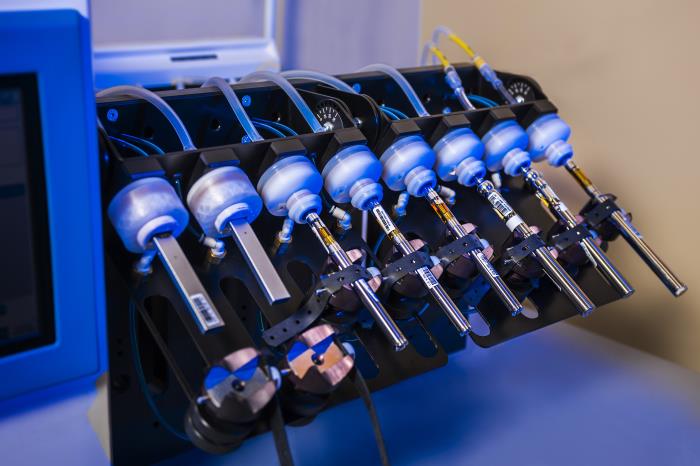
The Tobacco Laboratory uses smoking machines to collect particles and gases from smoke and e-cigarette/vape aerosols. The Tobacco Laboratory can change smoking conditions to mimic "real-world" use. It then examines how smoking differences change chemical delivery.
To understand product use, the Tobacco Laboratory studies smoking patterns. It measures how much smoke people inhale and how that amount affects nicotine delivery. It analyzes racial and genetic smoking differences, how the body breaks down nicotine, and the related health impacts.
Tracking trends in tobacco use
The Tobacco Laboratory measures harmful and addictive tobacco ingredients in blood and urine samples from participants in the National Health and Nutrition Examination Survey (NHANES). CDC publishes these findings in the National Report on Human Exposure to Environmental Chemicals. The report includes nationally representative data on markers, such as the tobacco-specific nitrosamine NNAL.
CDC measurements of cotinine and 3-hydroxycotinine—nicotine markers—show the harmful exposures occur in both smokers and nonsmokers. In the 1990s, data showing that 88% of nonsmokers were exposed to tobacco smoke prompted public smoking restrictions. Continued monitoring shows secondhand smoke exposure has dropped across all groups.
Every year, the Tobacco Laboratory provides over 700,000 analytical results for a population study. This study examines the behavioral and health effects of the 2009 Family Smoking Prevention and Tobacco Control Act, which aims to reduce youth smoking.
Responding to exposures of concern
During the 2019 outbreak of electronic cigarette, or vaping, product use-associated lung injury (EVALI), the Tobacco Laboratory helped identify the main harmful ingredient. The ingredient vitamin E acetate, used to dilute tetrahydrocannabinol (THC)-containing vape devices, was strongly linked to the lung injuries.
CDC scientists confirmed vitamin E acetate as the cause by testing vape aerosols and lung wash samples called bronchoalveolar lavage (BAL) fluid from patients.
Future tobacco research
CDC's Tobacco Laboratory accurately measures individual and population exposure to chemicals associated with tobacco use.
In the future, the Tobacco Laboratory plans to:
Advance tobacco product research
- Identify chemicals or design features that increase addiction and harmful exposures.
- Develop tests to measure major cancer-causing chemicals and toxic chemicals—such as pesticides, lead, chromium, polycyclic aromatic hydrocarbons, benzene, heterocyclic amines, and cyanide—in tobacco, e‑cigarette, and vape products.
- Provide laboratory support to help inform tobacco product regulation.
Improve understanding of people's exposure and health risks
- Develop short-term markers to predict long-term harms from tobacco use.
- Track trends in tobacco and e‑cigarette use.
- Improve methods to measure chemicals in people exposed to tobacco and vaping.