


At a glance
After November 3, 2026, at 11:59 pm Eastern Standard Time, all people boarding an international flight to the United States must attest (sign a statement) that they have not been present in the Democratic Republic of the Congo (DRC) in the 21 days before boarding a flight to the United States. An attestation is a statement that confirms that the information provided is true. Willfully providing false or misleading information may lead to criminal fines and imprisonment (18 U.S.C. § 1001).
Attestation Order
The Centers for Disease Control and Prevention (CDC) within the Department of Health and Human Services (HHS) issued an Order on October 22, 2026, requiring that all air travelers boarding an international flight into or connecting through the United States sign a statement (attestation) that they have not been present in DRC in the 21 days prior to boarding the flight to the United States.
On October 28, 2026, CDC issued an Amended Order to clarify that the requirement for the attestation applies to all people traveling on any aircraft, including crew on passenger- and cargo-carrying aircraft involved in operation of aircraft or the positioning of crew not operating the aircraft (e.g., on "deadhead" status). The overall risk to the American public and travelers remains low.
This requirement goes into effect November 3, 2026, at 11:59 p.m. EST. The requirement will apply to flights departing from a foreign country to the United States at or after 11:59 p.m. EST on November 3, 2026.
The Amended Order issued on October 28, 2026, is here. This Amended Order is published in the Federal Register.
A fillable PDF version of the attestation (Attachment A) is available in English and Spanish for use by airlines.
Technical Instructions
These Technical Instructions provide guidance to domestic and foreign airlines and aircraft operators on the implementation of the CDC Order. The Technical Instructions are applicable to airlines and aircraft operators intending to board any people subject to the Order on any flight from a foreign country to the United States. Airlines and aircraft operators intending to board people subject to the Order are required to take the measures described in the Order, as described below.
CDC's Order is complemented by the U.S. Department of Transportation (DOT) Enforcement Notice.
Applicability
The attestation requirement applies to all people who intend to board a flight destined for the United States unless they have an exemptionA issued by the U.S. Government.
Airlines and Aircraft Operators Must
- Confirm, at or shortly before the time of boarding, that all people onboard the aircraft, or a representative authorized to act on their behalf, have completed an attestation (i.e., by physical or authenticated digital signature or through electronic attestation checkbox) confirming that they have not been present in the DRC during the 21 days before boarding a flight to the United States, including transit through a DRC airport whether or not they disembarked.
- Prohibit the boarding of any person who has failed to complete and present such an attestationB unless they have an exemption issued by the U.S. Government.
- Retain a copy of the completed version of the attestation for each person for at least 42 days after the person's flight arrives in the United States from a foreign country and be able to provide the attestation to the U.S. Government upon request.
Attestation Implementation
- Airlines or aircraft operators must implement a process by which they will collect and retain this attestation in digital or paper form. CDC has posted a fillable PDF version of the attestation for use by airlines.
- Airlines or aircraft operators are required to provide the attestation to the U.S. Government upon request. The U.S. Government may also need certain information to identify the person to which the attestation belongs.
General FAQs
What is an attestation?
- An attestation is a statement a person makes confirming that the information they have provided is true. For this Order, the attestation is a signed statement (either on paper or digital).
What is the purpose of this attestation?
- This attestation is required as a public health measure intended to reduce the risk of Ebola being introduced into the United States through air travel. It requires persons to confirm before boarding a flight to the United States that they have not been in the DRC during the previous 21 days. The 21-day period reflects the maximum incubation period (time between exposure and symptoms starting) for Ebola disease. Persons who do not sign an attestation will not be allowed to board a flight to the United States.
Does the attestation requirement apply to U.S. citizens?
- This Order applies to all people boarding a flight to the United States from any foreign country, including U.S. citizens, U.S. nationals, and lawful permanent residents (Green Card holders).
Who is exempt from this Order?
- Per the CDC Order, exemptions may include (1) the aircraft is designated air medical transport that is transporting persons with Ebola disease pursuant to U.S. Government authorization and in accordance with CDC guidance; and/or (2) individuals for whom the CDC has issued an exemption from this Order based on humanitarian or other important government considerations.
What counts as "being present in DRC" for purposes of the 21-day period?
- A person is considered to have been in the DRC if they were physically present in DRC at any time during the previous 21 days. This includes entering or traveling through DRC by air, land, or sea. Connecting through an airport in DRC also counts as being present in the country, even if the person did not leave the airport or the plane.
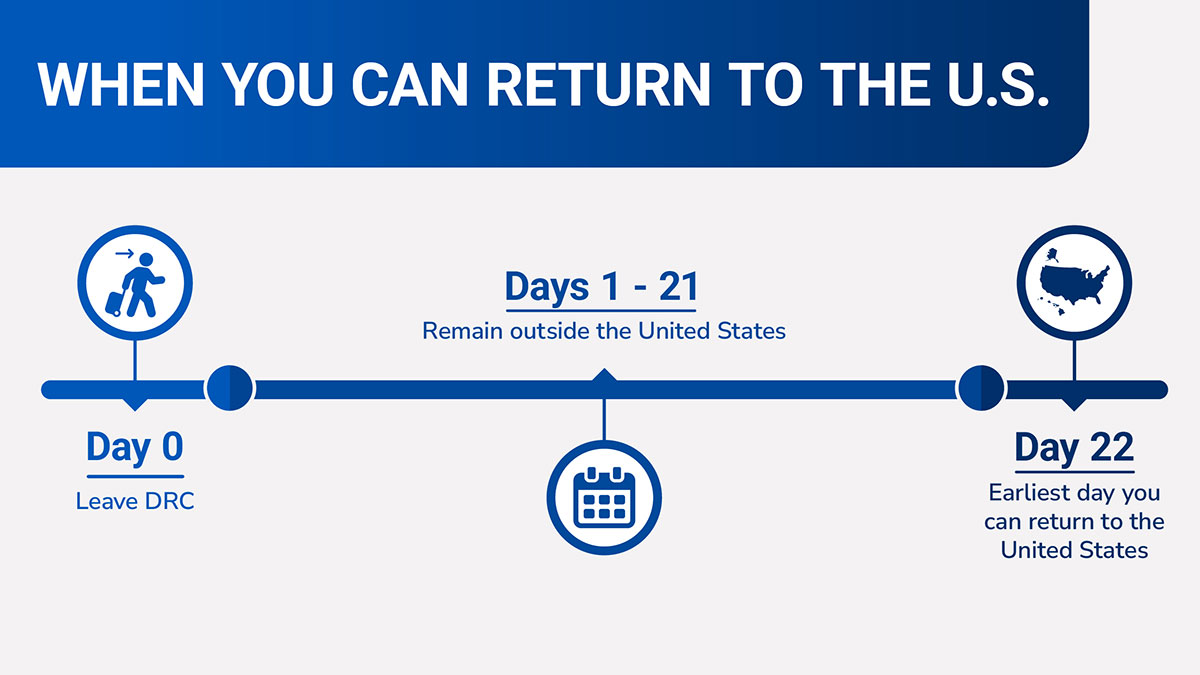
- The 21-day waiting period is based on calendar days. Day 0 is the day a person leaves DRC, and Day 1 is the first full calendar day they are outside DRC. A person may board a flight to the United States beginning on Day 22, provided they meet all other travel requirements. Travel to the United States is not allowed during Days 0–21.
- Use this graphic as a reference to determine when a person can return to the United States.
How will the airline and CDC use this attestation?
- The attestation process ensures that no person who was in DRC in the previous 21 days will be able to board a flight to the United States. Airlines and aircraft operators are responsible for collecting and retaining attestations. CDC may request an attestation from an airline to verify compliance with the Order or as part of a public health investigation or response.
Do people have to complete and print the attestation posted on the CDC website before coming to the airport? How do people provide the attestation to the airline?
- As required by United States federal law, all airlines or other aircraft operators will provide and collect the attestation on behalf of the U.S. Government prior to boarding. Travelers should check with the airline or aircraft operator for their flight to learn how the airline or aircraft operator will collect their attestation.
What happens if a person refuses to submit an attestation?
- Any person who fails to sign an attestation (or have an attestation signed on their behalf by an authorized representative) confirming that they have not been present in the Democratic Republic of the Congo (DRC) during the 21 days prior to boarding a flight to the United States will be denied boarding a flight to the United States.
What happens if a traveler provides a false attestation?
- The U.S. Department of Justice may seek to prosecute and fine individuals who knowingly and willfully submit false statements in violation of 18 U.S.C. § 1001.
Who is considered an authorized representative?
- Authorized representative means a parent, guardian, travel companion, adult member of a person in the same traveling party or person authorized by the person required to complete and submit an attestation on the person's behalf. Airline or other aircraft operator personnel who assist with data entry or submission at the direction of the person required to complete the attestation (or their authorized representative) does not, solely by providing such assistance, become the authorized representative or provide the attestation on the person's behalf.
Can one person complete one attestation on behalf of their entire family/traveling party?
- Airlines and aircraft operators must collect and have a record that an attestation was completed for each individual on every flight. However, one authorized representative may attest on behalf of each member of a traveling party.
Can a traveler under 18 years old sign their own attestation?
- If a traveler is younger than 18, their parent, guardian, or another authorized person may sign the attestation on their behalf. The authorized adult confirms the information is true by completing and signing the document for the child.
Can an authorized representative sign on behalf of someone who is unable to sign the attestation?
- A travel companion, or other authorized person can complete and sign an attestation on behalf of someone who has a disability or is otherwise unable to sign.
If a person is connecting through the United States to another country, do they still need to complete an attestation?
- The attestation requirement applies even for people who are only passing through the United States to reach another country, regardless of whether they disembark or stay on the airplane while in the United States.
Does the attestation requirement apply to land border crossings or seaports?
- The requirements of this attestation only apply to air travel into or connecting flights through the United States. The requirement does not apply to land border crossings or seaports.
Are territories or possessions of the U.S. considered foreign countries for the purposes of this Order?
- U.S. territories and possessions include American Samoa, Guam, the Northern Mariana Islands, the Commonwealth of Puerto Rico, and the U.S. Virgin Islands. They are not considered foreign countries.
Do people need to keep a copy of their attestation after submitting it to the airline?
- People may choose to keep a copy (or take a photo, if digital) of the attestation for their personal records but are not required to do so. The airline or aircraft operator will be responsible for keeping a record of the attestation.
Are there other public health travel restrictions for people who have been in DRC recently?
Other public health travel measures currently in place see:
FAQs for Airlines
Does the Order apply to all flights or only commercial flights?
- This Order applies to all flights departing for the United States, including commercial flights, general aviation, cargo, and private aircraft.
Does the Order apply at pre-clearance ports?
- The Order applies to all people traveling to United States via air from any foreign country, including people on flights departing from pre-clearance ports.
Can airlines or other aircraft operators create digital or electronic versions of the attestation?
- Airlines and other aircraft operators may use a process that captures authenticated digital signatures on attestations.
- Alternatively, an airline or other aircraft operator may establish an electronic process that allows a person to complete the attestation at check-in, at the gate, or at another point before boarding. The person or an authorized representative must review the attestation text and complete the attestation as required. The system must create a unique electronic record that can be retained for 42 days after the person's flight departs to the United States and produced to the U.S. Government upon request. Additionally for an authorized representative attesting on behalf of other people in their traveling party, airline or other aircraft operator may use a single electronic workflow to collect and record that an attestation was made on behalf of each person in the traveling party.
Can airlines or other aircraft operators modify the text in the attestation?
- Airlines and other aircraft operators must include all text from the attestation in Attachment A of the Order, including display of the Office of Management and Budget (OMB) control number and expiration date shown in the upper-right corner of the attestation available online. The text from the Airline and Aircraft Operator Disclosure Requirement and Privacy Statement must also be displayed, however the text may be provided via a hyperlink on a digital screen. To facilitate completion, airlines and other aircraft operators may reformat the attestation as necessary when putting into an electronic system.
Can airline personnel assist a traveler or authorized representative with completing an attestation?
- Airline or aircraft operator personnel may assist with submission or data entry of the attestation at the direction of the traveler or a person authorized to act for the traveler. The traveler, or their authorized representative, remains the person providing the attestation. Airline or aircraft operator personnel do not attest on behalf of the traveler merely by assisting with data entry or submission.
Can a person provide a verbal attestation?
- An airline or other aircraft operator may accept a verbal attestation to complete the form on behalf of a person if a person attempting to board a flight (or authorized representative) has reviewed the applicable attestation language, either in print, or through a digital mechanism (e.g. hyperlink, screen) and (1) the agent has asked the person to confirm that they have not been in the Democratic Republic of the Congo (DRC) in 21 days prior to boarding and (2) the agent then records that the person reviewed the language and provided this attestation. The traveler, or their authorized representative, remains the person providing the attestation. If recorded in this manner, the system must create a unique electronic record that can be retained for 42 days after the person's flight departs to the United States and produced to the U.S. Government upon request.
Will CDC offer the attestation form in other languages besides English?
- CDC will provide attestation forms in Spanish and French as soon as available. Airlines and aircraft operators may also translate the attestation into other languages or use a third party to provide translations of the attestation. However, the airline or aircraft operator is responsible for ensuring the accuracy of any translation. The airline or aircraft operator may not shift this responsibility to a third party.
Can airlines/other aircraft operators use an attestation only in a foreign language (rather than an English translation), so that the only version retained for 42 days would be in a foreign language?
- Airlines/aircraft operators may use and retain an attestation only in a foreign language.
Can airlines use a third party (e.g. airport personnel, subcontractor, etc.) to collect the attestations?
- Airlines and aircraft operators can use a third party to collect the attestations, however, an airline or aircraft operator has sole legal responsibility to ensure the appropriate implementation and compliance with the obligations under this Order. An airline or aircraft operator is responsible for any failure to comply with its responsibilities as set forth in this Order, including for actions of a third party used to help effectuate its compliance with this Order.
Should airlines or aircraft operators transmit the attestation through the Advance Passenger Information System (APIS)?
- Attestations should not be transmitted through APIS. If CDC requests an airline send a record of a person's attestation, CDC will provide instructions (either directly to airline or via a federal or industry partner) on how to send the information.
When might CDC request proof that a person completed the attestation?
- CDC may request an attestation to verify compliance with the Order or if needed for a public health investigation or response at any time during the 42 days after a person's flight landed in the U.S. Should this occur, CDC will provide instructions on how to send the information.
What information would airlines/other aircraft operators need to provide to CDC along with proof that a person completed the attestation?
- For this purpose, airlines and other aircraft operators should be prepared to provide the followingC:
- First and Last name
- Passenger Name Record Number (if applicable)
- For airlines: Airline and carrier code; for other aircraft operators: aircraft registration number
- Flight number, if applicable
- Departure airport
- Arrival airport
- Dates and times of travel
How will airlines or aircraft operators know if the U.S. government has issued an exemption for a person?
- Exemptions to these and other public health travel restrictions are rare. If the U.S. government issues an exemption to a traveler who has been in DRC in the past 21 days, CDC will reach out to the airline and will coordinate with the airline and federal partners.
This page was last updated on this date. Updates may include minor edits, image changes, or other modifications to page content.
The information on this page was last reviewed by subject matter experts to ensure accuracy.
- Per the CDC Order, exceptions may include (1) the aircraft is transporting persons with Ebola disease pursuant to U.S. Government authorization and in accordance with CDC guidance; and/or (2) Individuals for whom the CDC has issued an exemption from this Order based on humanitarian or other important government considerations.
- The U.S. Department of Transportation (DOT) Office of Aviation Consumer Protection (OACP) will not take action against an airline for adhering strictly to this specific travel directive for individuals who are unable to present the attestation as required in the CDC’s Order (DOT Enforcement Notice dated 10/28/2026).
- The collection of this information is authorized under 42 CFR 71.4.