Mining Topic: Ground Monitoring
What is the health and safety problem?
Observing and monitoring rock deformations can provide information for making critical safety decisions. Generally, underground mines use observational techniques to determine roof stability which are not very efficient or accurate. Mine workers have "sounded" the rock - striking it and listening for the “drummy sounds” that signal loose rock. Other techniques include microseismic monitoring, mechanical measurement, load cells, or electromechanical roof monitors.
What is the extent of the problem?
According to Mine Safety and Health Administration (MSHA) statistics (2003-2012), falls of ground were responsible for the largest portion (27%) of fatal incidents in the coal mining industry and about 33% of fatal incidents in underground coal mining.
How is the NIOSH Mining Program addressing this problem?
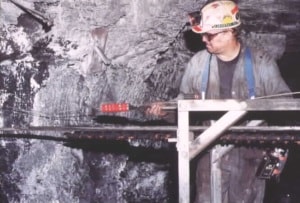
Ground monitoring
The NIOSH Mining Program is developing and applying ground monitoring methods in a variety of mines with a current focus on monitoring ground in deep coal mines. Roof monitors can provide information related to roof rock stability where geologic discontinuities or weaknesses exist in the mine roof. Over time, monitoring provides the operator with a history of the stability of the mine opening, allowing for the installation of additional support where needed or the removal of personnel and equipment from potentially hazardous situations.
What are the significant findings?
NIOSH Mining has been involved in the research and development of several significant ground monitoring systems. Most recently, NIOSH research has led to a permissible miniaturized data logging system that was licensed for commercial production, but it is no longer manufactured or commercially available.
What are the next steps?
Ongoing work is focusing on monitoring the ground response to the mining of coal at depth including ground pressures, displacements, and seismicity. The availability of a new permissible data logging system is critical to the continuation of this work.
- Calibration and Verification of Longwall Stress Models
- Coal Mine Safety Applications of Seismic Monitoring
- Computer Simulation of Ground Behaviour and Rock Bolt Interaction at Emerald Mine
- Developments in Sealant Support Systems for Ground Control
- Drill Monitor With Strata Strength Classification in Near-Real Time
- Durable Support for Western U.S. Underground Metal Mines
- Initial Stability Study of Large Openings for the National Underground Science Laboratory at the Homestake Mine, Lead, SD
- Long-Term Stability of a Backfilled Room-and-Pillar Test section at the Buick Mine, Missouri, USA
- Microseismic Activity Associated With a Deep Longwall Coal Mine
- Monitoring Coal Mine Seismicity with an Automated Wireless Digital Strong-Motion Network
- Neural Network Technology for Strata Strength Characterization
- Rock Damage Characterisation from Microseismic Monitoring
- Roof Monitoring Helps Prevent Injuries in Stone Mines
- Roof Monitoring in Limestone - Experience with the Roof Monitoring Safety System (RMSS)
- Roof Support
- Seismic Network Operations at a Deep Underground Coal Mining District in Western Colorado (USA)
- Shotcrete Design and Installation Compliance Testing: Early Strength, Load Capacity,Toughness, Adhesion Strength, and Applied Quality
- Technology News 475 - Roof Monitoring Safety System for Underground Stone Mines
- Three Dimensional Microseismic Monitoring of a Utah Longwall