|
|
 |

Amebiasis
(Entamoeba histolytica or E. histolytica infection)
What is amebiasis?
Amebiasis (am-e-BI-a-sis) is a disease
caused by a one-celled parasite called Entamoeba histolytica (ent-a-ME-ba
his-to-LI-ti-ka).

Who is at risk for amebiasis?
Although anyone can have this disease, it is more common in people who live in tropical areas with poor sanitary conditions. In the United States, amebiasis is most often found in travelers to and immigrants from these areas, as well as in poeple who live in institutions that have poor sanitary conditions. Men who have sex with men can also become infected.

How can I become infected with E.
histolytica?
- By putting anything
into your mouth that has touched the stool of a person who is infected
with E. histolytica.
- By swallowing
something, such as water or food, that is contaminated with E.
histolytica.
- By touching and
bringing to your mouth E. histolytica cysts (eggs) picked up from surfaces that are
contaminated with E. histolytica.

What are the symptoms of
amebiasis?
Only about 10% to 20% of people who are infected with
E. histolytica become sick from the infection. The symptoms often are quite mild and can include loose stools, stomach pain, and
stomach cramping. Amebic dysentery is a severe form of amebiasis associated with stomach
pain, bloody stools, and fever. Rarely, E. histolytica invades the liver and forms an abscess.
Even less commonly, it spreads to other parts of the body, such as the lungs or brain.

If I swallowed E.
histolytica, how quickly would I become sick?
Only about 10% to 20% of people who are infected with E. histolytica become sick from the infection. Those people who do become sick usually develop symptoms within 2 to 4 weeks, although this may range from several weeks or longer.

What should I do if I think I
have amebiasis?
See your health care
provider.

How is amebiasis diagnosed?
Your health care provider will ask you to submit stool samples. Because
E. histolytica is not always found in every stool sample, you may be asked to submit several stool samples from
several different days.
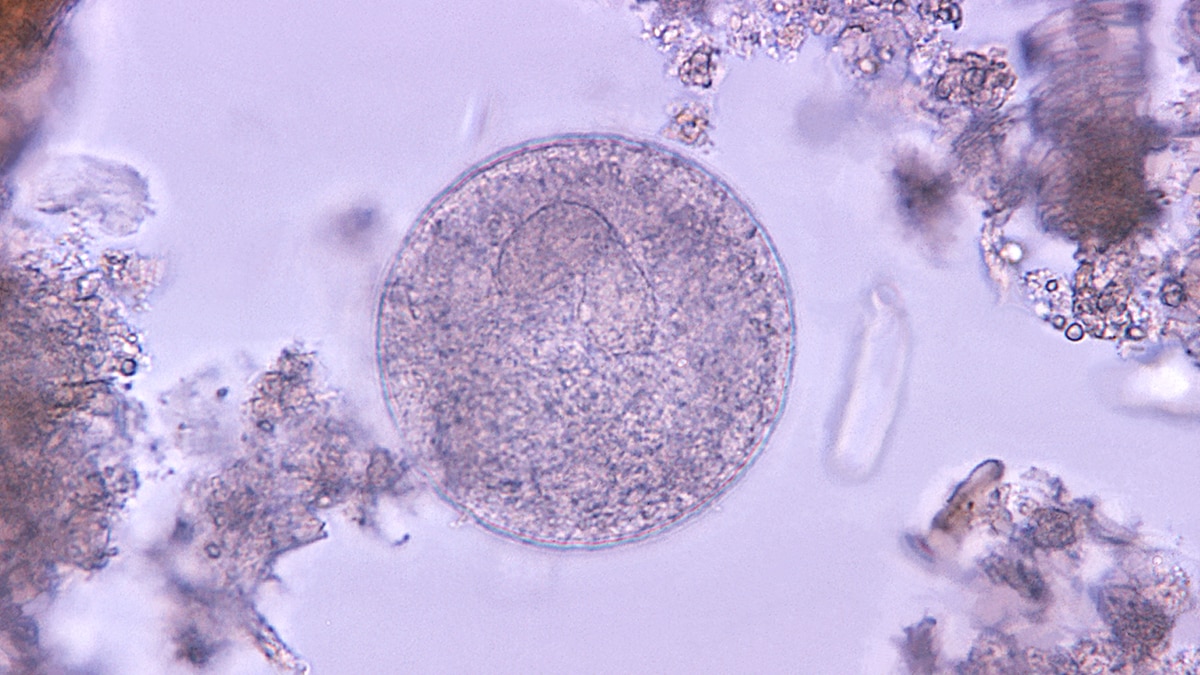
Diagnosis of amebiasis can be very difficult. One problem is that other parasites and cells can
look very similar to E. histolytica when seen under a microscope. Therefore, sometimes people are told that they are infected with E. histolytica even though they are not.
Entamoeba histolytica and another ameba, Entamoeba dispar, which is about 10 times more common, look the same when seen under a microscope. Unlike infection with E. histolytica, which sometimes makes people sick, infection with E. dispar does not make people sick and therefore does not need to be treated.
If you have been told that you are infected with E. histolytica but you are feeling fine, you might
be infected with E. dispar instead. Unfortunately, most laboratories do not yet have the tests that
can tell whether a person is infected with E. histolytica or with E. dispar. Until these tests become more widely available, it usually is best to assume that the parasite is
E. histolytica.
A blood test is also available but is only recommended when your health care provider thinks that your infection may have spread beyond the intestine (gut) to some other
organ of your body, such as the liver. However, this blood test may not be helpful in diagnosing your current illness because the test may still be positive if
you had amebiasis in the past, even if you are no longer infected now.

How is amebiasis treated?
Several antibiotics are
available to treat amebiasis. Treatment must be prescribed by a physician.
You will be treated with only one antibiotic if your E. histolytica
infection has not made you sick. You probably will be treated with
two antibiotics (first one and then the other) if your infection has
made you sick.

I am going to travel to a
country that has poor sanitary conditions. What should I eat and drink
there so I will NOT become infected with E. histolytica or
other such germs?
- Drink only bottled
or boiled (for 1 minute) water or carbonated (bubbly) drinks in cans
or bottles. Do not drink fountain drinks or any drinks with ice
cubes. Another way to make water safe is by filtering it through an
"absolute 1 micron or less" filter and dissolving
chlorine, chlorine dioxide, or iodine tablets in the filtered water. "Absolute 1 micron"
filters can be found in camping/outdoor supply stores.
- Do not eat
fresh fruit or vegetables that you did not peel yourself.
- Do not eat or
drink milk, cheese, or dairy products that may not have been
pasteurized.
- Do not eat or
drink anything sold by street vendors.

Should I be concerned about
spreading infection to the rest of my household?
Yes. However, the risk of spreading infection is low if the infected person is treated with
antibiotics and practices good personal hygiene. This includes thorough hand washing with soap
and water after using the toilet, after changing diapers, and before handling food.

For more information:
Ravdin JI. Amebiasis.
Clin Infect Dis 1995;20:1453-66.
This fact sheet is for
information only and is not meant to be used for self-diagnosis or as a
substitute for consultation with a health care provider. If you have any
questions about the disease described above or think that you may have a
parasitic infection, consult a health care provider.
|