Skip directly to search Skip directly to A to Z list Skip directly to navigation Skip directly to site content Skip directly to page options
CDC Home

Model Aquatic Health Code (MAHC) Module Abstracts


This page lists abstracts for the 12 MAHC modules. These abstracts highlight the most critical recommendations in each module.

Contamination Burden Module Abstract

Understanding the types of contaminants and the magnitude of disinfectant demand by various environmental factors (e.g., particulate) is an essential component to design and operate a recirculation and filtration system. Limited data currently exists, but a substantial research agenda has been created.

The following is a summary of the existing data and areas where data are lacking. Since the Contamination Burden Module is informational, this module is ANNEX-based only – NO CODE section accompanies it. After being posted for public comment, the information contained in this module will be merged into the appropriate MAHC modules upon final completion. The section numbering system will be different in this draft as there are no specific code sections yet assigned to any of this information.


Disinfection and Water Quality Module Abstract

Disinfection and water quality are critical components in maintaining bather health and comfort. Health issues related to inadequate disinfection and poor water quality are increasingly being documented. Outbreak investigations have often determined that disinfectant levels and other water quality parameters were not maintained appropriately thereby allowing disinfectant-sensitive pathogens to be associated with pool use. The emergence of chlorine-tolerant microbes also necessitates changing accepted standards for pool treatment to protect the health of bathers in the future. The Disinfection and Water Quality Module takes the first steps in addressing these recurring and emerging aquatic health issues.

The Disinfection and Water Quality Module contains requirements for new or modified construction that include:

  • Primary disinfectant levels set
  • Secondary disinfection required for “increased risk” aquatic venues such as Interactive features, spray pads, wading pools, and other venues designed primarily for diaper-aged children as well as therapy pools
  • Combined chlorine maximum levels set
  • Prohibition of cyanuric acid in Indoor facilities and “increased risk” aquatic venues

Facility Design and Construction Module Abstract

The sound design and construction of swimming pools, spas, and aquatic venues are paramount to ensuring the health and safety of patrons who use these facilities. The Facility Design and Construction Module contains requirements for new pool construction that includes:

  • Design/construction aspects of the pool shell that include general shape, design, and slope requirements to prevent injury;
  • Design/construction aspects of the aquatic venue that include decks, lighting, electrical, wastewater, and fencing;
  • Design/construction aspects of specialty bodies of water and features that include spas, wave pools, slide pools, wading pools, and infinity edges; and
  • Design/construction parameters for pool equipment and under what conditions its use is acceptable including starting blocks, moveable floors, bulkheads, and diving boards.

Facility Maintenance and Operation Module Abstract

Aquatic facility operation and maintenance is a critical component of maintaining health and safety. Past outbreaks have commonly found operation and maintenance lapses to be critical contributors to disease outbreaks and injuries. The Facility Maintenance and Operation Module lays the foundation for operational improvement by containing requirements for:

  • Closure and reopening guidance for long and short term closures
  • Comprehensive plans for preventive maintenance, equipment inventorying, and development of an operations manual to be maintained at the facility
  • Reducing and mitigating excessive glare and reflection on the pool surface through design and adjustments to windows and lighting equipment
  • Comprehensive daily records of pool operation and maintenance and of operational items inspected daily

Top of Page

Hygiene Facilities Module Abstract

Swimmer hygiene is a critical component that plays a role in documented waterborne disease outbreaks and poor water quality. The Hygiene Facilities Module is a first step towards improving swimmer hygiene and facility water quality to reduce the associated health effects. The Hygiene Facilities Module contains requirements for new or modified construction that include:

  • Minimum distances for hygiene facilities from aquatic venues
  • Newly defined diaper changing stations
  • Implementation of rinse vs. cleansing showers

Lifeguarding and Bather Supervision Module Abstract

Health and safety issues related to bather supervision and lifeguarding for both the patron and the potential rescuer of an aquatic facility are increasingly being documented. The Lifeguarding and Bather Supervision Module is a first step towards improving the consistency in training, lifeguard management and supervision, lifeguard competency for guarded facilities and proper bather supervision at unguarded facilities. The Lifeguarding and Bather Supervision Module contains requirements for unguarded and guarded aquatics along with the training necessary to be a qualified lifeguard. The module includes:

  • Standards for which aquatic facilities need to be guarded and which may not need to have professional lifeguard supervision but are still supervised.
  • An Aquatic Facilities Safety Plan guide including pre-service, in-service, staffing, single lifeguard, lifeguard management and Emergency Action Plan requirements.
  • Requirements for aquatic facilities to define, diagram, and document required zones of patron surveillance.
  • Determination of what constitutes proper staffing by the ability of the lifeguard to reach all areas of their zone of patron surveillance within a certain time frame.
  • Required lifesaving equipment, communications standards, and general requirements for lifeguards and lifeguard supervision/management training.

Monitoring and Testing Module Abstract

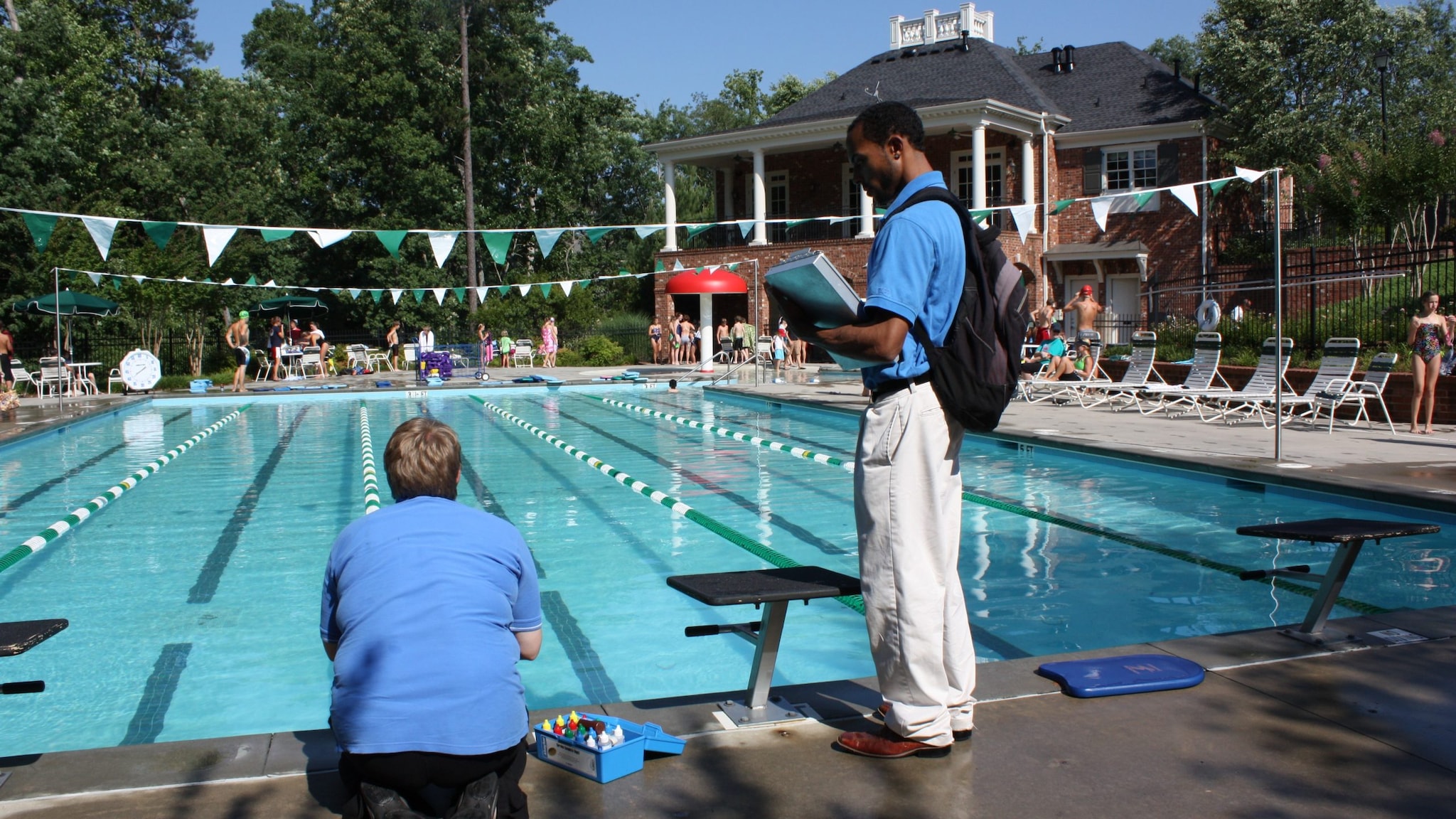
Ensuring water and air quality is important for maintaining a safe and healthy environment for pool and spa users and operators. The Monitoring and Testing Module identifies activities and procedures that pool and spa operators should follow to proactively evaluate the water and air quality in their facilities. The Monitoring and Testing Module contains requirements for new and existing aquatics facilities that include:

  • Ensuring that water quality testing devices comply with existing standards.
  • Monitoring automated controllers and treatment systems to ensure proper functioning.
  • Use of dye testing to evaluate pool circulation.
  • Procedures for collecting water samples from in-line sample ports and from bulk pool water, including frequency and timing of sample collection.
  • Frequency of testing for specific water quality chemical parameters.

Operator Training Module Abstract

Increased pool code violations have been linked to the lack pool operator training. These violations may also be linked to an increased potential for health effects if a facility is not operated and maintained appropriately. The Operator Training Module is a first step towards assuring adequate training for all personnel who operate aquatic facilities. The Operator Training Module contains requirements for:

  • Training course elements to be included in curricula
  • Instructor qualifications
  • Certificate validity to be for 5 years maximum

To make the module more complete and interpretable, proposed language from the Regulatory Program Administration Module is also included (6.3.1.1, 6.3.1.2). This language outlines the requirement for operator training and the aquatic facilities requiring on-site qualified operators.

Top of Page

Regulatory Program Administration Module Abstract

Regulatory guidance forms the framework around which an effective model aquatic health code is built. The Regulatory Program Administration Program Module follows a best practice and research-based protocol to ensure the AQUATIC FACILITY is operating safely. The guidance reflected in this module promotes all parties working together from the initial building permits to the code enforcement process. The Regulatory Module contains requirements for but not limited to:

  • Establishment of an independent Aquatic Health Advisory Committee
  • Delineation of imminent aquatic health hazards and corresponding remediation and enforcement procedures
  • Establishment of facility staffing requirements based on facility size and type
    • Trained operators required for all facilities
    • Outlines facilities requiring on-site vs. off-site operators
  • Aquatic facility operator training
  • Aquatic Facility Inspection Report and Marking Guide (Draft) [PDF - 7 pages]
  • Plans and permits guidelines
  • Recordkeeping requirements
  • Swimmer empowerment methods

Risk Management/Safety Module Abstract

Increased vigilance is needed at aquatic venues to reduce injuries in the water, chemical storage room, and around the pool and facility. The Risk Management/Safety Module outlines steps to be taken to manage and reduce these risks and associated health problems. The Risk Management/Safety Module contains new guidelines covering:

  • Controlled access aquatic venues (e.g., lazy rivers) not requiring depth markers throughout
  • Expanded employee training to cover fecal- and vomit-related pathogen response and clean-up
  • Potential sources of glare and ways to prevent glare in aquatic venue design
  • Consideration of water temperature and patron use
  • Expanded chemical storage and handling
  • Use of remote monitoring systems
  • Employee illness policies
  • Inspection items for daily opening and closing of aquatic features or venues

Ventilation and Air Quality Module Abstract

Health issues related to indoor pool use and associated poor water and air quality are increasingly being documented. The Ventilation and Air Quality Module is a first step towards improving air quality at indoor aquatic facilities and reducing associated health effects. The Ventilation Air Quality Module contains requirements for new or modified construction that include:

  • Increased make-up air required in addition to that required in the ASHRAE 62 standard for indoor pools
  • Determination of the extra make-up air needed based on the indoor venue water use type (e.g., flat water, agitated water, or hot water) and venue or deck patron density (square feet/person)
  • Inclusion in calculations of additional make-up air from surge tanks or gutters that introduce fresh air
  • Development and implementation of plans to reduce combined chlorine compounds in indoor aquatic facilities and inform facility patrons of their impact on building air quality

Top of Page


Contact Us:
  • Centers for Disease Control and Prevention
    1600 Clifton Rd
    Atlanta, GA 30333
  • 800-CDC-INFO
    (800-232-4636)
    TTY: (888) 232-6348
  • Contact CDC–INFO
USA.gov: The U.S. Government's Official Web PortalDepartment of Health and Human Services
Centers for Disease Control and Prevention   1600 Clifton Rd. Atlanta, GA 30333, USA
800-CDC-INFO (800-232-4636) TTY: (888) 232-6348 - Contact CDC–INFO
A-Z Index
  1. A
  2. B
  3. C
  4. D
  5. E
  6. F
  7. G
  8. H
  9. I
  10. J
  11. K
  12. L
  13. M
  14. N
  15. O
  16. P
  17. Q
  18. R
  19. S
  20. T
  21. U
  22. V
  23. W
  24. X
  25. Y
  26. Z
  27. #