Chapter Two, Course WB3151
CFS Case Definition
The International Working Group Case Definition of CFS (Fukuda et al., 1994) and clarifications published in 2003 (Reeves et al.) provide the current international standard for diagnosis of CFS in research studies and provide appropriate guidelines for clinical diagnosis. CDC has developed an empirical case definition that addresses diagnostic and assessment needs in both the research and clinical arenas (Reeves et al., 2005).

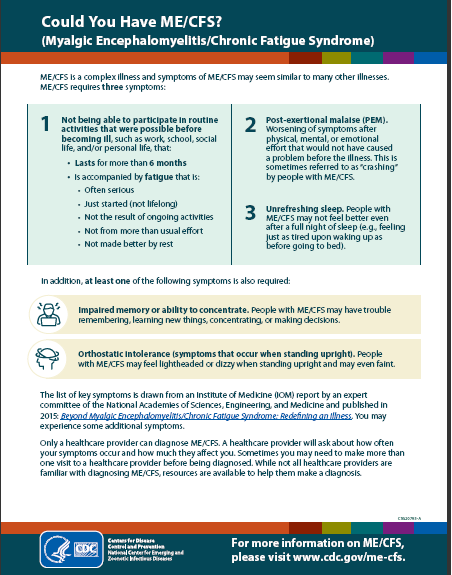
CFS has no characteristic physical signs or diagnostic laboratory abnormalities. Diagnosis of CFS involves careful evaluation of symptoms and ruling out or treating other causes of the patient’s complaints. The diagnosis of CFS requires that patients report severe persistent or relapsing fatigue of at least 6 months’ duration. This fatigue represents profound mental and physical exhaustion that is not relieved by rest. It is not the typical fatigue that people frequently experience after strenuous physical activity, a difficult workweek or other episodes of unusual stress. CFS must cause significant reduction in the patient’s previous ability to perform one or more aspects of daily life (work, household, recreation or school). Those evaluating patients with CFS should remember that, in spite of their profound disability, many people with CFS do not appear physically ill. In addition to fatigue, the illness must include at least 4 of the 8 symptoms specified in Table 1. Most people with CFS report unusual postexertional fatigue, unrefreshing sleep, and difficulty with memory/concentration; the other symptoms occur in varying proportions, as reported by people with CFS. Most CFS patients report that fatigue and other symptoms (especially concentration/memory problems and pain) are worsened by previously well-tolerated physical or mental activity.
CFS patients may report many other symptoms that are not part of the syndrome, such as allergies or sinus problems; numbness or tingling; feeling “in a fog”; dizziness and balance problems; sensitivity to substances and stimuli; and night sweats (Nisenbaum et al., 2004). Health care professionals should investigate the possibility of underlying medical and psychiatric disorders in those patients who report numerous symptoms not strictly associated with CFS and should remain alert to the development of new symptoms that require further evaluation.
Differential Diagnosis and Exclusionary Conditions
As mentioned previously, patients with chronically fatiguing illness should be carefully evaluated medically and psychiatrically both early in the diagnostic process and throughout their care. Many diseases present similarly to CFS, and these must receive appropriate evaluation and treatment before considering CFS as a diagnosis. Examples include: 1) conditions discovered during evaluation (e.g., effects of medications or dietary supplements, sleep disorders, untreated hypothyroidism, diabetes, infection, hypertension, obesity); 2) conditions that resolve on their own (e.g., pregnancy, recent surgery); and 3) chronic diseases whose resolution may be unclear for some time (e.g., myocardial infarction, heart failure).
Other medical diseases exclude the diagnosis of CFS in research studies. Examples include: 1) organ failure (e.g., emphysema, cirrhosis, renal disease, cardiac diseases); 2) chronic infections (e.g., AIDS, hepatitis B or C); 3) rheumatic and chronic inflammatory diseases (e.g., systemic lupus erythematosus, rheumatoid arthritis, inflammatory bowel disease, chronic pancreatitis); 4) major neurological diseases (e.g., multiple sclerosis, neuromuscular diseases, epilepsy, stroke, head injury); 5) major endocrine diseases (e.g., adrenal insufficiency, hypopituitarism); and 6) primary sleep disorders (e.g., sleep apnea, narcolepsy).
Note that these conditions are considered exclusionary only in the research setting. In the clinical setting, patients must receive a careful medical evaluation searching for accompanying conditions; after appropriate treatment for these conditions, the clinical professional will determine whether the other disease is a major contributor to the patient’s symptoms (Reeves et al., 2003).
Health care professionals caring for patients with CFS should also consider the possibility of an underlying or comorbid psychiatric condition. Several psychiatric disorders exclude the diagnosis of CFS and include lifetime occurrence of bipolar affective disorders, schizophrenia of any subtype, delusional disorders of any subtype, dementias of any subtype and organic brain disorders. Melancholic depression, alcohol or substance abuse, anorexia nervosa or bulimia are not necessarily exclusionary conditions. A thorough clinical evaluation must be completed to ensure that the illness has resolved before considering CFS.
CFS and Depression
Depressive disorders frequently complicate care of patients with CFS. Twenty-five percent of CFS patients suffer a major depressive disorder, and 50% to 75% have experienced a depressive episode during their lifetime (Afari and Buchwald, 2003). In comparison, 10% of American adults have a major depressive episode each year, and 17% have had at least one lifetime episode (Kessler et al., 1994). Depressive disorders are characterized by heterogeneity in terms of clinical symptoms, course and treatment response. On the basis of symptom patterns and clinical course, several subtypes of depressive disorders have been defined in the Diagnostic and Statistical Manual for Mental Disorders (DSM-IV) (American Psychological Association, 1994). Some of these subtypes are clearly different from CFS, whereas other subtypes resemble CFS, which might suggest that these disorders and CFS are part of a spectrum of disorders. For example,
- Major depression with a primary mood disturbance (e.g., sadness) can be readily separated from CFS.
- Major depression with the primary symptom of anhedonia (lack of interest) may be less clearly differentiated.
- Chronic minor depressive syndromes (dysthymia) may be more difficult to distinguish.
- Atypical depressive disorders (with primary symptoms of fatigue and anergy) may also be less clearly discernable.
The behavioral clinician should be aware of overlapping features between certain forms of depressive disorders and CFS, and select treatment options based on the types of symptoms present.
Comorbid Conditions
Some patients under evaluation for CFS may also have been diagnosed with other medically unexplained illnesses, such as fibromyalgia, Gulf War illness, anxiety disorders, somatoform disorders, irritable bowel syndrome, temporomandibular joint disorder and multiple chemical sensitivity. Some authors have proposed that these illnesses are part of the same continuum as CFS (Wessely and White, 2004). Appropriate therapy and rehabilitation of people with CFS and these unexplained conditions should address the cumulative symptom complex and not center on a specific diagnosis.
Patients with CFS may also have other diseases, including hypothyroidism, diabetes, asthma, allergies, heart disease and Lyme disease. These comorbid conditions must be considered when the provider is developing a therapeutic plan, since effective treatment must address both CFS and the accompanying disease. Health care professionals responsible for treatment of patients with CFS should also keep in mind that changes in symptoms may represent exacerbation of the comorbid condition rather than CFS.
It is critical that health care professionals are aware that people with CFS can develop other serious illnesses for which there are specific treatments. The symptoms of CFS wax and wane in occurrence and severity; however, changes in symptoms or impairment should not be automatically assigned to the CFS diagnosis.
Content Source: National Center for Zoonotic, Vector-Borne, and Enteric Diseases (ZVED)