Chapter Two, Course WB1032
Supportive Treatment
The goal of any management plan is to optimize health. Addressing a patient’s individual needs through a variety of supportive therapeutic strategies will assist in maximizing function.
- Diet: Some people with CFS report sensitivities to various foods or chemicals, including refined sugar, caffeine, alcohol and tobacco, all of which should be minimized to promote optimum health. Referral to a dietitian may be indicated if the person with CFS is too debilitated to prepare healthy meals, or if he or she has adopted an extreme diet in an attempt to reduce symptoms. A prudent, well-balanced diet is the foundation of good health.
- Alternative Therapies: Alternative medicine is a choice for many people with CFS when symptom improvement has not occurred with traditional medicine. A discussion of alternative remedies available to CFS patients is beyond the scope of this curriculum, but a brief overview is worth mention. Yoga, massage, acupuncture and Tai Chi are among the therapies that have been evaluated in CFS or related conditions, and found to be of help for some patients (Taggart et al., 2003).
- Nutritional and Herbal Supplements: In a recent CDC study, nutritional supplements and vitamins were cited as the second most widely used category of pharmacotherapy agents by people with CFS (Jones et al., 2003). Other studies have investigated or reported the use of supplements, including NADH, high-dose vitamin B12, essential fatty acids, magnesium, vitamin C, coenzyme Q10, echinacea and ginseng. These studies show inconsistent results, but symptom improvement was reported in some. Because these products are unregulated, quality, potency, dosage and information on side effects is frequently unknown. The health care professional needs to question patients regarding supplement use, including dosages, to determine interactions with prescription medications or possible contributions to symptoms. Patients should be informed of potentially dangerous interactions. One example of a serious interaction is the possibility of lowered serum potassium when the herbal supplement licorice root is taken with fludrocortisone.
- Activity:
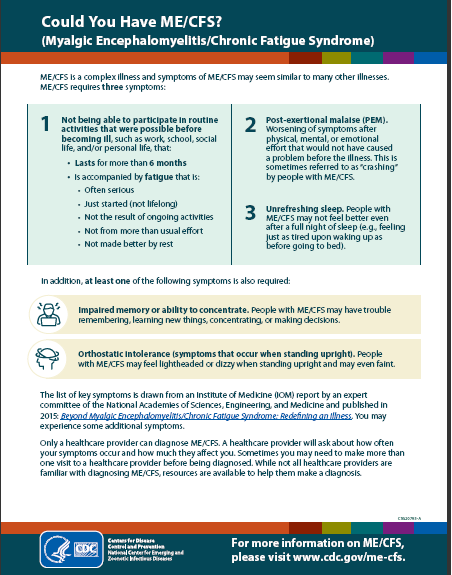
- Postexertional Malaise: Postexertional malaise and exercise intolerance are key symptoms of CFS and may help distinguish CFS from many other medical and psychological conditions. Activity that would rejuvenate or cause little trouble for a healthy person can result in a worsening of symptoms that necessitates days of bedrest. In one study, 75% of people with untreated CFS who performed a 5- to 12-minute incremental low-intensity treadmill test took longer than 3 days to recover (Stevens, 2004). Health care professionals responsible for rehabilitation should carefully consider this aspect of CFS when selecting and implementing interventions and should monitor and document patients’ reports of activity and exercise exacerbating symptoms. Having patients briefly track symptoms and function in a diary may more clearly illuminate this association for the patient and the therapist.
A subset of people with CFS are so severely ill that they are largely bedbound or housebound. They require special attention, including an approach to exercise that is focused on maintaining or increasing flexibility, minimizing the impact of deconditioning and developing the ability to accomplish activities of daily living. Assistance with coping skills and a review of behavioral factors are indicated as well.
"Energy Conservation in CFS Fact Sheet" is available in
Appendix B (PDF – 50KB).
- Postexertional Malaise: Postexertional malaise and exercise intolerance are key symptoms of CFS and may help distinguish CFS from many other medical and psychological conditions. Activity that would rejuvenate or cause little trouble for a healthy person can result in a worsening of symptoms that necessitates days of bedrest. In one study, 75% of people with untreated CFS who performed a 5- to 12-minute incremental low-intensity treadmill test took longer than 3 days to recover (Stevens, 2004). Health care professionals responsible for rehabilitation should carefully consider this aspect of CFS when selecting and implementing interventions and should monitor and document patients’ reports of activity and exercise exacerbating symptoms. Having patients briefly track symptoms and function in a diary may more clearly illuminate this association for the patient and the therapist.
Cognitive Behavioral Therapy (CBT): The goal of CBT is to help the patient understand their illness and to change perceptions, beliefs and behaviors that can contribute to the impact of symptoms. CBT is an important adjunctive therapy in many medical conditions, including cardiovascular disease, diabetes and cancer, and is central to therapy for many mental health conditions, such as depression and anxiety. Optimally, CBT results in better adaptation to illness and improved quality of life. Controlled clinical trials in CFS have shown that CBT can improve fatigue and activity levels, but has less impact on other symptoms (Deale et al., 2001).
For people with CFS, CBT is designed to promote a balance between activity, rest and leisure (Bleijenberg, Prins and Bazelmans, 2003; Taylor, Friedberg and Jason, 2001). People with CFS generally try to do more than they can capably manage without exacerbating symptoms. Specifically, they engage in a “push-crash” cycle in which they do too much, crash, rest, start to feel a little better, do too much once again, and so on (Bleijenberg et al., 2003). The techniques of CBT, including pacing, graded activity and graded exercise and related cognitive interventions, are intended to constructively alter this detrimental cycle.
Some people with CFS are reluctant to engage in CBT or exercise therapy because they perceive that a psychological treatment will be ineffective for their physical illness, or that exercise will aggravate their symptoms and should therefore be avoided. In these cases, it can be explained to the patient that lifestyle and stress can influence physical symptoms and illnesses. Health care professionals can assist patients in understanding the principles of CBT, including its successful application in treating other medical conditions. However, if patients are actively resistant to CBT or exercise therapy, it should not be forced upon him/her (Bleijenberg et al., 2003).
A “CBT Fact Sheet” is available in
Appendix C (PDF – 71KB).Graded Activity and Graded Exercise: Graded activity and exercise may be integral parts of CBT or they may be prescribed as stand-alone interventions supervised by rehabilitation specialists. The goals of graded activity are encouraging healthy, balanced activity patterns and promoting feelings of control and self-efficacy, important predictors of outcome in CFS patients (Prins et al., 2001; Vercoulen et al., 1996). Controlled trials have shown that graded exercise can be effective in decreasing fatigue and improving functioning (Fulcher and White, 1997; Wallman et al., 2004).
In contrast to exercise or conditioning programs for healthy people, graded activity or exercise in CFS management begins at much lower levels and increases more slowly. The initial goal should be to prevent further deconditioning. The temptation to adopt a traditional training program aimed at optimization of aerobic capacity should be firmly resisted (Bailey, 2003).
Activity must be started slowly and at low enough levels so as not to exacerbate fatigue, pain or other symptoms. It will be intermittent, brief, spread throughout the day and followed by rest. Therapists can help patients understand that activities of daily living reduce the energy available for other tasks. On busy days, patients may need to reduce other activities that day.
Patients who are caught in the “push-crash” cycle will likely need encouragement to reduce their activity levels at first. Initially, they should limit themselves to the basic activities of daily living—getting up, personal hygiene, dressing, essential tasks—until they have stabilized. Several daily sessions of brief, low-impact activity can then be added, such as one to three minutes of stretching, strength exercises or light aerobic activity (e.g., walking or cycling). These sessions are slowly increased (e.g., one to five minutes a week) as tolerance develops over two to six months. Daily exercise may be divided into two or more sessions to avoid symptom flare-ups. Intensity should not be the main focus of an exercise program; aim for a rate of perceived exertion between 9 (“very light”) and 12 (“somewhat hard”) on the Borg scale (U.S. Centers for Disease Control and Prevention, 2006, Instructions for Borg Rating of Perceived Exertion (RPE) Scale).
If patients experience an exacerbation in symptoms, they should return to the most recent manageable level of activity (Bleijenberg et al., 2003). Incorporating pacing, which allows patients to temporarily reduce their activity levels if they experience an exacerbation of fatigue or other symptoms, appears to be a beneficial addition to the traditional graded activity regimen (Lloyd, 2004; Wallman et al., 2004).
Because a major CFS symptom is exacerbation of illness after even minimal physical or mental activity, including standard physical therapy programs, many patients believe that exercise aggravates the underlying disease process and thus believe they must avoid activity (Lloyd, 2004).Reports of typical exercise programs, which are based on programmed, regular exertional increases, have made some people with CFS reluctant to initiate graded activity therapy. In these cases, health care professionals can provide encouragement to patients, assuring them that the therapy’s purpose is to reduce (not exacerbate) symptoms and improve function, and that the pace will be slow and based upon their individual tolerances and abilities. In the clinical setting, CFS graded exercise programs require both consistency and flexibility to be successful.
Strength and Conditioning: The goals of the strength and conditioning program for CFS management are similar to those of graded activity: improved strength and flexibility, reduced pain, better function and quality of life, greater mental clarity and a sense of accomplishment and control over symptoms. Standard rehabilitative methods, such as resistance training and flexibility exercises, are potentially useful in improving stamina and function (Stevens, 2004).
Activity begins slowly with simple stretching and strengthening exercises, using only the patient’s body weight as resistance. Patients must be closely monitored at first to make certain activity is not exacerbating symptoms. The goals are to promote increases in strength and range of motion, geared toward improving the ability to engage in activities of daily living.
Examples of functional exercises include repeated hand stretches, sitting and standing, or picking up and grasping objects. Patients might begin with one set of two to four repetitions, building to a maximum of eight repetitions. Focused breathing periods help facilitate recovery and strengthen the muscles of respiration. Each set should be followed by a rest break that lasts three times as long as the time it took to complete the set. Once this stage is mastered, resistance band exercises can be added to build strength and flexibility. The same principle of brief intervals of exercise, followed by adequate rest, applies to this stage. Interval training using a heart rate monitor and self-ratings of perceived exertion provides quantifiable feedback and teaches the person with CFS what level of exertion they can do to avoid postexertional malaise. As function improves, independence from the therapist is encouraged through education of the client about the safe and effective maintenance of these strategies in a home-based program.
Pacing/Envelope Theory: Energy management programs, such as pacing and envelope theory, are variations of CBT. They are based on the theory that people with CFS have finite levels of energy, and learning to live within their activity limits will avoid exacerbating symptoms. The underlying premise is that, by managing energy wisely, available energy will increase over time. Although they appear to be similar, the difference between this form of pacing and the type used in association with CBT is that CBT pacing is closely linked with other behavioral techniques that are presumed to increase physical functioning.
Activity pacing involves moderating activity to minimize the push-crash cycle and its consequences of more stress, discouragement and frustration (Taylor, Friedberg and Jason, 2001). Patients are advised to do specific activities, such as household tasks, in small, manageable portions with rest breaks, rather than in a single energy-depleting effort. Activity should be intermittent, spread evenly throughout the day, and should not cause an exacerbation of fatigue or other symptoms. To help sustain healthy pacing of activity levels, CBT can address patient self-criticisms of laziness and guilt, fears of increased disability and discouragement over the loss of pre-illness abilities. Once patients are stabilized, activity is incrementally increased (Bleijenberg et al., 2003). Envelope theory instructs people to view their available energy as though it were a bank account. If they overexert themselves, it is like being overdrawn at the bank and they have to pay it back by resting more the next day (Pesek, Jason and Taylor, 2000). Pacing also teaches that certain foods or stressful situations tap energy reserves in a similar manner as physical or mental activity. People are taught to adjust their activity as needed, based on individual preferences, needs and circumstances. As time passes, patients learn how much energy they can expend without experiencing the characteristic postexertional exacerbation of symptoms.
These methods tend to be supported by patients, even though there has been little formal research into their efficacy (CFS/ME Working Group, 2002, p. 51). The combination of pacing and graded activity/exercise, which allows patients to temporarily reduce their activity levels if they experience an exacerbation of fatigue or other symptoms, appears to be a beneficial combination for CFS patients (Lloyd, 2004; Wallman et al., 2004).
Other Health Issues: For many people with CFS, there are a number of health consequences of having CFS that can be addressed and often resolved with standard therapies before improvement in CFS can be expected.
- Stress, anxiety and depression: Many people with CFS experience symptoms of stress, anxiety and depression. Stress and anxiety may be reduced through relaxation training and resolution of their origins, and in some cases, combining medication and talk therapy may be required.
- Cognitive dysfunction: Memory and concentration complaints are two of the more distressing symptoms reported by people with CFS. Relaxation and meditation training and memory aids, such as organizers, schedulers and written resource manuals, can be helpful in addressing cognitive problems (Taylor and Kielhofner, 2003; Loy, 2006, section 4, Accommodating Employees with CFS). Behavioral health professionals may help the patient problem-solve and develop specific techniques for conducting activities of daily living that have become difficult. Referral to a neuropsychologist, neurologist or psychiatrist for evaluation and testing may be necessary in severe cases to determine whether other underlying conditions may be involved. It should be noted that training to improve cognition is a highly specialized therapy and requires input of trained behavioral health clinicians.
- Family issues: CFS impacts the entire family structure. In many cases the health care professionals will want to involve other family members to educate them and to resolve issues resulting from or related to CFS. This option is particularly true in the case of an adolescent with CFS.
- Empathy: People with CFS often feel misunderstood and isolated. They need reassurance that their health care professionals do not attribute all of their symptoms to psychological problems, accept their CFS diagnosis and the reality of their suffering and provide an environment where they may safely discuss issues regarding the impact of their illness.
- Counseling: A supportive counselor can help patients develop effective coping skills to manage the prospects of long-term illness, as well as family issues, anxiety, depression, grief, anger and guilt that frequently accompany any chronic illness. These problems can be addressed by a competent therapist using problem-solving techniques and standard psychotherapy and counseling methods.
- Support groups: Many people with CFS report that support groups can help fulfill their needs for information and a sense of community (Afari and Buchwald, 2003). Health care professionals can encourage their patients to seek out support groups with a positive focus.
Please note: Some of these publications are available for download only as *.pdf files. These files require Adobe Acrobat Reader in order to be viewed. Please review the information on downloading and using Acrobat Reader software.
Content Source: National Center for Zoonotic, Vector-Borne, and Enteric Diseases (ZVED)