Chapter One, Course WB1032
Possible Contributing Factors
Many hypotheses concerning the causes and pathophysiology have been raised, but no conclusive evidence in support of any single cause of CFS has been found. The multisystem nature of the illness along with the inherent interrelationship and interdependence of body systems further complicates the search for answers. It is unclear whether CFS has a single cause or represents a common pathophysiologic process following multiple precipitating factors; therefore, the current theories on CFS listed below should not be viewed as mutually exclusive. Each of these theories represents an active area of research and include:
- Infectious Agents: A large body of research has failed to document an association between any infectious agent and CFS (Natelson et al., 2002). Most importantly, no scientific evidence exists to indicate that CFS is contagious or that it can be transmitted from person to person. It is clear, however, that a prolonged fatiguing illness or post-infection fatigue syndrome that meets the 1994 CFS definition can follow infection with a number of agents (Hickie et al., 2006).
- Immune System Defects: The pathophysiology of CFS may involve perturbations of the immune system or in the patient’s immune response to various stimuli. Some researchers hypothesize that “trigger events,” such as unusual stress or a viral infection, may disrupt normal immune system function. Studies have reported a decreased number and function of natural killer cells or an overproduction of cytokines, but consistent evidence has not been found.
- Neuroendocrine Dysfunction: Several studies have reported neuroendocrine involvement, but whether these findings play a role in CFS pathogenesis or are a consequence of chronic illness is unclear. Hypothalamicpituitary-adrenal (HPA) dysfunction and reports of pituitary and adrenal impairment have not generated a consistent explanation. Some studies have shown that levels of the stress hormone, cortisol, is low in CFS. Additional research is necessary to further explore the role of neuroendocrine abnormalities in CFS.
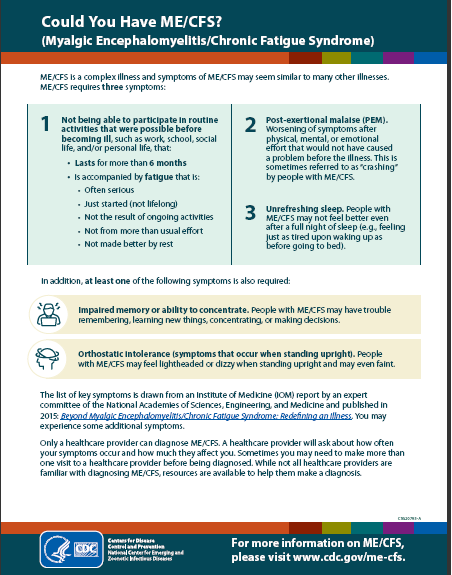
- Autonomic Nervous System (ANS) Dysfunction: Many CFS patients report lightheadedness or increased fatigue when they stand or sit for prolonged periods or when in a warm environment and this is similar to the manifestations of orthostatic instability. In 1995 researchers at Johns Hopkins University (Rowe et al.) first reported an association of orthostatic instability and CFS. Subsequent studies have not uniformly confirmed their findings.
- Gene Expression: The activation of different genes in CFS is being explored by CDC and other research groups. A preliminary 2002 study (Vernon et al.) of gene expression profiles of peripheral blood mononuclear cells of subjects with CFS and healthy controls found eight genes were differentially expressed. Several of the differentially expressed genes are associated with immunologic functions. Another preliminary analysis of microarray data revealed differential expression of 35 genes. Real time PCR confirmed differential expression in the same direction as array results for 16 of these genes with a profile suggesting T cell activation and perturbation of neuronal and mitochondrial function (Kaushik et al., 2005). Further studies of larger patient and control cohorts are ongoing.
- Sleep Disorders: The majority of CFS patients report disordered sleep (Unger et al., 2004). The results of sleep deprivation on multiple body systems is well-documented and can contribute to fatigue, cognitive dysfunction, pain, alterations in mood and psychological functioning and possibly immune and neuroendocrine disturbances. Further studies on the prevalence and effects of sleep disorders in CFS are needed.
- Other possible causes: Affective disorders, stress, deconditioning, oxidative stress or defective oxidative metabolism, [cellular] mitochondrial pathology, cardiovascular anomalies and other psychological and physical factors have been explored as possible causes of CFS, but evidence is inconsistent or preliminary. A causative role for these other factors in production of the illness is still undocumented, although they may lead to further complications or serve to prolong illness.
The general consensus of most CFS researchers is that many factors produce the syndrome. It may be that a genetically or situationally predisposed host, when confronted by stress or other insults, comes in contact with a “triggering event” that upsets the body’s normal functions (including the immune and endocrine systems). After this “hit and run” event, flu-like symptoms, pain and cognitive problems result from persistently altered pathways to the central nervous system. Understanding the pathogenesis of CFS—its effect on the body and the brain—is a primary goal of ongoing biomedical research.
Another formulation of the origins of CFS describes a variety of predisposing or associated factors that result in a recognizable pattern of symptoms and impairment. Proponents of this view have sought to study the origins of CFS by using a biopsychosocial model in which the body and mind influence each other’s function and activity. This model includes three general factors involved in the onset and clinical course of CFS: risks, triggers and perpetuators.
- Predisposing/risk factors: those that make a person more susceptible to CFS
- Triggering factors: those which, when experienced by a susceptible person, lead to the onset of CFS
- Perpetuating factors: those that delay or prevent improvement
Essentially all studies have shown that women are at least 3 to 4 times more likely to develop CFS than are men. Physical and mental stress and acute infectious diseases have been associated with CFS, but the specific nature of their association (risk vs. triggering factors) is unknown. How risk factors impact responses to infections or other stresses that precede chronically fatiguing illnesses remains unclear. Finally, other conditions that occur in many individuals with CFS (e.g., sleep disorders, hormonal disturbances or psychiatric conditions) may represent comorbid illness unrelated to CFS, may result from CFS, may be causally associated with risk of CFS, or could share the same pathophysiologic pathways and risk factors.
- Effects of Exertion: Unusual exacerbation and prolonged duration of symptoms following physical or mental exertion is one defining symptom of CFS. This atypical response to exertion is reported by most patients, and is of particular importance to those responsible for therapy and rehabilitation of people with CFS. As discussed below, individually designed and supervised rehabilitation therapy is important in the care plan for patients with CFS. Patients can learn to modify their activities to avoid postexertional malaise and therefore improve their health status and function. Postexertional exacerbation of the illness must be considered when developing interventional strategies for people with CFS. It is essential that rest and activity are balanced to avoid both deconditioning from lack of activity and flare-ups of illness due to overexertion.
Content Source: National Center for Zoonotic, Vector-Borne, and Enteric Diseases (ZVED)