Surveillance
Behavioral Risk Factor Surveillance System (BRFSS) Perceived Cognitive Impairment Module
Frequently Asked Questions
- What is cognitive impairment and what are its causes?
- What are the public health impacts of cognitive impairment for states and communities?
- Why was the module developed?
- How was the module developed?
- What does the module measure?
- How does this module differ from other modules on the BRFSS?
- What states have used the module?
- What can the data from the module tell us?
- Are there considerations to take into account when reporting these data?
- Where can I get more information?
- What if I want technical assistance?
What is cognitive impairment and what are its causes?
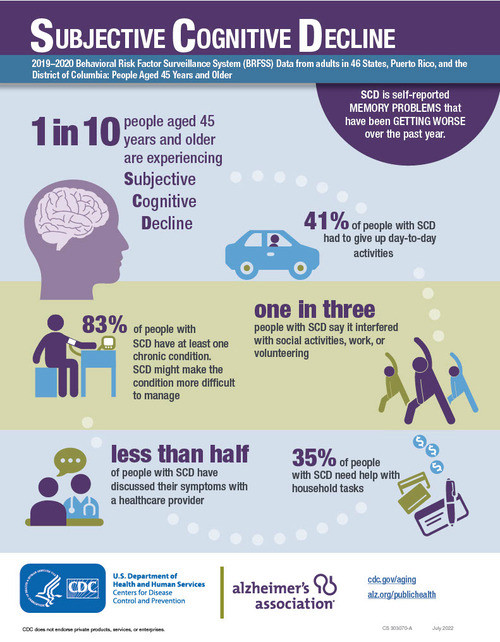
Cognitive impairment (CI) can affect a person's memory, language, perception, ability to plan and carry out tasks, and judgment. The degree of CI can range from mild to serious. On one hand, it might be noticeable to others and measurable on cognitive tests but not severe enough to interfere with daily activities such as shopping, working, socializing, and driving. On the other hand, more serious CI can significantly disrupt a person's life, to the extent that they are unable to take care of themselves, and need help with basic needs such as bathing and eating. Other problems resulting from more serious impairment include being unable to remember to take medications or follow instructions for coping with existing medical conditions.
CI does not have a single cause but common causes include Alzheimer's disease, stroke, brain injury, and developmental disabilities. In addition, temporary CI can occur as a result of nutritional deficiencies and drug interactions. Although cognitive impairment happens more frequently as people become older, younger people can also be affected.
What are the public health impacts of cognitive impairment for states and communities?
CI is an important issue for states and communities because it can lead to an increase in healthcare and long term care needs, as well as major caregiving and financial challenges for families and society. Because older adults in the United States are increasing in number and in proportion, this has resulted in increased attention on this key public health issue.
In 2007, the CDC Healthy Aging Program, in collaboration with national experts, developed a ten-question Behavioral Risk Factor Surveillance System (BRFSS) module to assess the public's beliefs about cognitive impairment and its associated impact or burden. This work was guided by an increased recognition about the importance of CI as a public health issue, and was fueled by the recommendation to develop population-based surveillance of CI in The Healthy Brain Initiative: A National Public Health Road Map to Maintaining Cognitive Health [PDF–2.6M].
The BRFSS was selected because it has a long history of helping states survey U.S. adults about a wide range of behaviors that affect their health. The primary focus of these surveys has been on behaviors and conditions that are linked with the leading causes of death—heart disease, cancer, stroke, diabetes, and injury—and other important health issues. Like several other measures included on the BRFSS, such as visual impairment or disability, there is no standard definition of CI and no existing set of questions available for the BRFSS telephone survey. As a result, we consulted with a national panel of experts to develop the items that would be subsequently cognitively tested and determine the best approach.
A multi-step process was used to develop the questions for the module. A scientific literature review was conducted to identify existing surveys and questions that measure CI (http://www.ncbi.nlm.nih.gov/pubmed/19525214). Next, a panel of subject matter experts met to guide development of the module. The panel reviewed questions used on other surveys, adapted existing questions, and developed a set of 33 possible questions for the module. The panel decided which concepts were the most important to measure and which questions best measured these concepts. The module was finalized after four rounds of cognitive testing and field testing in California's BRFSS survey during fall 2008. Five states (CA, FL, IA, LA and MI) pilot-tested the module in their BRFSS surveys in 2009.
The module asks the respondent's perception about "confusion or memory loss (in the past 12 months) that is happening more often or is getting worse," and thus does not refer to a specific diagnosis. Because the questions measure the respondent's perception and are not trying to assess whether the person has a medical condition or diagnosis, we recommend that the measure be referred to as perceived cognitive impairment (PCI).
If a respondent answers "yes" to this question, other questions from the module are asked to help understand the burden of PCI. These questions address how often PCI causes individuals to give up household chores or interferes with work, volunteering, or social activities, need for assistance, and any medical follow-up and treatment they received as a result of confusion or memory loss.
The module can be viewed at: http://www.cdc.gov/aging/pdf/impact_of_cognitive_impairment_module.pdf [PDF–46K]
How does this module differ from other modules on the BRFSS?
Most questions on BRFSS ask only about the respondent, and much of the information from the CI module can be analyzed just like other BRFSS questions. Additionally, this module asks questions about other household members, and can provide information about the household through further analysis. Other BRFSS questions that have addressed households include children in the household with asthma, general (emergency) preparedness, CO detectors, radon testing and firearms in the home.
In addition to the individual and household data, the expert panel that helped develop the questions for the module recommended using a novel approach in BRFSS by collecting proxy data. Thus, if the adult being surveyed does not report PCI and indicates there are other adults in the household with confusion or memory loss, the follow-up questions are asked about the other adult living in the household. To our knowledge, no other BRFSS questions currently use proxy-level measures, and weights are not available for analyzing these data. However, un-weighted data comparing proxy respondent data with that from selected respondents in other households can provide useful context about the burden of cognitive impairment occurring in the state.
The box below provides more details about each of the levels for which data can be gathered using the module.
Respondent (similar to other measures on BRFSS)
Person selected through BRFSS random survey method
Individual reports having PCI in Question 1 and answers questions about himself or herself
Household (household weight is used)
Constructed through data analysis
Question 1 (if the individual reported that they themselves have PCI) + Question 2 (if others in the household have PCI)
Proxy (no weights are available, un-weighted data)
BRFSS Respondent does not report PCI for self, and reports another other person(s) living in the household with PCI (identified in Questions 2 and 3) and answers questions about that person (or person selected in Question 2 if there is more than one person with perceived cognitive impairment in the household)
What states have used the module?
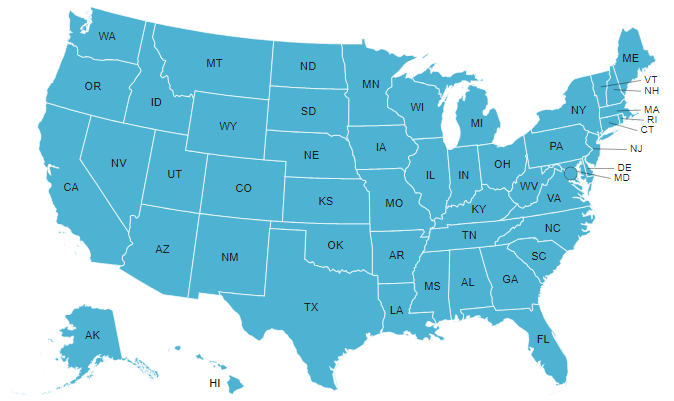
A total of 37 states and the District of Columbia included the module in their BRFSS to date.
- In 2009, the following 5 states pilot tested the module: Florida, Louisiana, Michigan, California and Iowa
- In 2011, the following 22 states included the module as an optional module: Arkansas, California, Florida, Georgia, Hawaii, Illinois, Iowa, Louisiana, Maryland, Michigan, Nebraska, New Hampshire, New York, North Carolina, Oklahoma, South Carolina, Tennessee, Texas, Utah, Washington, West Virginia, and Wisconsin.
- In 2012, the following 24 states included the module as state-added questions: Alabama, Arizona, Arkansas, California, Connecticut, Georgia, Indiana, Iowa, Kentucky, Louisiana, Maine, Maryland, Mississippi, Missouri, Nevada, New Jersey, North Dakota, Ohio, Oregon, Virginia, West Virginia, Wisconsin, Wyoming and the District of Columbia.
What can the data from the module tell us?
The module can provide state-level data leading to valuable insights, such as:
- The percent of adults reporting perceived cognitive impairment and the percent of older adults (e.g. age 60 and older) reporting PCI.
- Reported need for assistance due to perceived cognitive impairment and impact on everyday activities
- Characteristics of adults with PCI (respondent-level data can be linked to other BRFSS measures such as health insurance and chronic conditions.)
- Households in which any adults have PCI*
- Adults with PCI who are the only adult in the household*
- Households in which all adults report PCI*
- Further context about PCI through un-weighted proxy-level responses
* The Healthy Aging Program recommends that cell phone data are treated as single households and not included in the household measures.
Are there considerations to take into account when reporting these data?
It is important to understand that any measure of CI obtained from the BRFSS is meant for public health purposes to help describe the problems associated with CI in states and communities. Thus, it is not appropriate to compare with other measures of CI or dementia.
Because the first question measures the respondent's perceptions and is not attempting to assess whether or not the person has a medical condition or a medical diagnosis, the data are not intended to be reported as a prevalence measure of CI.
Preliminary data indicate that adults of all ages report PCI. There is no way to determine from the data the factors contributing to the memory loss and confusion reported by younger adults as the causes and possible progression may differ from that of older adults.
As is the case with BRFSS questions in general, it is important to remember that the BRFSS only surveys households and does not include residents of nursing homes, group homes, or other facilities. In addition, if the selected respondent is unable to respond to the survey because of physical or mental problems, the entire household is removed from the sample. Thus respondents who complete the survey have been deemed by themselves or another household member to be mentally fit to respond to the survey.
Cell phone data are being included for the first time in 2011 but states may opt to not ask optional modules on cell phone surveys. In addition, cell phone respondents are considered to be one-adult households so the household and proxy measures would not apply to those interviews.
Where can I get more information?
It is recommended that researchers not familiar with BRFSS data analysis become familiar with the methods unique to BRFSS data analysis, including weighting and raking methods. More information can be found at: http://www.cdc.gov/brfss/technical_infodata/index.htm. Additionally, because the module is new and because it takes an innovative approach to collecting data at the respondent, proxy and household levels, there are concerns unique to the module that should be considered in data analysis. You may wish to contact your state BRFSS Coordinator (http://apps.nccd.cdc.gov/BRFSSCoordinators/coordinator.asp) or the Healthy Aging Program for more information.
What if I want technical assistance?
Technical assistance for states is available for the CI module and accessible by contacting the Healthy Aging Program.
Contact Us:
- Centers for Disease Control and Prevention
Healthy Aging Program
4770 Buford Highway, N.E., Mailstop K-45
Atlanta, GA 30341-3717 - 800-CDC-INFO
(800-232-4636)
TTY: (888) 232-6348
8am-8pm
ET/Monday-Friday
Closed Holidays - cdcinfo@cdc.gov