



Key points
- The Class of 2027 fellowship application will be open March 9–June 19, 2026.
- The Epidemic Intelligence Service (EIS) is CDC’s globally recognized applied epidemiology training program.
- Established in 1951, EIS has trained over 4,100 disease detectives who have investigated and responded to a wide range of public health challenges and emergencies.
Overview
EIS offers an unparalleled service and learning program. EIS officers are CDC's disease detectives who learn from and work alongside subject matter experts while providing service to domestic and international partners. EIS maintains its core focus on training disease detectives to practice consequential epidemiology, which is the collection, analysis, and interpretation of data for evidence-based public health action.
EIS was among the first programs to be accredited by the Training Programs in Epidemiology and Public Health Interventions Network (TEPHINET), the global network for field epidemiology training programs (FETPs), during their first accreditation cycle in 2016. During the 2023 reaccreditation cycle, EIS achieved reaccreditation at a new and higher level, earning distinction in all standards and merit in all thematic areas.
EIS will continue preparing generations of public health leaders for years to come. The EIS program plays a critical role in strengthening the public health workforce. We are focused on preparing a workforce that is ready to face existing and emerging public health threats. For both EIS officers and our staff, we are committed to attracting and recruiting highly trained and service-oriented applicants from a variety of disciplines, experiences, backgrounds, and perspectives.
Did You Know?

Timeline
Milestone Investigations
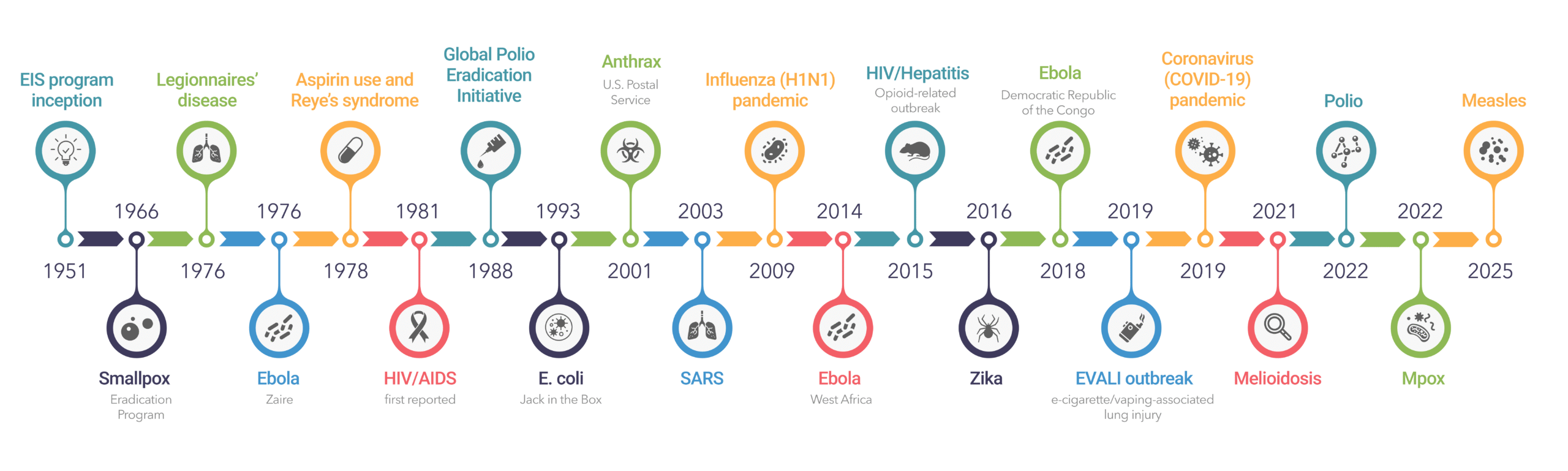
EIS has a 75-year history of success in training disease detectives. EIS officers step up at a moment's notice to investigate public health threats in the United States and around the world. From the Smallpox Eradication Program in the 1960s to the measles outbreak in 2025, EIS officers are called on to protect people and save lives.
Preparedness
EIS has changed all elements of their program to be better prepared to respond and serve
The EIS program constantly evolves as the field of epidemiology, the science of learning and communication, and the needs of CDC and state and local health departments change over time. With most EIS officers remaining in public health positions after the fellowship, the EIS program is uniquely positioned to have an impact on public health.
We recognize this opportunity and accept the responsibility to recruit, select, and train EIS officers and program staff from a breadth of backgrounds who are well prepared to respond to existing and emerging public health threats. The following describes some examples of how we do this as a program:
Recruitment
- Provide live and recorded webinars for all interested applicants about the EIS experience and the EIS application process
- Host virtual participation opportunities for EIS conference attendees to learn about the program
- Work with partners to increase awareness of the program
Selection
- Hold virtual interviews to reduce barriers for applicants to participate across geographic locations
- Invite Selection Advisors (from outside of the EIS program) to review and participate in the fellowship selection process; this promotes transparency and ensures that the process is standardized and fair
- Train staff involved as application reviewers and interviewers to ensure a standardized and fair process
Training
- Facilitate trainings for EIS officers based on best practices for addressing all factors that influence health outcomes
- Require programs that host EIS officers (or host sites) to describe how projects would consider all factors that influence health outcomes
Reports

The Epidemic Intelligence Service 2025 Annual Update features recent program highlights, response work summaries, EIS class demographics, and more. See previous annual reports on the archived page.

The Epidemic Intelligence Service Fact Sheet provides a quick overview of the EIS program, what officers do, why this program matters, and a closer look at how EIS officers protect health and save lives.
Historically Significant Publications
- Epidemiologic field investigations by the Centers for Disease Control and Epidemic Intelligence Service, 1946–87Goodman RA, Bauman CF, Gregg MB, Videtto JF, Stroup DF, Chalmers NP. Public Health Rep. 1990;105(6):604–610.Discusses the epidemiologic field investigation as an important tool CDC uses to assist state, local, and international public health agencies.
- Applied epidemiology for the 21st Century Thacker SB, Buffington J. Int J Epidemiol. 2001;30(2):320–325.
Reviews literature examining key issues in epidemiologic practice and training. - Veterinarians and public health: the Epidemic Intelligence Service of the Centers for Disease Control and Prevention, 1951–2002 Pappaioanou M, Garbe PL, Glynn MK, Thacker SB. J Vet Med Educ. 2003;30(4):383–391.
Puts forth EIS as a career option for veterinarians. - Bright, Aggressive, and Abrasive:" A History of the Chief Epidemic Intelligence Service Officer of the U.S. Centers for Disease Control and Prevention, 1951 – 2006. Kelsey, Hugh J. Thesis, Georgia State University, 2006.
Examines the evolving roles of the Epidemic Intelligence Service Chief, program, and CDC in relation to public health history. - Epidemiology and public health at CDC CDC. Morb Mortal Wkly Rep. 2006;55(Suppl No. 2):3–4.
Defines epidemiology and traces its relationship with public health at CDC. - The Epidemic Intelligence Service: The Centers for Disease Control and Prevention's Disease Detectives Hamilton DH. Virtual Mentor. 2006;8(4):261–264.
Highlights early and more recent investigations that reflect the EIS program's key philosophy—to train epidemiologists to respond to the whole spectrum of public health emergencies. - Epidemic Intelligence Service of the Centers for Disease Control and Prevention: 50 years of training and service in applied epidemiology Thacker SB, Dannenberg AL, Hamilton DH. Am J Epidemiol. 2011;154(11):985–992.
Highlights the changing experience of EIS officers because of increased need for more sophisticated analytical methods and tools, as well as CDC's expanded mission into chronic diseases, environmental health, occupational health, and injury control. - Fifty-Five Years of International Epidemic-Assistance Investigations Conducted by CDC's Disease Detectives Rolle IV, Pearson ML, Nsubuga P. Am J Epidemiol. 2011;174(11 Suppl.):S97–112.
Focuses on the evolution of EIS officers' international epidemiologic field investigations and how they contribute to global disease prevention and control, public health science, and health policy. - Introduction: The Centers for Disease Control and Prevention's Epi-Aids—A Fond Recollection Koplan JP, Foege WH. Am J Epidemiol. 2011;174(11 Suppl.):S1–3.
Reflects on the evolution of the Epi-Aid; a written summary of a field investigation and a key element of the EIS officers' experience. - Vaccine-preventable Diseases, Immunizations, and the Epidemic Intelligence Service Hinman AR, Orenstein WA, Schuchat A. Am J Epidemiol. 2011;174(11 Suppl.):S16–22.
Describes past and future role of EIS in vaccine-preventable diseases epidemiology and immunization program implementation. - The Epidemic Intelligence Service: An exciting opportunity for pharmacists to improve population health Minhaj FS, Carranza D, Adeyemo A, Smith DJ. J Am Pharm Assoc. 2022 Apr 20:S1544-3191(22)00129-7.
Puts forth EIS as a career pathway for pharmacists. - Epidemic Intelligence Service Alumni in Public Health Leadership Roles So M, Winquist A, Fisher S, Eaton D, Carroll D, Simone P, Pevzner E, Arvelo W. Int J Environ Res Public Health. 2022 May 30;19(11):6662.
Examines the EIS program's effect on graduates' leadership outcomes.