Mining Topic: Hearing Loss Prevention Overview
What is the health and safety problem?
Trouble Hearing
One out of every four mine workers has a severe hearing problem. Even worse, four out of five mine workers have a hearing impairment when they reach mid-60’s retirement age. Hazardous noise is the primary culprit – 76% of mine workers are exposed to hazardous noise, the highest prevalence of all major industries.
What is the extent of the problem?
Noise-induced hearing loss (NIHL) is a permanent affliction that interferes with a mine worker’s ability to communicate with family, friends, and co-workers. It also creates a safety hazard when mine workers are unable to hear moving machinery and warnings. In addition, many afflicted with NIHL also experience tinnitus—a ringing or buzzing sound that persists in the absence of any real sound—which can be intensely stressful and annoying.
How is OMSHR addressing this problem?
NIHL is being addressed in all areas of the mining industry, including both surface and underground for all commodities. Initially, the noise control efforts concentrated on underground coal mine noise and produced solutions for continuous mining machines, roof bolting machines, and the vibrating screens used in preparation plants. Current work by the Office of Mine Safety and Health Research (OMSHR) is addressing mobile equipment in underground metal/nonmetal mines with an emphasis on haul trucks.
The ultimate strategic goal of this research program is to reduce NIHL in the mining industry. To accomplish this goal, the program will:
- Develop durable and practical noise controls for mining equipment.
- Attain widespread industry implementation of noise controls.
- Evaluate the short-term and long-term effectiveness of noise controls by acquiring surveillance data.
What are the significant findings?
A dual-sprocket continuous mining machine chain was developed that reduced sound levels by 2-3 dB(A) at the operator ear. It was commercialized by Joy Mining Machinery in 2008 and had been implemented on over 30% of the machines in the U.S. by 2012.
A drill bit isolator based on OMSHR technology was found to reduce noise reaching the operator ear by 2-5 dB(A). It was commercialized by Corry Rubber and Kennametal in 2011.
A dual-sprocket urethane-coated continuous mining machine chain was developed and was found to reduce noise reaching the operator ear by 5-7 dB(A). It was commercialized by Joy Global in 2012
What are the next steps?
The program is evaluating additional metal/nonmetal machines for noise hazards to be addressed through noise controls. OMSHR researchers are also developing an enhanced modeling capability to develop noise controls more efficiently and conduct evaluations in the simulated acoustic environment of a computer-modeled mine.
Noteworthy Publications & Products
An Evaluation of Sound Restoration Hearing Protection Devices and Audibility Issues in Mining (2012-08)
This paper presents test results from a selection of four sound restoration hearing protection devices, with the objective of determining whether they provide improved speech intelligibility to workers near certain types of mining equipment.
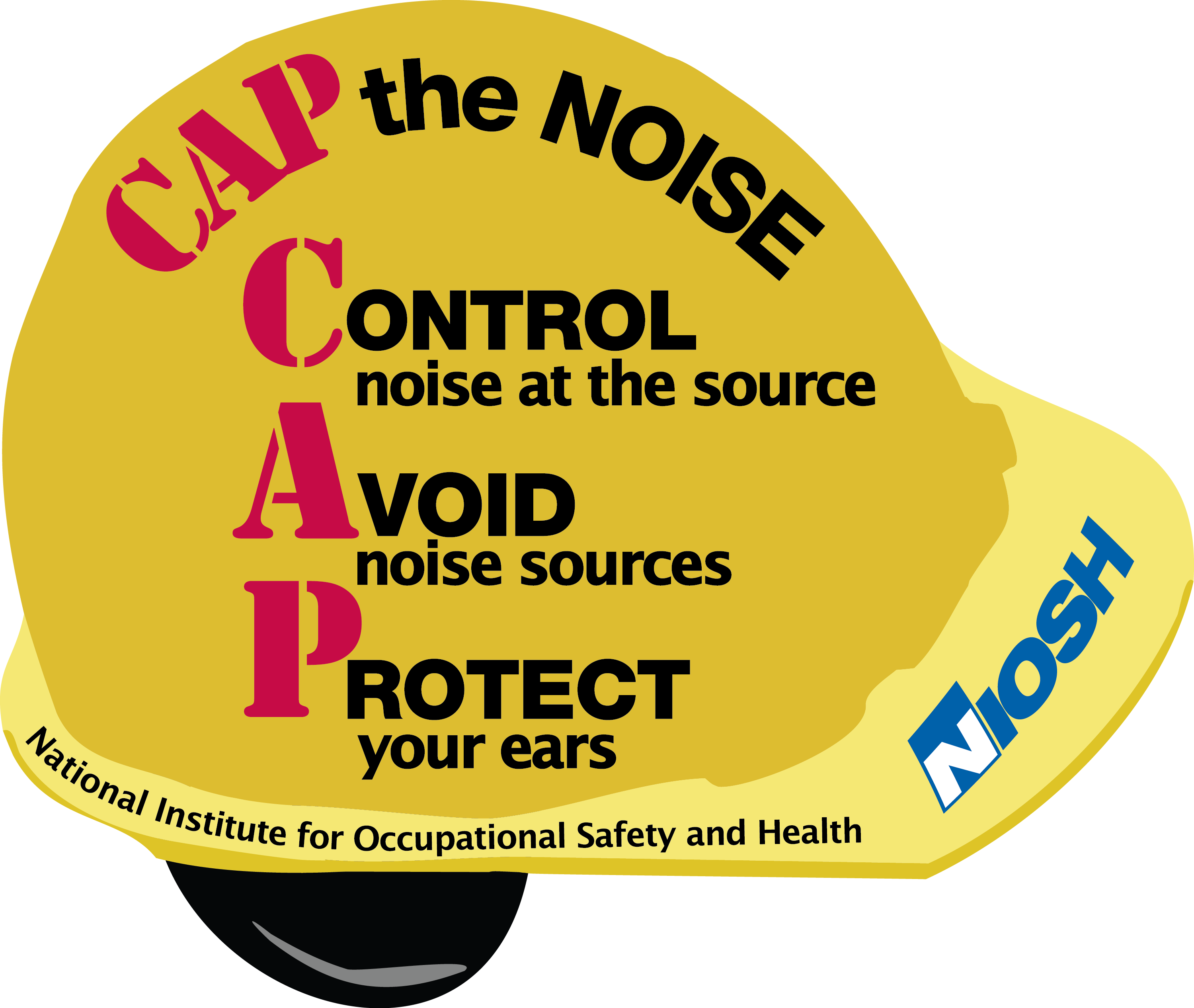
CAP the Noise to Save your Hearing! (2011-03)
This publication addresses what you can do when you are exposed to hazardous noise.
DOSES - Determination of Sound Exposures (2012-09)
Software to simplify the record-keeping and analysis associated with time-motion studies and worker noise exposures, making it easier to identify and solve noise problems.
Equipment Noise and Worker Exposure in the Coal Mining Industry (2012-08)
This study presents a NIOSH cross-sectional survey of noise sources and worker noise exposures, discusses the survey's application to administrative and engineering controls, and reviews exposure reduction methods.
Hearing Loss in the Mining Industry: The Evolution of NIOSH and Bureau of Mines Hearing Loss Research (2011-03)
The NIOSH strategy expands on decades of research by its U.S. Bureau of Mines predecessors that identified some of the key issues with underground and surface noise sources.
HLSim - NIOSH Hearing Loss Simulator (2013-02)
A software training and communication tool for demonstrating the effects of noise exposure on hearing without experiencing an actual noise-induced hearing loss.- How Can I Test My Hearing Protection? (2013-02)
Use the sound player on this page to perform a quick test of whether you are getting at least a minimal 15 decibel (dB) level of protection.
Noise Control in Underground Metal Mining (2012-08)
This document describes principles of noise control to operators, safety personnel, and mechanics in the mining industry so that they can evaluate the extent of a noise problem, determine the best approach, and apply the most appropriate solution.
Technology News 531 - Engineering Controls for Reducing Continuous Mining Machine Noise (2013-03)
This publication describes research conducted by NIOSH on producing treatments to reduce noise generated by the continuous mining machine conveyor system. The treatments discussed are the urethane-coated flight bar chain and the dual-sprocket chain.
Technology News 548 - Bit Isolator Reduces Drilling Noise in Underground Coal Mines (2012-08)
This paper describes an engineering noise control that reduces roof bolting machine (RBM) operators’ exposure to noise in underground coal mines, thereby decreasing the risk of noise-induced hearing loss (NIHL) in RBM operators and nearby workers.- What Does a Hearing Loss Sound Like? (2012-09)
Loud noise can permanently damage your hearing. It especially affects the sounds that help you understand speech. To hear what this sounds like, try these computer-generated samples.
On This Page
Contact Us:
- Office of Mine Safety and Health (OMSHR)
- National Institute for Occupational Safety and Health (NIOSH)
- Centers for Disease Control and Prevention
- 800-CDC-INFO
(800-232-4636)
TTY: (888) 232-6348 - New Hours of Operation
8am-8pm ET/Monday-Friday
Closed Holidays - omshr@cdc.gov