Mining Topic: Fire Fighting
What is the health and safety problem?
Mine fires occur every year due to equipment malfunction, spontaneous combustion, frictional ignition, cutting and welding, lightning, and other causes. Misaligned or damaged conveyor belts are often the source of frictional heating that leads to fires. Further, fire suppression systems do not always function as intended. Many mines conduct regular firefighting training for their workforce and some mines support specially equipped fire brigades. When a fire occurs, mine workers not engaged in extinguishing it must evacuate the area inby the fire, sometimes under significantly impaired visibility from smoke or difficult environmental conditions.
The spontaneous heating of coal in mines often occurs in gob areas and may not be easily detected. The risk of an explosion ignited by a spontaneous combustion fire is also present in mines with appreciable levels of accumulated methane. A project was conducted to develop new methods to prevent, detect, control, and suppress spontaneous heating in western coal mines.
What is the extent of the problem?
Since 2000, more than 150 underground mine fires have occurred in the United States. In fact, three of the mine fires since 2000 resulted in subsequent methane explosions. Two mine workers were fatally injured as a result of an underground mine conveyor belt fire in 2006 in West Virginia. During the same time period, 25 spontaneous combustion fires have been reported in underground coal mines. Generally there are over 50 face ignitions reported to the Mine Safety and Health Administration (MSHA) every year.
How is the NIOSH Mining program addressing this problem?
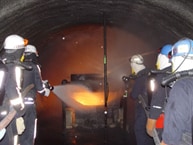
Fire fighters in training to fight a mine belt fire.
Section 11 of the MINER Act of 2006 required that a Technical Study Panel be formed to provide recommendations on the use of belt air and new technology that may be available for increasing the fire resistance properties of conveyor belts used in underground coal mines. The Office of Mine Safety and Health Research (OMSHR) has been working on research to reduce the hazards of underground coal mine fires. A project focusing on applying recent technological advances in the areas of fire-resistant and fireproof belt materials, and belt fire suppression systems was completed. A current project is working on atmospheric monitoring systems, and computer codes for predicting and assessing, in real time, the impact of fire on the mine ventilation system and the spread of fire contaminants throughout the mine.
OMSHR completed a long-running emergency response research program that included interacting with 440 fire fighters and 3,200 mine rescuers, identifying methods to improve skills that are now incorporated in expanded mine rescue training events. The Mine Rescue and Escape Training Laboratory was used to determine optimal use of virtual reality (VR) technologies for training and assessing mine emergency responders. Responders include specially trained individuals, such as mine rescue or fire brigade team members, and also managers and mine workers who may be called upon to respond to an emergency situation.
Computational fluid dynamics modeling techniques were used to simulate the spontaneous heating of coal in longwall gob areas. These simulation results were used to evaluate spontaneous combustion control methods and to determine nitrogen injection strategies to prevent/suppress the spontaneous heating in longwall gob areas.
What are the significant findings?
The number of conveyor belt fires and injuries/fatalities due to fire can be significantly reduced by fire-resistant and fireproof belt materials, well-designed belt fire suppression systems, and atmospheric monitoring systems to detect incipient heating. Real-time prediction of the impact of fire on the mine ventilation system and the spread of fire contaminants throughout the mine is possible with new software.
What are the next steps?
OMSHR will continue both laboratory and field evaluations of novel and emerging technologies to keep mine fires from starting, control fires after they become large enough to detect and suppress, and train and equip human fire fighting efforts. Plans are also in the works to incorporate atmospheric monitoring system sensor data into the mine fire simulation program, MFIRE, to develop innovative firefighting strategies.
- Application of Gas-Enhanced Foam at the Excel No. 3 Mine Fire
- Development of a Gas Monitor Simulator and Mine Rescue Contest Field Trials
- Effect of Air Velocity on Conveyor Belt Fire Suppression Systems
- Effect of Longwall Face Advance on Spontaneous Heating in Longwall Gob Areas
- Effects of Ventilation and Gob Characteristics on Spontaneous Heating in Longwall Gob Areas
- The Effects of Ventilation and Preburn Time on Water Mist Extinguishing of Diesel Fuel Pool Fires
- Evaluation of a Novel Fire Blocking Gel to Prevent and Suppress Mine Fires
- Evaluation of Smoke Detectors for Use in Underground Mines
- Evaluation of the Bagged Stone Dust Barrier Effectiveness in a Bord and Pillar Mine
- Final Report of the Technical Study Panel on the Utilization of Belt Air and the Composition and Fire Retardant Properties of Belt Materials in Underground Coal Mining
- Fire Response Preparedness for Underground Mines
- A Global Inventory of Mine Rescue Training Facilities: Compendium of Ideas to Improve U.S. Coal Mine Rescue Training
- Inflatable Partitions for High-Expansion Foam Generators
- In-Mine Study of High-Expansion Firefighting Foam
- Mine Fires - Measuring the Efficacy of Gas-Enhanced Foam
- Mine Rescue Training Facility Inventory - Compendium of Ideas to Improve US Coal Mine Rescue Training
- Performance-Based Fire Safety Designs for Self-Escape in Underground Mines
- Reducing the Fire and Explosion Hazards of Flame-Cutting and Welding in Underground Coal Mines
- Technical Solutions for Enhancements to Mine Safety Using Barricade II Fire Blocking Gel
- Testing and Evaluation of an Inflatable Temporary Ventilation Control Device