Skip directly to search Skip directly to A to Z list Skip directly to navigation Skip directly to site content Skip directly to page options
CDC Home

Prevention & Control

Risk of Infection

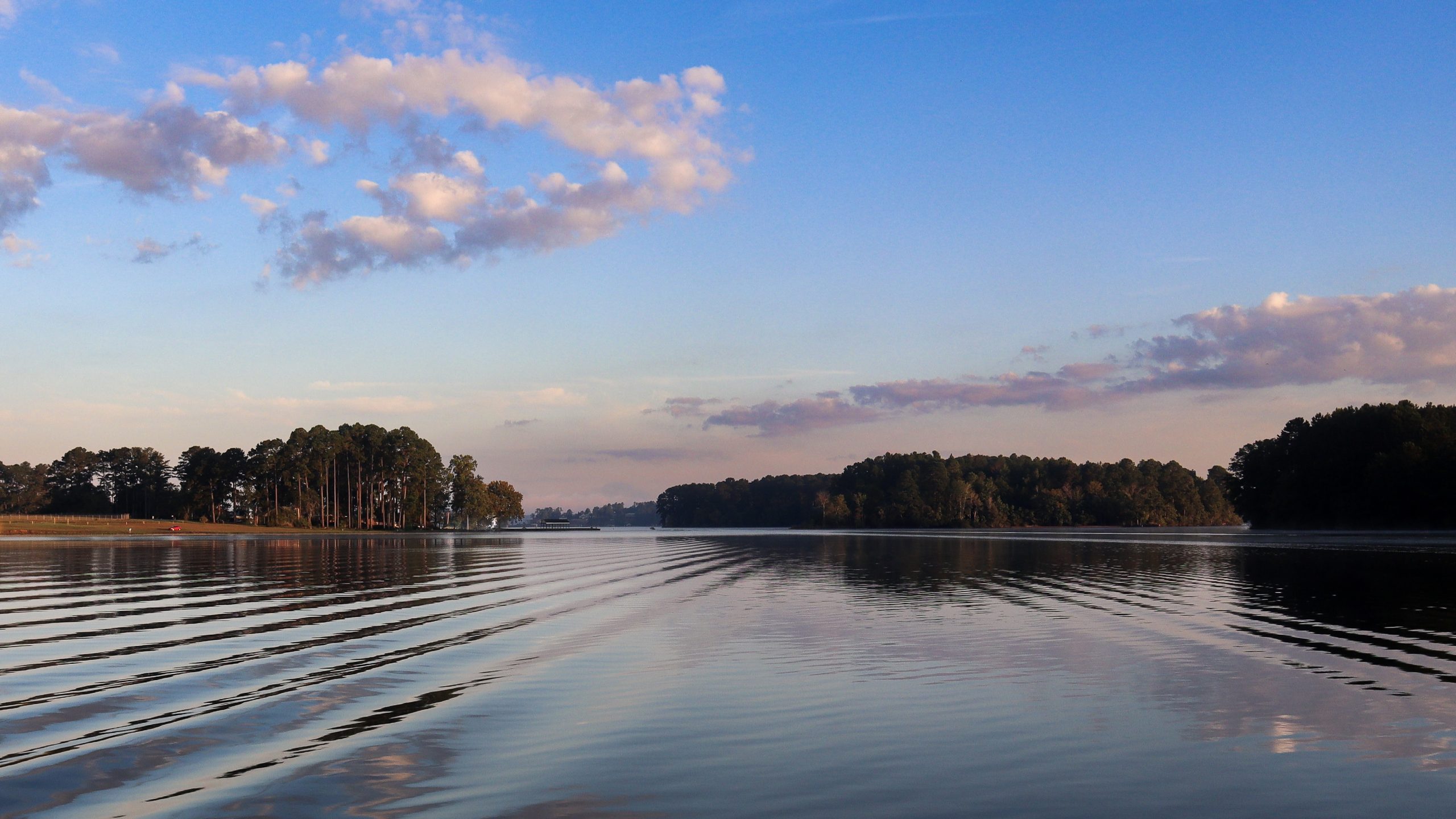
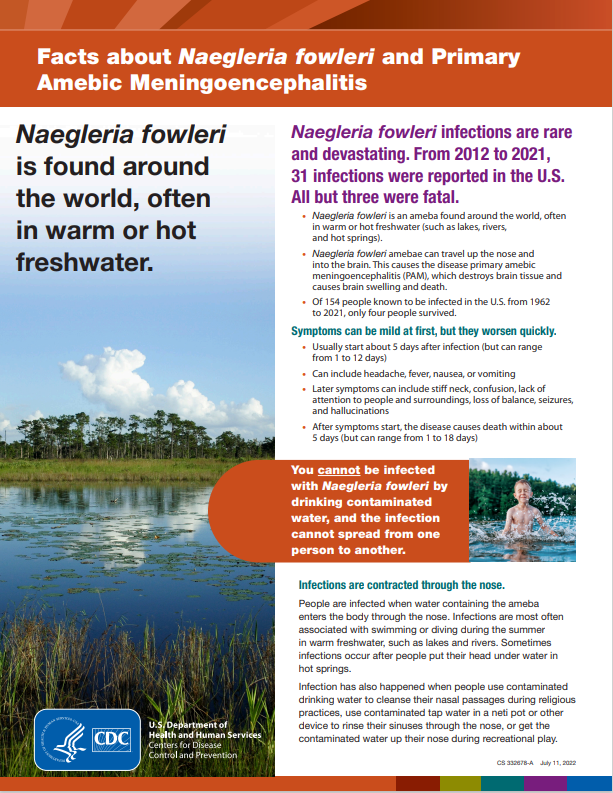
Naegleria fowleri is found naturally in freshwater lakes, rivers, and hot springs in the United States 1, 2, 3, particularly in southern-tier states 4-8, but has recently caused infections as far north as Minnesota 9. No data exist to accurately estimate the true risk of PAM. Hundreds of millions of visits to swimming venues occur each year in the U.S. 10 that result in 0-8 infections per year 11. It is unknown why certain persons become infected with the amebae while millions of others exposed to warm recreational fresh waters do not, including those who were swimming with people who became infected. Attempts have been made to determine what concentration of Naegleria fowleri in the environment poses an unacceptable risk 12. However, no method currently exists that accurately and reproducibly measures the numbers of amebae in the water. This makes it unclear how a standard might be set to protect human health and how public health officials would measure and enforce such a standard. However, the risk of Naegleria fowleri infection is very low. There have been 32 reported infections in the U.S. in the 10 years from 2002 to 2011, despite hundreds of millions of recreational water exposures each year 10. By comparison, in the ten years from 1996 to 2005, there were more than 36,000 drowning deaths in the United States.

There are no means yet known that would control natural Naegleria fowleri levels in lakes and rivers making prevention difficult. Because of this, recreational water users should assume that there is always a low level of risk whenever they enter warm freshwater lakes, rivers, and hot springs (for example, when swimming, diving, or waterskiing), particularly in southern-tier states. This means that the only certain way to prevent a Naegleria fowleri infection due to swimming is to refrain from water-related activities in warm freshwater.

Education

Personal actions to reduce the risk of Naegleria fowleri infection should focus on limiting the amount of water going up the nose and lowering the chances that Naegleria fowleri may be in the water. These actions could include:

Swimming-related risk

  • Hold your nose shut, use nose clips, or keep your head above water when taking part in water-related activities in bodies of warm freshwater.
  • Avoid putting your head under the water in hot springs and other untreated thermal waters.
  • Avoid water-related activities in warm freshwater during periods of high water temperature and low water levels.
  • Avoid digging in, or stirring up, the sediment while taking part in water-related activities in shallow, warm freshwater areas.

These recommendations make common sense but are not based on any scientific testing since the low numbers of infections make it difficult to ever show that they are effective.

Peering through the weeds at a warm freshwater lake.
Picture of muddy, shallow, meandering river.

Non-swimming-related risk

Even more rarely, infections have been reported when people submerge their heads, cleanse during religious practices 13, or irrigate their sinuses (nose) 14 using heated and contaminated tap water. If you are making a solution for irrigating, flushing, or rinsing your sinuses (for example, by using a neti-pot, sinus rinse bottle or other irrigation device), use water that has been:

  • previously boiled for 1 minute (at elevations above 6,500 feet, boil for 3 minutes) and left to cool
OR
OR
  • purchased with a label specifying that it contains distilled or sterile water

Rinse the irrigation device after each use with water that has been previously boiled, filtered, distilled, or sterilized and leave the device open to air dry completely.

For more information on neti pots and other nasal rinsing devices, see FDA’s Consumer Update: Is Rinsing Your Sinuses Safe?

Image of a blue neti pot.

In very rare instances, Naegleria infections may occur when contaminated water enters the nose, for example when people irrigate their sinuses (nose) using a neti pot.

picture of a woman standing in front of the mirror using a neti pot.

If you are making a solution for irrigating, flushing, or rinsing your sinuses (for example, by using a neti pot), use the right kind of water to protect yourself.


Routine, enhanced education of the public in advance of the summer swim season might be helpful. Education should put Naegleria fowleri infection in the context of other risks associated with recreational water use to help raise awareness and assist swimmers in making informed choices about their recreational activities. Healthcare professional education may be useful in areas of the U.S. that routinely have PAM infections diagnosed.

Top of Page

Posting Signs

Posting signs based on finding Naegleria fowleri in the water is unlikely to be an effective way to prevent infections. This is because:

  • Naegleria fowleri occurrence is common, infections are rare.
  • The relationship between finding Naegleria fowleri in the water and the occurrence of infections is unclear
  • The location and number of amebae in the water can vary over time within the same lake or river 4-8.
  • There are no rapid, standardized testing methods to detect and quantitate Naegleria fowleri in water.
  • Posting signs might create a misconception that bodies of water without signs are Naegleria fowleri-free.
References
  1. Visvesvara GS. Free-living amebae as opportunistic agents of human disease. [PDF - 13 pages] J Neuroparasitol. 2010;1.
  2. Visvesvara GS, Moura H, Schuster FL. Pathogenic and opportunistic free-living amoebae: Acanthamoeba spp., Balamuthia mandrillaris, Naegleria fowleri, and Sappinia diploidea. FEMS Immunol Med Microbiol. 2007;50:1-26.
  3. Marciano-Cabral F, Cabral G. The immune response to Naegleria fowleri amebae and pathogenesis of infection. FEMS Immunol Med Microbiol. 2007;51:243-59.
  4. Maclean RC, et al. The identification of Naegleria fowleri from water and soil samples by nested PCR. Parasitol Res 2004;93: 211–17.
  5. Wellings FM, et al. Isolation and identification of pathogenic Naegleria from Florida lakes. Appl Environ Microbiol 1977;34:661–7.
  6. John DT, Howard MJ. Seasonal distribution of pathogenic free-living amebae in Oklahoma waters. Parasitol Res 1995;81:193–201.
  7. Duma RJ. Study of pathogenic free-living amebas in fresh-water lakes in Virginia. EPA Publication. 1980;EPA-PB-126369, Summary, 1981 is EPA-600/S1-80-037.
  8. Ettinger MR, Webb SR, Harris SA, McIninch SP, C Garman G, Brown BL. Distribution of free-living amoebae in James River, Virginia, USA. Parasitol Res. 2003;89:6-15.
  9. Kemble SK, Lynfield R, DeVries AS, Drehner DM, Pomputius WF 3rd, Beach MJ, Visvesvara GS, da Silva AJ, Hill VR, Yoder JS, Xiao L, Smith KE, Danila R. Fatal Naegleria fowleri infection acquired in Minnesota: possible expanded range of a deadly thermophilic organism. Clin Infect Dis. 2012;54:805-9.
  10. US Census Bureau. Statistical Abstract of the United States: 2012. Arts, Recreation, and Travel: Participation in Selected Sports Activities 2009. [PDF - 2 pages]
  11. Yoder JS, Eddy BA, Visvesvara GS, Capewell L, Beach MJ. The epidemiology of primary amoebic meningoencephalitis in the USA, 1962-2008. Epidemiol Infect. 2010;138:968-75.
  12. Cabanes PA, Wallet F, Pringuez E, Pernin P. Assessing the risk of primary amoebic meningoencephalitis from swimming in the presence of environmental Naegleria fowleri. Appl Environ Microbiol. 2001;67:2927-31.
  13. Shakoor S, Beg MA, Mahmood SF, Bandea R, Sriram R, Noman F, Ali F, Visvesvara GS, Zafar A. Primary amebic meningoencephalitis caused by Naegleria fowleri, Karachi, Pakistan. [PDF - 4 pages] Emerg Infect Dis. 2011;17:258-61.
  14. Yoder JS, Straif-Bourgeois S, Roy SL, Moore TA, Visvesvara GS, Ratard RC, Hill V, Wilson JD, Linscott AJ, Crager R, Kozak NA, Sriram R, Narayanan J, Mull B, Kahler AM, Schneeberger C, da Silva AJ, Beach MJ. Deaths from Naegleria fowleri associated with sinus irrigation with tap water: a review of the changing epidemiology of primary amebic meningoencephalitis. Clin Infect Dis. 2012;1-7.

Top of Page

 
Contact Us:
  • Centers for Disease Control and Prevention
    1600 Clifton Rd
    Atlanta, GA 30333
  • 800-CDC-INFO
    (800-232-4636)
    TTY: (888) 232-6348
  • Contact CDC–INFO
USA.gov: The U.S. Government's Official Web PortalDepartment of Health and Human Services
Centers for Disease Control and Prevention   1600 Clifton Rd. Atlanta, GA 30333, USA
800-CDC-INFO (800-232-4636) TTY: (888) 232-6348 - Contact CDC–INFO
A-Z Index
  1. A
  2. B
  3. C
  4. D
  5. E
  6. F
  7. G
  8. H
  9. I
  10. J
  11. K
  12. L
  13. M
  14. N
  15. O
  16. P
  17. Q
  18. R
  19. S
  20. T
  21. U
  22. V
  23. W
  24. X
  25. Y
  26. Z
  27. #