
Ground Man For Milling Operation Dies When Struck by a Dump Truck Backing Into Work Zone
Michigan Case Report: 06MI096

Summary
|
|
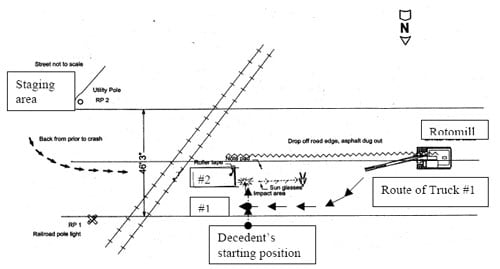
Figure 1. Police Diagram of Incident Scene with MIFACE additions |
On August 8, 2006, a 40-year-old male ground man/truck driver was killed when a dump truck driven by a county road commission employee ran over him while the truck was backing into the work zone. The three-person work crew consisted of the rotomill operator and two ground men, one of whom was the decedent. The rotomill had made two passes on an asphalt road and was in the process of a third pass. The dump truck into which the mill was emptying needed to be changed out because it was filled. The decedent decided to perform some required measurements during the downtime in the operation while the dump trucks were being changed out. The decedent sketched the jobsite to record his measurements on a notepad. With a digiroller in hand, he walked across the road. Apparently unbeknownst to the decedent, as the full dump truck was exiting (Truck #1), another dump truck driver (Truck #2) was backing his empty dump truck into position by the rotomill from his staging position. It appears the decedent waited for Truck #1 to pass him, and then he walked behind Truck #1 into the path of the Truck #2. He was struck by the driver’s side rear wheel and run over. Emergency response was called and the decedent was taken to a local hospital where he was declared dead.
Recommendations:
- Employers should develop, implement, and enforce an internal traffic control plan (ITCP) that minimizes backing distances through work zones and exposures of workers on foot to moving vehicles and equipment. Because many times multiple contractors are present at a job site, the ITCP must be shared with all employers and their employees.
- Employers should develop and implement specific training for mobile equipment operators and workers on foot regarding driver blind areas on equipment.
- Employers should develop, implement, and enforce a comprehensive written safety program, which includes training in hazard recognition and the avoidance of unsafe conditions.
- Employers should ensure backing procedures are in place for the use of mobile construction vehicles and that drivers have communication with workers on foot and use a designated spotter to direct backing.
- Employers should consider the use of proximity warning devices such as radar and sonar based systems and/or rear-view camera systems to enable operators to detect when someone is near or approaching a vehicle or piece of machinery.
- Employers should ensure that pedestrian workers wear a high visibility vest, shirt or jacket when working in a road construction zone.
- The U.S. Occupational Safety and Health Administration (OSHA) and MIOSHA should initiate rulemaking to require new safeguards for employees on roadway construction worksites.
Introduction
On August 8, 2006, a 40-year-old male ground man/truck driver was killed when a dump truck driven by a county road commission employee backed over him while the truck was backing into a work zone. On August 9, 2006, MIFACE investigators were informed by the Michigan Occupational Safety and Health Administration (MIOSHA) personnel who had received a report on their 24-hour-a-day hotline that a work-related fatal injury had occurred. On February 20, 2007, MIFACE interviewed the firm’s owners and the driver of the rotomill who was on the jobsite at the time of the incident. During the course of writing this report, MIFACE visited the incident site and reviewed the police report, medical examiner’s report, and MIOSHA file and citations.
MIFACE contacted the National Institute for Occupational Safety and Health (NIOSH) to obtain copies and permission to include the blind area diagrams included in Appendix I. Caterpillar, Inc. produced the blind area diagrams for NIOSH under contract No. 200-2002-00563. The findings and conclusions of contract report No. 200-2002-00563 have not been formally disseminated by the NIOSH and should not be construed to represent any agency determination or policy.
MIFACE has modified Figures 1-5 to remove identifiers. Additionally, MIFACE modified the police report drawing (Figure 1) by adding the locations of dump truck #1, the decedent, and the dump truck staging area. Figures 2 and 5 are courtesy of the MIOSHA compliance officer and MIOSHA file.
The decedent’s employer was an asphalt milling operation that removed asphalt for recycling. At the time of the incident, the 26-year-old company employed 20 individuals. Eight individuals had the same job classification as the decedent, ground man. The decedent also drove the truck/low-boy trailer hauling the rotomill to the work site. The decedent was an hourly, full time worker and had been employed for five months by this company. He had worked for another trucking company and was familiar with milling operations from his previous employment. A ground man had many job responsibilities on the worksite such as checking the grade, greasing and maintaining the mill, observing the road for obstructions such as manhole covers, etc. Work hours were dependent upon the location and duration of the job. The owner estimated that based on the duration of the job, the crew would have stopped working at 6:00 p.m.
Ground men were trained on-the-job by an experienced ground man. The three-person work crew would be increased to a four-person crew so the new ground man could receive necessary training. When the experienced ground man determined that the new ground man could competently perform ground man duties, the trainer left. During the summer, the decedent worked as a ground man with another milling crew. This milling crew had been assigned to a remote location and he was then assigned to work with this current crew. He had been with this crew for at least one week. This was the first day of measuring with this crew.
The company employee handbook included among other items, a safety policy, disciplinary action, and job descriptions for milling crews, pulverizer operators, shop manager/mechanic, and truck drivers. The safety policy statement and the safety chapter in the handbook included the requirement for tool box meetings to be held one time per month, the requirement to wear all safety equipment, and to follow the operating manuals for the machines. Interspersed within the employee handbook were some general safety rules. The employer stated during the MIFACE interview that employees wore the safety vests only at night and in high traffic areas. In all other work situations, the workers wore red or reflective green tee shirts.
Employee health and safety training was conducted both at the company headquarters and on-the-job. The owners stated that prior to the road construction season, all employees met at the company headquarters where safety issues were stressed and reviewed. During the MIFACE interview, the company management stated that one of the topics stressed at the beginning of this season’s work were the hazards posed by trucks backing into the work zone, because one of the firm’s employees witnessed an injury to a different contractor employee on a job site the prior year caused by a backing up truck. On an as-necessary basis, the owners stated that safety toolbox meetings would be held with employees. Employees were encouraged to bring up safety issues with management, who acted upon those concerns. Management policy at the worksite was if the work crew did not feel that the jobsite was a safe place to work (i.e., the prime contractor did not protect them from motorists) and if the prime contractor would not remedy these concerns, then the crew could refuse to work the job. The crew must call in to the office stating why the work area was unsafe. Company management would contact the prime contractor and have the prime contractor remedy the situation.
At the conclusion of the MIOSHA investigation, the firm was issued a Serious and Other-than-Serious citation of MIOSHA General Rules, Part 1:
Serious:
- RULE 114(2)(d)- No instruction to employees on proper procedure for the work environment or hazard recognition on the jobsite to control or eliminate exposure.
Other-than-Serious:
- RULE 114(1)-No Accident Prevention Program available on the jobsite.
Investigation
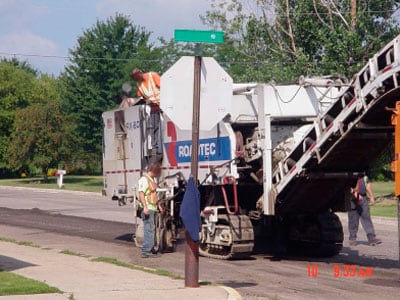
On the day of the incident, the three-person work crew, consisting of a milling machine (rotomill) operator and two ground men (one of whom was the decedent), departed from the company headquarters in the early morning hours and traveled approximately four hours to the incident site (Figure 2). The decedent drove the truck/low-boy trailer hauling the rotomill to the jobsite. The crew began the milling operation between 7:30 a.m. – 8:00 a.m. Two days of milling work was scheduled. The decedent was wearing a red tee shirt with blue pants. He was not wearing hearing protection, a hard hat, or a reflective vest.
 |
|
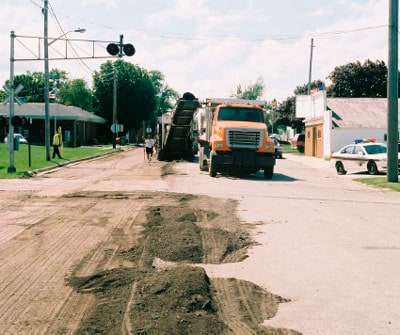
Figure 2. Typical rotomilling operation with rotomill operator and two ground men
|
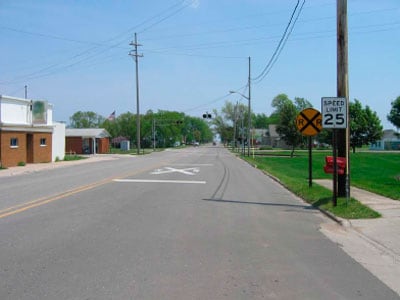
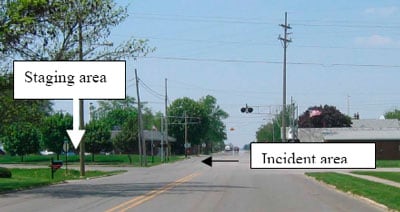
The roadway being milled was a two-lane, east-west, 46-foot 3-inch wide asphalt road, with parking lanes on the north and south sides of the outer lanes. The road length for milling was approximately 250 feet long, defined to the west by a four-way stop and to the east by a railroad track (Figures 3 and 4). At the time of the incident, the rotomill was located approximately 150 feet from the four-way stop and 100 feet from the railroad track in the south lane. The road was closed to through traffic. The road commission dump trucks that were hauling away the milled asphalt were located in a staging area located to the east of the worksite.
The rotomill had completed two passes on the road, starting from the west at the intersection and heading east toward the railroad tracks. Each time a dump truck was filled, it would drive out in the east direction and a dump truck from the staging area would back up into the work zone to position the truck along side and a little in front of the rotomill.
 |
|
Figure 3. MIFACE photograph of incident scene, |
During the third pass, the Truck #1 (the dump truck into which the asphalt was dumped) was full and needed to be changed out. The miller operator placed the rotomill in idle but kept it at a high RPM because he noticed that a staged truck began to move into the worksite.
The owners stated that measurements are kept throughout the job to allow for accurate measurements. Measurements are usually taken during a break in loading or at a standstill point in the operation. The firm is paid by the square yard of milled area. This was the first time the decedent had taken measurements with this crew. Consistent with company policy, while waiting for the trucks to change out, the decedent began the site measurement process.
 |
|
Figure 4. MIFACE photograph of incident scene, facing west
|
The incident occurred during the dump truck change out. It is unknown why the decedent chose to cross the road with his yellow note pad and digiroller, and begin the measuring process from the north side of the westbound lane ahead of the rotomill instead of taking the measurements behind the rotomill out of the path of construction vehicular traffic. Prior to the time of the incident, he had a drawn a rough sketch of the worksite on his note pad. He had not written any work zone measurements on the note pad.
Truck #1 pulled away from the rotomill. As Truck #1 drove away, Truck #2 began to back into the worksite. At approximately 80 feet from the rotomill they were nearly parallel to each other. The decedent stepped out from the curb behind Truck #1 after it passed him with his notepad and digiroller (Figures 1 and 5 ). He apparently did not hear or disregarded the audible backup alarm of Truck #2 backing into position. He was struck by the Truck #2 driver’s side rear wheels and dragged approximately 19 feet. Emergency response was called and the decedent was transported to a local hospital and pronounced dead.
 |
|
Figure 5. Position of dump truck and rotomill
|
Another road commission truck driver in the staging area witnessed the incident. He stated that he noticed a worker starting to walk behind Truck #2. The police report stated that the driver of Truck #2 stated that he didn’t see anyone behind him. Most likely, while backing to the chute the milling machine, the driver would have been focusing his attention to his right side view mirror in order to line up with the rotomill discharge chute, which was on his right side.
Truck #2’s reverse alarm was operational. The responding police agency’s deputy listened to the reverse beeper alert on Truck #2 while the asphalt milling machine ran a high RPM like it was at the time of the incident. The report indicated that the reverse alarm could be heard clearly over the noise of the milling machine.
In this incident, the staging area for empty dump trucks required the empty asphalt trucks to back into the active work zone. When MIFACE visited the incident site, other potential truck staging areas that would permit trucks to drive into the work zone and minimize the backing distance into position near the rotomill were noted. A grain elevator with nearby available parking was approximately 1/4 mile south of the work site on the north-south intersecting road.
Another possible truck staging location was located further west on the road being milled. The road had a parking lane available for homeowners to park their vehicles and may have been appropriate for waiting dump trucks. There was a blinking light at the intersection; the north-south road had the right of way.
Back to Top
Cause of Death
The cause of death as stated on the death certificate was massive trauma to the head. No toxicological tests were performed.
Back to Top
Recommendations/Discussion
Employers should develop, implement, and enforce an internal traffic control plan (ITCP) that minimizes backing distances through work zones and exposures of workers on foot to moving vehicles and equipment. Because many times multiple contractors are present at a job site, the ITCP must be shared with all employers and their employees.
It is critical that employers develop procedures to minimize exposure of workers on foot to moving vehicles and equipment in the tight confines of roadway construction work zones. The decedent in this incident was a worker on foot conducting measuring operations in an active part of the work zone. An internal traffic control plan (ITCP) is a tool for protecting workers on foot from moving vehicles and equipment. ITCPs are site-specific plans that coordinate the flow of construction vehicles, equipment, and workers on foot. ITCPs identify directions and pathways for moving vehicles and equipment, and should be developed to minimize the backing of vehicles and equipment. ITCPs may include designated walkways for workers that are clear of operating construction vehicles and equipment and designated areas of a work zone that are prohibited for workers on foot.
MIFACE did not read the contract between the road commission and the decedent’s employer. It is unknown if an internal traffic control plan (ITCP) had been developed for this job operation. The decedent’s employer was a subcontractor on the site. If the primary contractor does not give appropriate subcontractors a copy of the ITCP, subcontractors should request a copy of the ITCP so that they can inform their workers. If an ITCP has not been developed, the subcontractor should work with the primary contractor to determine safe working areas for workers on foot, inform the workers of these areas, and enforce employee use of these areas. During the planning phases of a project, alternative areas to conduct measuring operations should be evaluated to determine the safest possible area that would not involve the use of heavy equipment, and/or conditions that would minimize the exposure of a worker on foot to moving equipment and vehicles.
Additional information and recommendations for protecting roadway construction workers can be obtained from the NIOSH document entitled “Building Safer Roadway Work Zones: Measures to Prevent Worker Injuries from Vehicles and Equipment,” and the Roadway Work Zone Safety and Health Coalition Alliance document entitled “Internal Traffic Control Plans.” Both of these documents, with their respective Internet addresses can be found in the REFERENCES section of this report.
Employers should develop and implement specific training for mobile equipment operators and workers on foot regarding driver blind areas on equipment.
MIOSHA regulations require employers to train workers to recognize and avoid unsafe conditions that may be present in their work environments and to provide training on the regulations applicable to their work. Training should be a vital part of a roadway construction company’s safety program and should address, at a minimum, all known and anticipated hazards. Roadway construction workers should be made aware that blind areas exist around construction vehicles and they should receive specific training in the identification of these blind areas. A blind area (or blind spot) is the area around a vehicle or piece of construction equipment that is not visible to the vehicle operator, either by direct line-of-sight or indirectly by the use of internal and external mirrors. Training on equipment blind areas is important for both equipment operators and workers on foot in proximity to vehicles and equipment.
As part of a research project evaluating different strategies to prevent worker injuries in construction work zones, NIOSH contracted with Caterpillar to provide blind area diagrams for 38 different vehicles or machines used in the construction industry. Appendix I contains blind area diagrams for a Sterling Acterra 7500, which is a little smaller in terms of gross vehicle weight of the truck that struck the decedent. These drawings are for operator visibility (driver in the driver’s seat) of objects at ground level, 900mm above ground level and 1500 mm above ground level by looking out of the front windshield, rearview mirror and both side view mirrors. MIFACE cautions employers that there may be potential differences between the diagram(s) depicted in Appendix I and the blind areas for the truck involved in the incident. Employers may find the diagrams in Appendix I useful in worker training to demonstrate the sizeable blind areas around a common piece of construction equipment, a dump truck.
Employers should develop, implement, and enforce a comprehensive written safety program, which includes training in hazard recognition and the avoidance of unsafe conditions.
Although the employer had an employee handbook that covered some requirements of the MIOSHA Accident Prevention Program requirements, it did not cover all of the requirements. Specifically, the employee handbook did not:
- Have a designated qualified employee or person responsible for administering the
an accident prevention program, - Instruct employees regarding the operating procedures, hazards and safeguards of
tools and equipment when necessary to perform the job, - Inspect the construction site, tools, materials and equipment to assure that unsafe conditions which could create a hazard are eliminated,
- Instruct employees on proper procedures for the work environment or hazard recognition on the jobsite to control or eliminate exposure.
Given the known hazards associated with road construction (e.g., hazards of being struck by or run over by vehicles and/or equipment), employers should provide their workers with a comprehensive safety program and training that addresses standard operating procedures that are to be followed when working on or near moving vehicles and /or equipment. Employers should develop, communicate, implement, and enforce safe standard operating procedures (SOPs) that address and control these hazards. When workers are assigned to tasks in the vicinity of moving vehicles/equipment on road construction sites, the employers’ SOPs should require drivers and workers on foot to:
- Hold a pre-work meeting with all involved workers to outline/review the procedures to be followed for the tasks assigned,
- Minimize, to the extent possible, work that must be done by workers on foot near moving vehicles,
- Define blind spots and prohibit workers on foot from entering these areas (workers should be advised to look at the side mirrors; if they cannot see themselves in one of the side mirrors, they are in a blind spot),
- Maintain continuous visual and verbal contact,
- Require workers on foot to maintain a safe minimum distance between themselves and the moving vehicles/equipment,
- Require all workers to wear appropriate high visibility safety apparel.
Because all workers, including equipment operators and supervisors, are likely to be on foot around operating equipment, all workers should be trained to recognize the hazards of working on foot around equipment. Training should be a vital part of a road construction company’s AND road commission safety program and should address, at a minimum, all known and anticipated hazards.
Employers should ensure backing procedures are in place for the use of mobile construction vehicles and that drivers have communication with workers on foot and use a designated spotter to direct backing.
In highway and road construction it is a routine practice for large construction vehicles to continually move in and out of the work zone. When a truck backs up in a busy work zone there is a high risk of an incident or injury to either the driving public or pedestrian traffic and to construction vehicles and workers within the work zone. The highway/road construction work zone can be a very confined and congested space. Truck drivers and other equipment operators need to be observant and aware of activities, vehicles, and people that may interfere with their ability to safely complete their task.
Employers should not rely on a construction vehicle’s reverse alarm to protect workers on foot. If the ITCP cannot eliminate backing of construction vehicles in the work zone, backing procedures should be developed and implemented. Backing protocols should include, but not be limited to, an assigned backing spotter, and policies that backing will not begin without an understandable signal from the spotter that it is safe to start backing. In addition, operators of construction vehicles and equipment must come to a complete stop if contact with a spotter is lost and backing should not resume until contact is re-established. All equipment operators and truck drivers, upon entering the construction site, should be aware of who the spotters are, and the established backing protocol. Mirrors cannot reflect blind spots directly behind large pieces of construction equipment. Even when the driver physically checks the rear of their vehicle before backing, conditions can change unexpectedly. Using another worker as a spotter when backing heavy equipment with blind spots assures drivers that when conditions change on the work site, they will be able to react appropriately.
As an additional precaution, the spotter could be equipped with an air horn that would only be used when a hazard exists from a backing vehicle. The air horn might get the attention of the backing vehicle operator, the operator of another piece of equipment or a worker on foot, reducing the hazard of a backing vehicle.
Communication among all workers on a construction roadway work zone site regarding current work plans and any potential changes to scheduled tasks is critical, especially between mobile equipment operators and workers on foot. This can be accomplished by personal one-on-one communication, hand signaling or with two-way radios. Communication used in combination with an ITCP and a site-specific backing protocol could reduce the likelihood of workers on foot being struck by backing vehicles.
Both equipment operators and spotters should receive training that includes, at a minimum, the following items:
Training for equipment/driver operators should include:
- Window rolled down.
- Radio off.
- Material Performance
- No cell phone or similar distraction while backing.
- Foot on brake.
- If you lose sight of the spotter in your mirror, STOP.
Training for the “spotter” should include:
- Always wear a retro reflective vest, visible at 360 degrees in a wide range of body motions in accordance with MIOSHA Construction Standard Part 22 Signals, Signs, Tags and Barricades.
- Stand alone, do not allow anyone to congregate around you.
- If you cannot see the driver’s face in the mirror, have him STOP until you do.
- Use both hands to spot/direct the driver with large exaggerated motions.
- The spotter needs to be out of vehicle traffic lanes and out of the direct path of the moving/backing construction vehicle’s movement.
- The spotter should walk along the side of the backing vehicle and should not walk backwards while directing the vehicle.
- Watch for pinch points behind you such as other vehicles, utility poles, trees, etc.
- Always have an escape route.
- Never turn your back on traffic, including construction equipment.
Employers should consider the use of proximity warning devices such as radar and sonar based systems and/or rear-view camera systems to enable operators to
detect when someone is near or approaching a vehicle or piece of machinery.
The police reported that the truck operator stated he did not see the victim behind the truck. Roadway construction workers often work in close proximity to moving vehicles or heavy equipment. Being exposed on a daily basis to the constant noise can desensitize individuals to the movement of such vehicles.
Rear-view cameras are normally mounted near a rear license plate and have a wide-angle lens (up to 120 degrees cone of vision), and a visibility range of 165 feet. Sensors based on radar, sonar, radio frequency identification (RFID) tags and tag readers, and infrared technology are also available to help monitor equipment blind spots and provide a warning to the driver. An RFID system encompasses each worker on foot wearing a small RFID tag and a tag reader mounted in the equipment. When a tag is sensed within the tag reader’s sensing range, the equipment operator receives a warning.
There are other options available for construction equipment, vehicles and employees.
Some of these are:
- Changing the audible tone on equipment. This can be done using either mechanical or electrical warning devices. Workers that are exposed to the same warning tones every day may tend to become complacent when these audible signals are used. Changes every so often may help to alleviate this.
- Parabolic mirrors. The use of parabolic mirrors on construction equipment and vehicles, similar to those used on school buses, allows the operator to view what is directly behind their vehicle. These mirrors normally produce a “fish-eye” type view, which must be taken into consideration when judging distances between a vehicle and the obstacle.
- Ultrasonic backup sensing system. These devices attach to the left and right rear of trucks, and wired to either the left or right back up light, allowing it to only function when the vehicle is in reverse. The device emits an audio warning and sends a wireless signal to a video display to indicate in feet and in tenths of feet how close the vehicle is getting to the obstacle. The audio alerts and the red-flashing video display warning begin at about 6 feet and continue as the distance decreases to the obstacle. The audio warning becomes continuous when the video display indicates the distance to be one foot and/or less from the obstacle.
Employers should ensure pedestrian workers wear a high visibility vest, shirt or jacket when working in a road construction zone.
Per the company’s employee manual, employees are required to wear a high visibility vest at all times when in a road construction zone. The employer did not enforce this policy. MIOSHA regulations require that traffic regulators wear a vest, shirt or jacket that that is fluorescent orange, yellow, strong yellow green, a combination of these colors and shall contain retro reflective material that is orange, yellow, white, silver, or strong yellow green. Although the MIOSHA regulations address high-visibility protective clothing for traffic regulators, this protective clothing significantly increases the visibility of any pedestrian worker at a construction zone. Additionally, providing and requiring each crewmember to wear an upper body garment that has multiple colors (orange, green and yellow) could aid in distinguishing the worker on foot from a background of orange trucks, signs, and other devices in the work zone.
The National Institute for Occupational Safety and Health (NIOSH) in their April 2001 document, “Building Safer Highway Work Zones,” Measures to Prevent Worker Injuries from Vehicles and Equipment, states that “all workers exposed to the risk of moving roadway traffic or construction equipment should wear high-visibility safety apparel meeting the requirements of International Safety Equipment Association (ISEA) “American National Standard for High-Visibility Apparel (section 1A.11) or equivalent revisions and labeled as ANSI 107-1999 standard performance for Class 1, 2, or 3 risk exposure.” Although this was not a highway work zone, the victim was exposed to moving heavy equipment in a limited travel area. The victim was not wearing safety apparel meeting this standard at the time of the incident. His employer now mandates the use of high visibility clothing meeting the ANSI standard when employees are on any road construction site.
This clothing should be inspected regularly to ensure that color has not faded and that retro-reflective properties have not been lost. So that workers do not blend into the background, consider seasonal variations in landscape and foliage when choosing colors for worker apparel. Consider using fluorescent garments with retro-reflective material when working under poor lighting conditions.
The U.S. Department of Labor, Occupational Safety and Health Administration (OSHA) and MIOSHA should initiate rulemaking to require new safeguards for employees on roadway construction worksites.
The State of Washington is the first jurisdiction in the United States to enact specific legislation to protect roadway construction workers. The State of Washington, with input from stakeholders, adopted an emergency rule in May 2004. The rule imposed significant new requirements for dump truck drivers backing their vehicles inside roadway worksites. This rule, Washington Administrative Code WAC 296-155-610 entitled Motor Vehicles on Construction Sites was permanently adopted in December 2004, and became effective in January 2005. It affects all construction companies that operate dump trucks in reverse while on the jobsite. WAC 296-155-610 (2)(f), states that if you operate a dump truck in reverse within 50 feet of workers on the jobsite, that in addition to an audible warning device, the driver must use an observer to signal that it is safe to back up. If an observer is not used, the truck must have an operable mechanical device that provides a full view behind the truck, such as a video camera. The Washington State regulationexternal icon is available at: http://apps.leg.wa.gov/wac/default.aspx?cite=296-155&full=true#296-155-610. (Link updated 3/25/2013)
A May 2007 Hazard Alert from the Washington State Department of Labor and Industries, “Dump Trucks in the Construction Zonepdf iconexternal icon” contains a link to the WAC 296-155-610(2)(f), Operating Dump Trucks in Reverse. The Hazard Alert also contains a brief summary of WAC 265-195 as it pertains to dump truck drivers, and an illustration that defines the backing zone (distances in feet). The Alert may be accessed on the Internet at http://www.lni.wa.gov/safety/hazardalerts/HZDumpTrucks.pdf (Link updated 4/9/2015)
References
MIOSHA standardsexternal icon cited in this report may be found at and downloaded from the MIOSHA, Michigan Department of Labor and Economic Growth (DLEG) website at: www.michigan.gov/mioshastandards. MIOSHA standards are available for a fee by writing to: Michigan Department of Labor and Economic Growth, MIOSHA Standards Section, P.O. Box 30643, Lansing, Michigan 48909-8143 or calling (517) 322-1845.
- DLEG MIOSHA Construction Safety and Health Standard Part 1. General Rules.
- DLEG MIOSHA Construction Safety and Health Standard Part 22-Signals, Signs, Tags and Barricades.
- Nebraska FACE NE 2004-07. Subject: Engineering Technician Run Over and Killed by Backing Dump Truck. Internet address: www.dol.state.ne.us/nwd/center.cfm?PRICAT=4⊂CAT=4F&ACTION=face (Link no longer available 11/12/2009)
- Pratt SG, Fosbroke DE, Marsh SM [2001]. Building Safer Highway Work Zones” Measures to prevent Worker Injuries from Vehicles and Equipment. Cincinnati, OH: U.S. Department of Health and Human Services, Centers for Disease Control and Prevention, National Institute for Occupational Safety and Health (pub. No. 2001-128) Internet address: www.cdc.gov/niosh/2001128.html
- FHWA [2000]. Manual on uniform traffic control devices millennium edition. U.S. Department of Transportation, Federal Highway Administration (FHWA).
- California Department of Health Services [2000]. A Construction Inspector Dies after Being Backed Over by a Ten-wheel Asphalt Dump Truck – California. California Fatality Assessment and Control Evaluation (FACE) Report No. 00CA05. Internet Address: www.cdc.gov/Niosh/FACE/In-house/full200206.html
- Washington State Department of Labor and Industries [1999]. Flagger Killed When Struck by a Dump Truck During Road Construction, in Washington State. Washington Fatality Assessment and Control Evaluation (FACE) Report No. 99WA70. Internet Address: https://www.cdc.gov/niosh/face/stateface/wa/99wa070.html
- Washington State Department of Labor and Industries. Hazard Prevention.external icon Internet Address: www.lni.wa.gov/Safety/Prevention/default.asp
- Haapaniemi P [1996]. “Will High-tech Systems Help Drivers Avoid Crashes?” Traffic Safety Vol. 96, No. 5, pp 16-19. National Safety Council, September/October 1996.
- Hoffner K [1997]. A training program for the ribbon switch/radio control truck stopping system-the truck stop. Laborers’ Health and Safety Fund of North America. Unpublished Report for FHWA Grant DTFH-93-X-00024.
- Caterpillar [2004]. Final Report: Construction Vehicle and Equipment Blind Area Diagrams. Peoria, IL: Caterpillar Inc. CDC, NIOSH contract no. 200-2002-00563 for Highway Work Zone Project.
Appendix
MIFACE Investigation Report # 06MI096 Appendixpdf iconexternal icon (see page 15 of report)
Michigan FACE Program
MIFACE (Michigan Fatality Assessment and Control Evaluation), Michigan State University (MSU) Occupational & Environmental Medicineexternal icon, 117 West Fee Hall, East Lansing, Michigan 48824-1315; http://www.oem.msu.edu/MiFACE_Program.aspx. This information is for educational purposes only. This MIFACE report becomes public property upon publication and may be printed verbatim with credit to MSU. Reprinting cannot be used to endorse or advertise a commercial product or company. All rights reserved. MSU is an affirmative-action, equal opportunity employer. 9/25//07 (Link updated 8/5/2009)
MIFACE Investigation Report # 06MI096 Evaluationpdf iconexternal icon (see page 19 of report)
To contact Michigan State FACE program personnel regarding State-based FACE reports, please use information listed on the Contact Sheet on the NIOSH FACE web site Please contact In-house FACE program personnel regarding In-house FACE reports and to gain assistance when State-FACE program personnel cannot be reached.