Treatment
Clinicians: For 24/7 diagnostic assistance, specimen collection guidance, shipping instructions, and treatment recommendations, please contact the CDC Emergency Operations Center at 770-488-7100.
Clinicians: CDC no longer provides miltefosine for treatment of free-living ameba infections. Miltefosine is now commercially available. Please visit impavido.comexternal icon for more information on obtaining miltefosine in the United States. If you have a patient with suspected free-living ameba infection, please contact the CDC Emergency Operations Center at 770-488-7100 to consult with a CDC expert regarding the use of this drug.
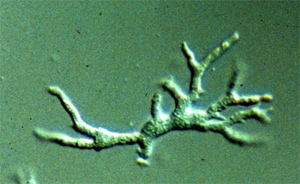
Trophozoites of B. mandrillaris in culture.
Although there have been more than 200 cases of Balamuthia infection worldwide, few patients are known to have survived as a result of successful drug treatment. Early diagnosis and treatment might increase the chances for survival.
Drugs used in treating granulomatous amebic encephalitis (GAE) caused by Balamuthia have included a combination of flucytosine, pentamidine, fluconazole, sulfadiazine and either azithromycin or clarithromycin. Recently, miltefosine in combination with some of these other drugs has shown some promise. Much more information is needed in treating patients with GAE due to Balamuthia.