CDC in India
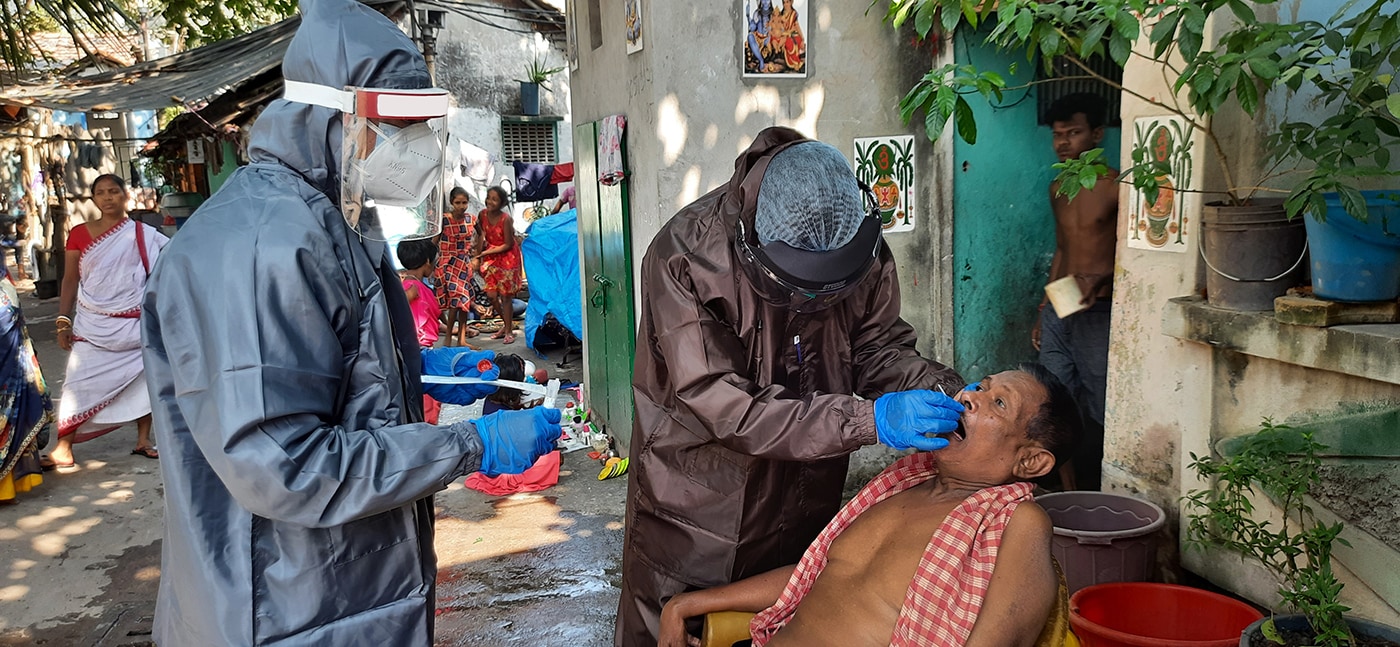
Nurses collect swab from participants with respiratory symptoms in a low-resource area in Kolkata as a part of a CDC supported study to estimate community burden of influenza and SARS-CoV-2 (INSPIRE).
For over 50 years, the U.S. Centers for Disease Control and Prevention (CDC) has engaged in highly successful technical collaboration with the Government of India and Ministry of Health and Family Welfare while addressing India’s public health priorities. As new health threats emerge, CDC and national partners are well-placed to leverage past successful initiatives to strengthen global health security capabilities and rapidly respond to new public health challenges.
Strengthening Public Health Systems
CDC supports global health security priorities in India by providing technical expertise in strengthening public health systems to prevent, detect, and respond to emerging infectious diseases, such as COVID-19. CDC focuses on real-time disease surveillance, laboratory systems and diagnostics, workforce development, and emergency management. Efforts include developing the evidence base and leading technical guidance for Integrated Public Health Laboratory (IPHL) implementation; strengthening surveillance and reporting for antimicrobial resistance (AMR), Healthcare Associated Infections (HAI), Acute Febrile Illness (AFI), Acute Encephalitis Syndrome (AES), and zoonotic diseases. CDC also supported training for over 10,000 workers in epidemiology and disease surveillance, public health emergency management, laboratory diagnostic testing, and biosafety and quality management.

CDC’s ongoing efforts to strengthen molecular detection capabilities increase the capacity of district laboratories to detect emerging pathogens like COVID-19

CDC-supported AFI and AES surveillance efforts across 13 high burden states produced data-driven change in national policy. India adopted algorithmic testing for AFI/AES cases which translated into early diagnosis and better treatment outcomes of patients

CDC supported Government of India in the conceptualization, development, and implementation of Integrated Public Health Laboratories, and is now supporting the scale-up of IPHL across all 730 districts in India. IPHLs have streamlined district- and block-level laboratory practices and increased laboratory diagnostic capacity

CDC helped improve infection prevention and control (IPC) at 50 hospitals led by the All India Institute for Medical Sciences
HIV/AIDS
As a key implementer of the U.S. President’s Emergency Plan for AIDS Relief (PEPFAR), CDC works with the National AIDS Control Organization (NACO) to implement evidence-based, high impact, sustainable interventions in prevention, testing, treatment, and viral load monitoring. CDC uses an equity lens while striving to close access gaps among key populations. Through Project Sunshine, CDC implements strategies to improve prevention, testing, and treatment options for people in northeastern states where HIV prevalence is highest (Manipur, Mizoram, and Nagaland). In collaboration with NACO and State AIDS Control Societies, CDC supported treatment optimization and differentiated service delivery models, such as multi-month dispensation, decentralized drug dispensation in the community and health system settings, and person-centered package of services. NACO later adopted these strategies across a network of 540 antiretroviral treatment (ART) centers throughout the country.

CDC supports India’s nationwide HIV behavioral sentinel surveillance — the largest in the world— and integrated biological and behavioral surveillance among key populations

CDC supported implementation of full package of Advanced Disease Management (ADM) for early screening of cryptococcosis (a fungal infection) and tuberculosis

In addition, CDC helped integrate screening and management of hypertension into HIV care to ensure treatment continuity

CDC was instrumental in drafting the national operational guidelines for ART services and national guidelines for HIV care and treatment. These guidelines were disseminated to staff from 625 ART centers and 29 state AIDS Control Societies

CDC helped enhance laboratory quality toward ISO accreditation for 130 HIV reference labs and over 5,000 HIV testing sites, leading to early and accurate diagnosis of HIV

CDC used diagnostic network optimization and workforce development to strengthen HIV viral load testing capacity and increased access to services for focus populations
Tuberculosis (TB)
CDC supports the National Tuberculosis Elimination Program (NTEP) to end TB by supporting four strategic pillars: detect, treat, prevent, and strengthen capacity. CDC provides technical support and implements projects, such as external quality assessment (EQA) for rapid molecular tests that ensure accurate and timely results. This EQA is applied to over 800 machines annually; NTEP plans to eventually cover all 3,000 testing sites.

During the COVID-19 pandemic, CDC’s Dharavi project improved treatment outcomes among patients with drug-resistant TB in Mumbai’s informal urban settlements. The project retained nearly all patients on treatment, even those who migrated elsewhere

CDC successfully implemented early TB preventive treatment programs in India to diagnose and treat latent TB infection among household contacts in Nagpur and Mumbai, Maharashtra. CDC used patient-friendly diagnostic tests and treatment regimens

CDC implemented and integrated TB IPC activities in health facilities throughout Mumbai. CDC is expanding these IPC activities to 61 sites in ten states to support NTEP’s TB Mukt Bharat (TB-free India) campaign

CDC helped increase capacity for next generation sequencing at the National Institute of Research in TB (NIRT) in Chennai

With CDC support, NIRT conducted next generation sequencing on a prospective cohort of patients with drug resistant TB across India. This effort identified common and new TB mutations and led to the first Indian TB catalogue of mutations

CDC works with NTEP to strengthen state- and district-level capacity to use local data to accelerate TB control and elimination efforts in 11 states across India
Field Epidemiology Training Program (FETP)
FETP strengthens the public health workforce’s abilities to detect, respond, and control disease outbreaks at the source. CDC continues to support FETPs across India through mentorship for outbreak investigations, surveillance evaluations, COVID-19 activities, and regular remote training. As of January 2023, India FETP has trained over 900 officers across three tiers (advanced, intermediate, and frontline), with over 200 officers currently enrolled. Moving forward, CDC is collaborating with institutions to meet India’s goal of having one epidemiologist per 200,000 people.

Since 2012, India FETP officers investigated over 550 outbreaks and conducted over 300 surveillance evaluations

FETP officers have responded to the COVID-19 pandemic in 22 states and union territories and support measles and rubella elimination efforts
Influenza
CDC’s influenza program focuses on strengthening three main areas: the influenza surveillance network, public health research, and pandemic preparedness. Influenza viruses change constantly and require continued vigilance. CDC helps India prepare for pandemics in alignment with India’s Pandemic Influenza Preparedness and Response Plan by strengthening laboratories and training clinicians on effective case management and infection control. Many of these activities were developed during the 2009 influenza A/H1N1 pandemic but are directly relevant to the current COVID-19 pandemic. Strong influenza surveillance has enabled India to detect influenza seasonal peaks during monsoons, understand the seasonality of influenza in tropical countries, and guide timing for influenza vaccination.

In collaboration with the All India Institute of Medical Sciences, CDC helps determine the disease and economic burdens of influenza and other respiratory viruses, evaluates effectiveness of influenza vaccines, and identifies optimal timing for influenza vaccination

CDC’s advanced molecular diagnostic trainings helped the National Institute of Virology to scale up PCR SARS-CoV-2 testing across India’s influenza laboratory network
Emergency Management
CDC partners with the Government of India to enhance emergency response capabilities that are critical for the country’s response to infectious diseases and other public health threats. CDC provides technical support to apply modern emergency management concepts and principles using a common framework for public health response and exercises. CDC focuses on increasing emergency management human resource capacity; strengthening national and sub-national emergency operations centers (EOCs); developing emergency response plans, protocols, and procedures; training rapid response teams; and providing real-time support for multiple activations of EOCs and outbreak response systems.

CDC’s Emergency Management Program helps establish, operate, and manage national and sub-national EOCs that respond to disease outbreaks, natural or manmade disasters, and other public health emergencies

CDC partners with WHO to strengthen rapid response teams, enabling state and district surveillance teams to rapidly respond to health threats like COVID-19

CDC has supported training for thousands of staff on COVID-19 and other emergencies
Antimicrobial Resistance (AMR)
CDC works to increase AMR and Healthcare-Associated Infections (HAI) surveillance and institutionalize IPC capacity nationally and sub-nationally. CDC supported the Government of India to establish the National Antimicrobial Surveillance Network, which increased the country’s network from 10 laboratories in 2013 to 40 laboratories across 29 states and union territories. CDC partnered with the Indian Council of Medical Research and the All India Institute of Medical Sciences to develop and implement a network for surveillance and prevention of HAIs. These networks were used to quickly disseminate COVID-19 information to hospitals.

CDC helped strengthen antimicrobial resistance and healthcare-associated infection surveillance across 29 states
Vaccine-Preventable Diseases
CDC supports efforts to eradicate or control vaccine-preventable diseases in India through the Universal Immunization Program. Since the mid 1990’s, CDC has helped strengthen epidemiology and laboratory methods, routine immunization services, training methods, data systems, case-based disease surveillance, and outbreak preparedness and response. CDC’s support of the National Public Health Surveillance Project strengthened implementation of polio, measles, and COVID-19 vaccination campaigns, outbreak response activities, and surveillance.
- 8 U.S. Assignees
- 30 Locally Employed
- Population: > 1.4 billion
- Per capita income: > $7,220
- Life expectancy: F 71 / M 68 years
- Infant mortality rate: 28/1,000 live births
Sources: Population Reference Bureau 2022, India
U.S. Embassy and Consulates in India
CDC India Anniversary Report | CDC Global Health
Global HIV & TB India country profile
India | Travelers’ Health | CDC
Publications:
- India Articles All Issues | Emerging Infectious Diseases journal | CDC
- Progress Toward Measles and Rubella Elimination — India, 2005–2021
- India Field Epidemiology Training Program Response to COVID-19 Pandemic, 2020–2021
Photos: India | CDCGlobal Flickr


