CDC in Bangladesh
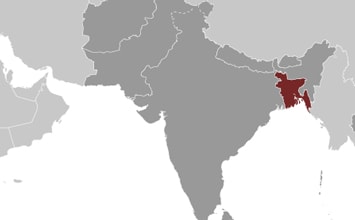
The Centers for Disease Control and Prevention (CDC) has been collaborating with the International Centre for Diarrheal Disease Research (ICDDRB) over the last 40 years most recently to strengthen the country's capacity to detect emerging infectious diseases and to evaluate new vaccines and other interventions. A strong collaboration between CDC and the Institute of Epidemiology Disease Control and Research (IEDCR) within the Bangladesh Ministry of Health and Family Welfare has further strengthened the country's ability to detect and respond to disease threats. Since 2002, a CDC medical epidemiologist has led the Program on Infectious Diseases and Vaccine Sciences at ICDDRB.
- Population: 158,065,841
- Per capita income: $1,600
- Life expectancy at birth women/men: 63 /57 yrs
Influenza
CDC works with the Institute of Epidemiology, Disease Control, and Research (IEDCR), within the Bangladesh Ministry of Health to maintain surveillance for dangerous emerging strains of influenza, determine the burden of seasonal influenza, and develop and test strategies to reduce human influenza burden. CDC and IEDCR conduct surveillance for severe respiratory disease and influenza like illness in the general population and in hospitals across Bangladesh. In 2007, CDC renovated government laboratory space, resulting in strengthened capacity and improved diagnosis of respiratory diseases.
Impact in Bangladesh
- 30 acute disease outbreak investigations in collaboration with the government of Bangladesh in 2009
- 14 national influenza surveillance sites at district hospitals established within Bangladesh in 2009
- 22,699 people included in a visceral leishmaniasis surveillance study to determine incidence of the disease in Bangladesh
- 9,500 immigrants to the U.S. screened for communicable diseases
Global Tobacco Surveillance
In 2009, Bangladesh conducted the Global Youth Tobacco Survey a survey designed to produce internationally comparable data on tobacco use and tobacco control measures. CDC alongside many partners provided technical support to Bangladesh and helped establish standard survey operating procedures, survey design and sample selection, data management and processing, training and technical assistance in data analysis and reporting, and global data release.
Personal Digital Assistants (PDAs) were used to gather and transmit data from 400 sites across Bangladesh. The survey has built capacity in Bangladesh. The Bangladesh National Institute of Preventive and Social Medicine can now conduct large-scale surveys on its own.
Tuberculosis
CDC supports laboratory costs for surveillance of drug resistance against tuberculosis the only such surveillance conducted in the country.
Emerging Infections and Vaccine Preventable Diseases
CDC conducts research to learn more about the transmission and burden of select pathogens that cause diseases, such as leishmaniasis, typhoid fever, encephalitis, rotovirus, and pneumococcol disease. Study results inform Bangladesh policy makers and help them reach decisions about introducing vaccines and other interventions to most effectively reduce burden of disease in the country.
Staffing
- 3 U.S. staff
Top 10 Causes of Death
- Ischaemic heart disease 12 %
- Lower respiratory infections 11 %
- Perinatal conditions 8 %
- Tuberculosis 7%
- Diarrheal disease 6 %
- Cerebrovascular disease 6%
- Chronic obstructive pulmonary
disease 4 % - Measles 2 %
- Road traffic accidents 2 %
- Self-inflicted injuries 2 %
Zoonosis
CDC develops and evaluates strategies to mitigate the risk of animal to human transmission of influenza in Bangladesh by conducting surveillance for new strains of influenza in poultry markets and working with partners to improve the safety of slaughtering and defeathering poultry in villages. CDC has set up surveillance at six hospitals in Bangladesh to detect illness caused by Nipah virus, a virus carried by fruit bats. CDC works alongside wildlife ecologists at the Consortium for Conservation Medicine to better understand the transmission of Nipah virus within bats in Bangladesh, and the conditions that lead to transmission to humans.
Water, Sanitation, and Hygiene
In 2007, the Government of Bangladesh and UNICEF, with support from the British Government, launched one of the largest handwashing, hygiene/sanitation and water quality improvement programs ever attempted in a developing country. The program will initially reach 19.6 million people in rural Bangladesh. CDC is evaluating the health outcomes associated with this intervention. CDC is also piloting a behavior change intervention to promote safer caring practices in hospitals, such as handwashing with soap, not sharing food, and not sharing beds. CDC is also testing a handwashing intervention to prevent the secondary transmission of influenza and evaluating innovative methods designed to improve the quality of drinking water, especially after flooding.
Health Systems Strengthening
CDC helps to strengthen diagnostic laboratory capacity in Bangladesh and trains Bangladesh health officers. CDC posts infectious disease research investigators in country to assist the government in surveillance and outbreak investigations. CDC investigators train government personnel on effective outbreak investigation techniques. CDC works with the government of Bangladesh to train district level health officers how to effectively respond to threats of Nipah virus outbreaks, influenza outbreaks, and outbreaks of unknown diseases. In addition, an infectious disease research fellowship program, modeled after CDC's Epidemiology Intellgence Service, trains capable young Bangladesh nationals. Investigations guide the government in making policy and program decisions.
Immigrant, Refugee, and Migrant Health
CDC works with the International Organization for Migration to oversee the quality of the medical screening of U.S. bound refugees and prevent importation of disease into the United States. The U.S. government has recently initiated a refugee resettlement program for 30,000 Burmese Rohingya refugees from the Kutupalong and Nayapara refugee camps.
Get email updates
To receive email updates about the Global Health site, enter your email address: