CDC in Malawi
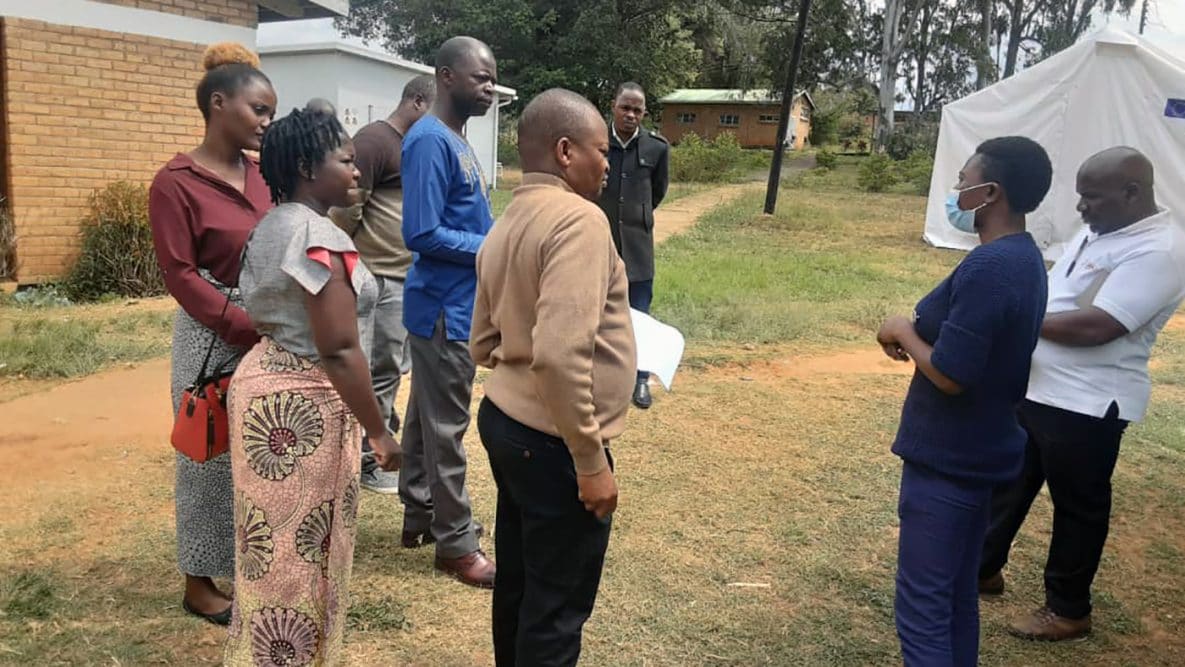
Intermediate Field Epidemiology Training Program trainees and their mentors investigate the magnitude and risk factors associated with a 2022 cholera outbreak. Photo by Gracious Sakaza/ Tukombo Health Centre in Nkhata Bay
The Centers for Disease Control and Prevention (CDC) established an office in Malawi in 2001. CDC Malawi helps implement high-impact HIV and tuberculosis (TB) programs through the President’s Emergency Plan for AIDS Relief (PEPFAR). The office also works with local and international partners to strengthen health systems to prevent, detect and respond to diseases. Beyond service delivery, CDC’s partnership with Malawi also focuses on building healthcare workforce capacity, strengthening laboratory systems, and increasing the capacity of surveillance and health information systems.
These systems collect and analyze data to inform program decisions and activities.
CDC Malawi provides technical and financial assistance to the Ministry of Health (MOH) to develop national laboratory policy and strategic plans to guide and monitor HIV and TB program implementation. CDC also provides support to implement interventions for malaria control under the U.S. President’s Malaria Initiative (PMI).
HIV and TB
As a key implementer of PEPFAR, CDC works with Malawi to build a sustainable national HIV response program to accelerate progress towards the UNAIDS global goals to control the HIV epidemic. Through PEPFAR, CDC supports HIV prevention, treatment, and care in Malawi. In 2017, Malawi began providing TB preventive therapy (TPT) to people living with HIV in districts with the highest HIV/TB burden. CDC also partners with the MOH to strengthen the country’s health system capacity and implement high-impact HIV programs. CDC is scaling up two initiatives: pre-exposure prophylaxis and the Determined, Resilient, Empowered, AIDS-Free, Mentored, and Safe (DREAMS) program.

As of September 2022, more than 920,000 people receive HIV antiretroviral therapy, which represents 93% coverage

In August 2022, 107 participants from the DREAMS program graduated from Siyakha, a comprehensive economic strengthening program that provides vocational training and internships. Siyakha sharpens participants’ skills and increases their opportunities to get jobs or start their own businesses

CDC Malawi provides technical and financial assistance to the MOH to develop national laboratory policy and strategic plans to guide and monitor HIV and TB program implementation

With CDC support in 2017, Malawi began providing TPT to people living with HIV in five districts. Three years after the TPT program began, approximately 300,000 (94%) of people receiving care for HIV also received TPT

In 2021, Malawi introduced the short-course TPT regimen (3 months of weekly Isoniazid and Rifapentine)
Learn more about CDC’s HIV and TB work in Malawi.
Strengthening Public Health Systems
With CDC support, the Malawi MOH and partners enhanced healthcare quality and health facility efficiency across the country by establishing an electronic medical record system. CDC’s technical support strengthens public health systems to prevent, detect, and respond to emerging infectious diseases, such as COVID-19. CDC focuses on real-time disease surveillance, laboratory systems and diagnostics, workforce development, and emergency management. CDC’s efforts include developing an integrated laboratory strengthening initiative and strengthening surveillance for antimicrobial resistance, acute febrile illness, and acute encephalitis syndrome.

In 2022, 764 facilities in Malawi had an electronic medical record (EMR) system that supports one or more service delivery areas

Elizabeth Glaser Pediatric AIDS Foundation, one of CDC’s partners, maintains the point-of-care EMR and eMasterCard systems. More than 220 sites are now covered by the point-of-care EMR system, more than 500 sites by the eMasterCard system, and more than 20 sites by privately developed electronic systems

The Public Health Emergency Operating Centre was established during COVID-19 to centralize emergency response activities
Laboratory Capacity Strengthening
CDC supports the MOH to establish and sustain a four-tiered approach (central, district, facility, and community) to strengthen laboratory capacity testing for HIV diagnostic and treatment monitoring, COVID-19, and TB. CDC helps implement continuous quality improvement for both conventional and point-of-care testing laboratories. CDC also supports the Public Health Institute of Malawi on emerging infectious diseases and pandemic response.
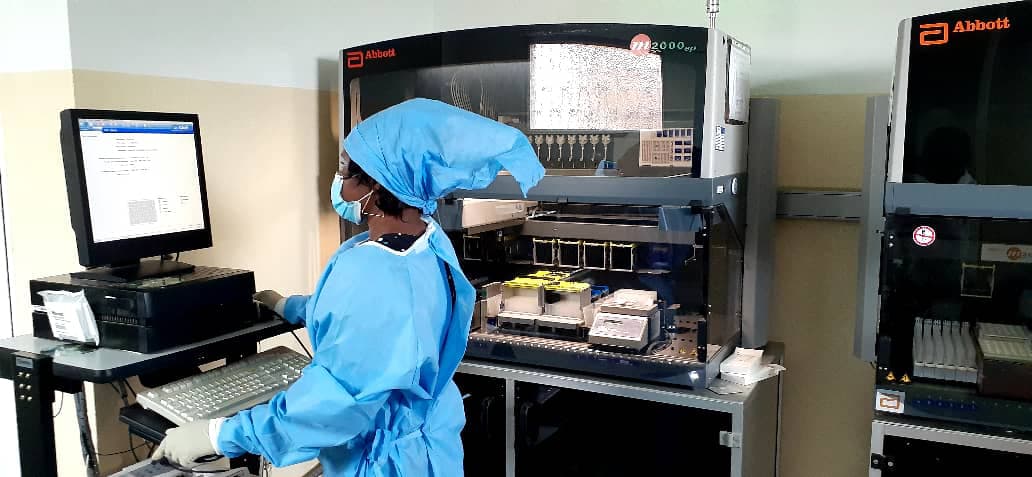
The director of the Balaka DREAM laboratory performs daily maintenance. The CDC-supported Balaka DREAM laboratory achieved international accreditation in 2021 and ensures consistent, accurate, and reliable testing. Photo by Fredrick Namaya.

In 2022, four more CDC-supported molecular laboratories were accredited for HIV viral load testing (ISO15189), increasing the total of accredited laboratories to eight out of ten

CDC conducted more than 640,000 HIV viral load tests in 2022

The National HIV Reference laboratory provided rapid HIV proficiency testing panels to more than 4,400 testers

In 2022, CDC enrolled 14 more districts in rapid testing continuous quality improvement. All 28 districts in Malawi participate in this initiative

CDC trained more than 8,000 staff working in COVID-19 diagnostic testing and sample collection
Field Epidemiology Training Program (FETP)
CDC partnered with the Public Health Institute of Malawi to establish FETP in 2016. FETP trains epidemiologists to investigate and respond to disease outbreaks before they become epidemics. Participants strengthen their data collection skills and translate data into evidence-based action.

More than 140 people graduated from the FETP as of November 2022

Over the past six years, FETP trained more than 140 health workers from across the country in essential epidemiologic skills. These skills include outbreak investigation, public health surveillance, data collection, data analysis, and presentation of scientific findings

CDC helped introduce FETP-Intermediate between 2021 and 2022. Participants help the MOH to investigate and determine the magnitude and risk factors associated with an ongoing cholera outbreak
Malaria
Through the U.S. President’s Malaria Initiative (PMI), CDC assigned a resident advisor to the malaria-endemic country of Malawi to support malaria prevention and control activities. PMI provides long-lasting, insecticide-treated bed nets and indoor residual spray, improves diagnostics and malaria case management, and helps prevent malaria during pregnancy. Through a cooperative agreement with the Malawi College of Medicine’s Malaria Alert Centre, PMI also conducts entomological monitoring and operational research to guide malaria program decisions. Recent studies include:
- Evaluation of first- and second-line antimalarials
- Assessments of the efficacy of an alternative medication for intermittent preventive treatment in pregnancy (IPTp) and of a new delivery method to increase its uptake

In collaboration with the Malaria Alert Centre, CDC research resulted in 13 peer-reviewed publications since 2016

CDC-supported entomological monitoring documented a rise in insecticide (pyrethroid) resistance in Malawi, which led to changes in the procurement of insecticide-treated bed nets
Vaccine Preventable Diseases
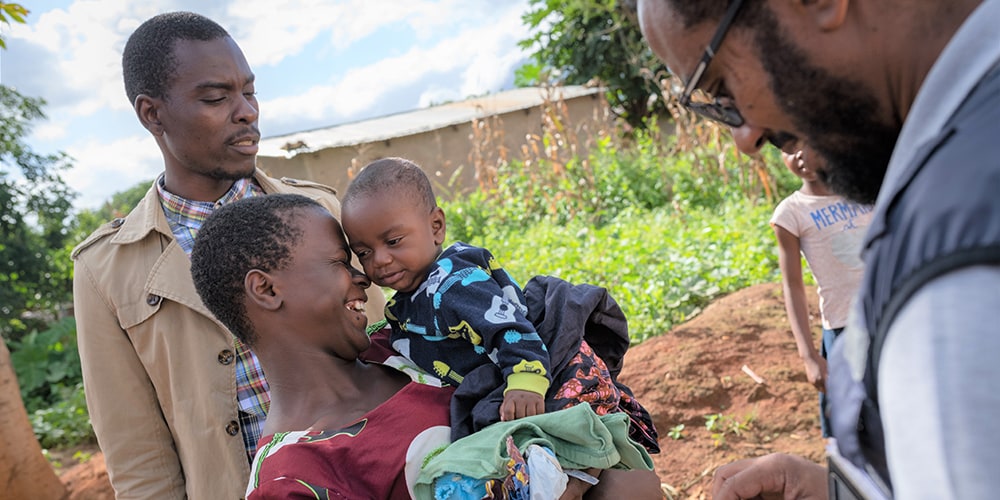
CDC STOP consultant Fitwi Meles (right) conducts door-to-door check-ups on children living near the Mozambique-Malawi border crossing at Mulanje to ensure they have been vaccinated against polio. Fitwi enters data into a mobile system which allows Expanded Programme on Immunization (EPI) coordinators and other stakeholders to see the progress and challenges of the campaign. Photo by UNICEF
CDC provides technical and programmatic expertise to eradicate, eliminate or control vaccine-preventable diseases through immunizations. CDC works with international and local partners to strengthen immunization systems and provide evidence-based technical knowledge to expand routine vaccine delivery. This work helps prevent cases of infectious diseases like polio and measles.
In 2022, CDC supported field activities to respond to the polio outbreak in Malawi. This included vaccination campaign planning, program monitoring, acute flaccid paralysis surveillance, outbreak investigations, community outreach, research, and data management.
- 9 U.S. Assignees
- 36 Locally Employed
- Population: > 20.4 million (mid-2022)
- Per Capita income: $1,630
- Life Expectancy: F 75 / M 69
- Infant mortality rate: 35/1,000 live births
Sources: Population Reference Bureau 2022, Malawi
Malawi | Travelers’ Health | CDC
Malawi Country Profile | Global HIV & TB | CDC
Malawi DREAMS Fact Sheet | U.S. State Department
Infographic: CDC and Malawi Advance Public Health | CDC
Publications: Malawi Articles All Issues | Emerging Infectious Diseases journal | CDC
Photos: Malawi | CDC Global Flickr


