Statistics and Epidemiology
Annual Cases of RMSF in the United States
Rocky Mountain spotted fever (RMSF) has been a reportable disease in the United States since the 1920s. CDC compiles the number of cases reported by state health departments. The incidence of RMSF (the number of RMSF cases for every million persons) has increased during the last decade, from less than 2 cases per million persons in 2000 to over 8 cases per million persons 2008. During the same time period, the proportion of RMSF cases resulting in death (case fatality) has declined to a low of less than 0.5%.
Epidemiology Figure 1 - Reported incidence and case fatality of RMSF in the United States, 1920-2008

Epidemiology Figure 2 - Number of U.S. RMSF cases* reported to CDC, 1993-2008. *Numbers presented here may differ from numbers presented in the MMWR Annual Summary of Notifiable Diseases. Data presented here are based on year of illness onset rather than reporting year.

Geography
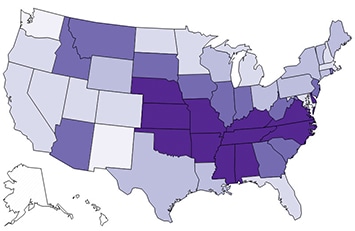
Although RMSF cases have been reported throughout most of the contiguous United States, five states (North Carolina, Oklahoma, Arkansas, Tennessee, and Missouri) account for over 60% of RMSF cases. The primary tick that transmits R. rickettsii in these states is the American dog tick (Dermacentor variabilis Dermacentor andersoni).
In eastern Arizona, RMSF cases have recently been identified in an area where the disease had not been previously seen. Through 2009, over 90 cases had been reported, and approximately 10% of the people diagnosed with the disease in this part of the state have died. The tick responsible for transmission of R. rickettii in Arizona is the brown dog tick (Rhipicephalus sanguineus), which is found on dogs and around people’s homes. Almost all of the cases occurred within communities with a large number of free-roaming dogs.
Epidemiology Figure 3 - Annual reported incidence (per million population) for RMSF in the United States for 2008. (NN= Not notifiable)

Seasonality
Although cases of RMSF can occur during any month of the year, the majority of cases reported to the CDC have an illness onset during the summer months and a peak in cases typically occurs in the months of June and July. This seasonality varies somewhat for different regions of the country due to the climate and the tick vectors involved. In Arizona, where transmission is associated with the brown dog tick, peak months of illness onset are August and September.
Epidemiology Figure 4 - Proportion of RMSF cases reported to CDC by month of onset 2008.

Persons at Risk
The frequency of reported cases of Rocky Mountain spotted fever is highest among males, American Indians, and people aged 50-69. Individuals with frequent exposure to dogs and who reside near wooded areas or areas with high grass may be at increased risk of infection. Children ages 0-9 and American Indians have an increased risk of fatal outcome from RMSF.
Epidemiology Figure 5 - Average annual incidence of Rocky Mountain spotted fever by age group, 2008

Reporting and Surveillance
As of January 1, 2010, cases of RMSF are reported under a new category called Spotted Fever Rickettsiosis (including Rocky Mountain spotted fever). This change was made to better reflect the scope of cases being reported under the previous heading of RMSF, as many of those cases were not identified as being specifically caused by R. rickettsii. The Council of State and Territorial Epidemiologists released a Position Statement detailing the new category. For more information on how to report cases of Rocky Mountain spotted fever and other tick-borne Rickettsial diseases, visit the tick portal for State Health Departments.
Further Reading
Openshaw JJ, Swerdlow DL, Krebs JW, et al. Rocky Mountain spotted fever in the United States, 2000-2007: Interpreting
contemporary increases in incidence. Am J Trop Med Hyg(83)2010,174; Erratum 83(2010), 729
Demma LJ, Traeger MD, Nicholson WL, et al. Rocky Mountain spotted fever from an unexpected tick vector in Arizona. NEJM(353)2005,587
Contact Us:
- Centers for Disease Control and Prevention
Rickettsial Zoonoses Branch
Mail Stop G-44
1600 Clifton Rd
Atlanta, GA 30333 - 800-CDC-INFO
(800-232-4636)
TTY: (888) 232-6348 - New Hours of Operation
8am-8pm ET/Monday-Friday
Closed Holidays - cdcinfo@cdc.gov