National Health Interview Survey
NCHS Fact Sheet, October 2018
PDF Version pdf icon[PDF – 252 KB]
About NCHS
The National Center for Health Statistics (NCHS) is the nation’s principal health statistics agency, providing data to identify and address health issues. NCHS compiles statistical information to help guide public health and health policy decisions.
Collaborating with other public and private health partners, NCHS uses a variety of data collection mechanisms to obtain accurate information from multiple sources. This process provides a broad perspective to help understand the population’s health, influences on health, and health outcomes.
National Health Interview Survey
The National Health Interview Survey (NHIS) provides information on the health of the U.S. civilian noninstitutionalized population through confidential interviews conducted in households. NHIS is one of the nation’s largest in-person household health surveys. It provides data for analyzing health trends and tracking progress toward achieving national health objectives.
These data, continuously collected throughout the year, are also used for epidemiological and policy analysis, such as characterizing those with various health conditions, determining barriers to accessing and using appropriate health care, and evaluating federal health programs.
Major Health Topics Addressed
- Physical and mental health status
- Chronic conditions, including asthma and diabetes
- Access to and use of health care services
- Health insurance coverage and type of coverage
- Health-related behaviors, including smoking, alcohol use, and physical activity
- Measures of functioning and disability
- Immunizations
Examples of NHIS Data
Smoking
Data from 2017 on current cigarette smoking show:
- For both sexes combined, the percentage of adults who were current cigarette smokers was highest for those aged 45–64 and lowest for those aged 65 and over. This pattern also held for women.
- For adults aged 18 and over, 18–44, and 65 and over, men were significantly more likely than women to be current cigarette smokers.
 image icon
NOTE: Data are based on household interviews of a sample of the civilian noninstitutionalized population.
SOURCE: NCHS, National Health Interview Survey, 2017 Sample Adult Core component.
Health insurance
Data from 2017 show:
- Among persons of all ages, 29.3 million (9.1%) were uninsured at the time of interview—not significantly different from 2016, but 19.3 million fewer persons than in 2010.
- Among adults aged 18–64, 69.3% (136.6 million) were covered by private health insurance plans at the time of interview.
- The percentage of adults aged 18–64 who were uninsured at the time of interview decreased, from 22.3% in 2010 to 12.8% in 2017.
- In 2017, the percentage of adults aged 18–64 who were uninsured at the time of interview varied by state. For example, 5.4% were uninsured in Massachusetts compared with 26.4% in Texas.
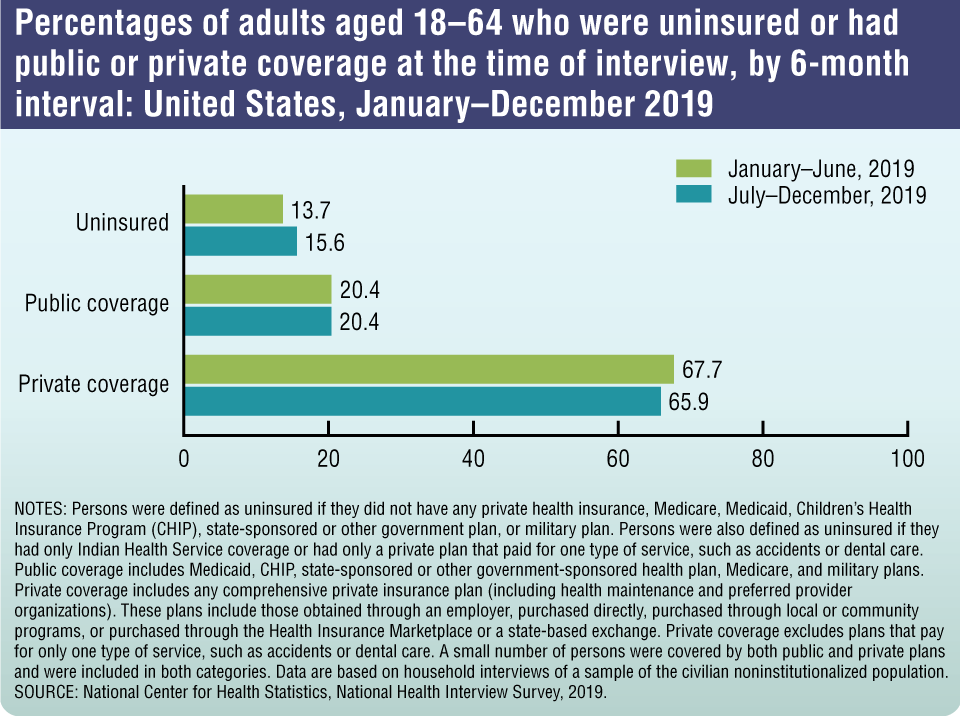 image icon
NOTE: Data are based on household interviews of a sample of the civilian noninstitutionalized population.
SOURCE: NCHS, National Health Interview Survey, 2017 Family Core component.
Other NHIS data from 2017:
- The percentage of persons of all ages with a usual place to go for medical care was highest for non-Hispanic white persons, at 89.6%, and lowest for Hispanic persons, at 82.7%.
- The percentage of adults aged 18 and over who met the 2008 federal physical activity guidelines for aerobic activity (based on leisure-time activity) was highest for non-Hispanic white persons, at 58.5.%, and lower for non-Hispanic black persons, at 44.8%, and Hispanic persons at 44.7%.
- The prevalence of diagnosed diabetes (based on self-report of a diagnosis by a doctor or other health professional) was higher among Hispanic and
non-Hispanic black persons than among non-Hispanic white persons.
Wireless substitution data
Twice a year, along with comparable estimates for the previous 3 years, NHIS releases the most current estimates of telephone coverage available from the federal government. These estimates, based on in-person interviews, are used by survey researchers and political pollsters to ensure that their random-digit-dial telephone surveys include sufficient numbers of households with only wireless telephones (also known as cellular telephones, cell phones, or mobile phones). If telephone surveys do not include wireless-only households, coverage bias could result from differences between persons with and without landline telephones for the substantive variables of interest.
- Preliminary results from the last 6 months of 2017 indicate that the number of homes with only wireless telephones continues to grow to more than one-half of homes (53.9%), an increase of 3.1 percentage points since the second half of 2016.
- The percentage of adults who had at least one heavy drinking day in the past year was substantially higher among those in wireless-only households (30.5%) than among adults living in landline households (18.7%).
Challenges and Future Opportunities
- Launch redesigned survey instrument in January 2019
- Redesigned survey questionnaire will increase relevance, enhance data quality, and minimize respondent burden
- Maintain efforts successful since 2005 to release public-use data files within 6 months of the data collection year
- Improve end-user experience and interface
For more information about NCHS, visit https://www.cdc.gov/nchs/.
For more information about NHIS, visit https://www.cdc.gov/nchs/nhis.htm.