CDC 24/7 - Protecting People - Oregon's Success
Increasing Awareness of and Testing for Radon

What is the problem?
Radon is the second leading cause of lung cancer and is the leading environmental cause of cancer deaths in the United States. Radon is a colorless, odorless, tasteless radioactive gas. Testing is the only way to know if radon levels are high in a building or home. In 1993, the U.S. Environmental Protection Agency identified Oregon as having low to moderate levels of radon. However, recent data show that some areas of the state have high radon levels. The state needed more accurate data on radon hazards to promote testing.
What did Tracking do?
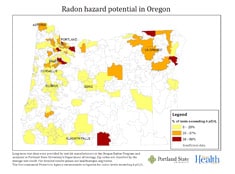
The Oregon Tracking Program and partners developed maps showing radon hazards for areas smaller than counties. Tracking staff used these maps to support public education to encourage in-home radon testing during January 2013, Radon Action Month. They published the radon maps on the health department’s Radon Program web pages and on Oregon Tracking’s Facebook page. They sent news releases to media outlets announcing the maps and providing information about radon testing.
Improved public health
Television news coverage and two front-page articles in The Oregonian newspaper about the maps helped raise public awareness of radon hazards and encourage radon testing. Following the media coverage, monthly average visits to the Radon Program’s web pages tripled. Data from the American Lung Association (ALA) of Oregon showed that they sold nearly 300 test kits during the first day the front page Oregonian article ran. Within three days, ALA sold more radon test kits online than they did in the entire year of 2012. Increases in radon testing likely will lead to more people taking steps to decrease the amount of radon they come in contact with.
Understanding indoor air quality in businesses that serve liquor

What is the problem?
In the United States, environmental tobacco smoke (ETS) causes about 3,000 lung cancer deaths in non-smokers each year. ETS is also linked to heart disease, nasal and sinus cancer, sudden infant death syndrome, asthma, middle ear infections in children, and other illnesses that affect breathing. Although data show ETS exposure is going down in the U.S., it is still a major public health concern. In 2006, only 12 states passed clean indoor air regulations that cover nearly all indoor worksites, including bars and restaurants. Oregon was not one of them.
What did Tracking do?
The Oregon Tracking Program worked with several partners to conduct the Oregon Air Monitoring Project. This project examined indoor air quality in 107 hospitality locations in the state and looked at how indoor smoking affected indoor air pollution. Results of the project showed that restaurants, bars, and other hospitality locations allowing indoor smoking had poorer air quality than both indoor-smoke-free sites and outdoor air. Workers in the locations sampled were exposed to pollution levels more than three times higher than the yearly amount of fine particle air pollution that the U.S. Environmental Protection Agency considers safe to breathe. This project showed that Oregon workers and people visiting bars and restaurants are exposed to harmful levels of cancer-causing chemicals and other poisons in cigarette smoke.
Improved public health
This study influenced state legislation passed in 2009, known as the Clean Indoor Air Act of Oregon. With a few exceptions, this legislation makes it illegal to smoke at work and in public places. Policies such as this can reduce ETS exposure and improve public health.