Volume 14, Number 2—February 2008
Dispatch
Prolonged Plasmodium falciparum Infection in Immigrants, Paris
 , Nadine Godineau†, Arnaud Fontanet‡, Sandrine Houze*, Olivier Bouchaud¶#, Sophie Matheron***, and Jacques Le Bras*
Abstract
Few immigrant travelers have Plasmodium falciparum infections >2 months after leaving malaria-endemic areas. We conducted a case–control study to identify factors associated with prolonged P. falciparum infection in immigrant travelers. Results suggest that P. falciparum infection should be systematically suspected, even months after travel, especially in pregnant women and first-arrival immigrants.
Approximately 100 countries endemic for malaria are visited by 125 million international travelers yearly, and >30,000 contract imported malaria (1). In France, the number of imported cases of Plasmodium falciparum malaria was estimated to be 4,500 in 2004, with a median time of 10 days between departure from an area endemic for malaria and diagnosis (2). The duration of a P. falciparum infection in humans is generally believed not to exceed 12 months. Most epidemiologic studies show that few patients have malaria onset >2 months after returning from travel (3,4). Late occurrence of infection could have severe consequences if physicians do not relate symptoms suggestive of malaria to travel history. Another risk is transfusion-transmitted malaria from an asymptomatic carrier of P. falciparum trophozoites (5).
Cases of late occurrence of P. falciparum malaria have been reported (6–9), but risk factors are unknown. The objective of this study was to determine the incidence and identify factors associated with prolonged P. falciparum infection in immigrant travelers.
A case–control study was conducted among patients with P. falciparum malaria diagnosed at Bichat-Claude Bernard and Saint-Denis Hospitals in Paris, France. Many African immigrants come to these hospitals. Participants traveled to or lived in an area endemic for malaria and had a P. falciparum infection during 1996–2005. The diagnostic criterion was P. falciparum trophozoites on a blood smear confirmed by the Centre National de Reference du Paludisme (CNRP) in Paris, without epidemiologic evidence of autochthonous, transfusion-transmitted, or occupational malaria. Case-patients had P. falciparum infections detected >59 days after their arrival in France. Controls had P. falciparum infections detected <30 days after their arrival. For each case-patient, 4 controls were matched by calendar year and hospital of diagnosis (70 cases and 280 controls). Data were collected from the CNRP database in which all cases are prospectively included and medical records are checked. We only considered immigrants (persons born in an area endemic for malaria and residing in France), which resulted in 61 case-patients and 197 controls. We distinguished first-arrival immigrants (persons who emigrated to France and never returned to areas endemic for malaria) from visiting friends and immigrant relatives (persons who traveled back to areas endemic for malaria after immigration to France).
Logistic regression was used to identify factors associated with prolonged P. falciparum infection and estimate odds ratios (ORs) and 95% confidence intervals (CIs). For multivariate analysis, variables with p values <0.25 were introduced into the model and removed after a backward stepwise approach, which resulted in only values with p<0.05 in the final model (except for age groups). Statistical analysis was performed by using Stata software version 8.2 (Stata Corporation, College Station, TX, USA).
Figure
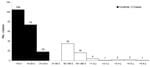
Figure. Delay in days or years between arrival in France and diagnosis of imported Plasmodium falciparum malaria, Bichat-Claude Bernard Hospital and Saint Denis Hospital, Paris, France, 1996–2005.
During the 10-year period, 61 (2.3%) late infections occurred among 2,680 diagnosed P. falciparum malaria infections. The median diagnosis delay was 5 months (interquartile range 3–9 months). These infections included 10 patients (5 pregnant women, 2 HIV-positive patients, and 3 first-arrival immigrants) with clinical malaria >1 year after their arrival. Four of them, all pregnant women, had clinical malaria >3 years after their arrival. For the case–control study, 197 controls were compared with 61 case-patients (Figure). Table 1 shows the main characteristics of case-patients and controls. Case-patients were younger (median age 30.6 years vs. 34.5 years, p = 0.04) and more often female (54.1% vs. 38.1%, p = 0.03) than controls. The mean parasitemia level was lower for case-patients than for controls (0.6% vs. 1.4%, p = 0.04), including patients with 8 asymptomatic cases versus none of the controls (in these cases, diagnosis of malaria was made through systematic checking).
Among immigrant travelers, 3 groups had a higher risk for prolonged P. falciparum infection: pregnant women, first-arrival immigrants, and HIV-positive patients. A total of 27.9% (n = 17) of the patients were pregnant women, with a median (range) age of 22 (16–36) years. All were of African origin and had become pregnant in France; 10 (58.8%) were in their second trimester, 5 (29.4%) were in their third trimester. First-arrival immigrants were younger than other patients (mean age 26.2 vs. 37.6 years, p = 0.001). All patients were of African origin except for 1 Indian man. HIV infection was associated with prolonged infection, but HIV status was not introduced into the final model because of missing data. Although chemoprophylaxis with chloroquine-proguanil was less common among case-patients than controls (8.5% vs. 21.2%, p = 0.03), the reverse was seen, although not significantly, with mefloquine use (4.9% vs. 1.5%, p = 0.15). Multivariate analysis (Table 2) showed that factors positively and independently associated with prolonged P. falciparum infection in immigrant travelers were being a first-arrival immigrant (OR 22.93, 95% CI 9.74–53.96, p<0.001), being a pregnant woman (OR 4.21, 95% CI 1.13–15.77, p = 0.03), and mefloquine prophylaxis (OR 11.55, 95% CI 2.06–64.78, p<0.005).
We also observed cases of malaria in a 26-year-old Caucasian man and a 2-year-old African girl who were hospitalized with diagnosis delays of 221 days and 127 days, respectively. The man was a French expatriate who lived in Madagascar for 2 years and took regular chloroquine-proguanil prophylaxis. He was hospitalized 7 months after his return with severe P. falciparum malaria (impaired consciousness) and responded to treatment. The girl had traveled in Mali for 2 weeks and took regular chloroquine-proguanil prophylaxis. She was hospitalized 4 months after her return with uncomplicated P. falciparum malaria occurring concomitantly with a Salmonella spp. infection that had been treated 1 week earlier with ceftriaxone.
Three independent factors were positively associated with prolonged P. falciparum infection: being a first-arrival immigrant, being a pregnant woman, and taking mefloquine prophylaxis. The first 2 factors most likely reflect partial control of parasitemia by acquired immunity. Persons living in areas with high transmission of malaria acquire this immunity during childhood. In these areas, P. falciparum infections in adults are mostly asymptomatic with transient low parasitemia levels (10). Chronic asymptomatic carriage of P. falciparum helps prevent symptomatic malaria attacks (11). In a previous study, 29% of asymptomatic Liberian children had detectable P. falciparum 4 weeks after immigration to the United States (Minnesota) (12). We postulate that many first-arrival immigrants are asymptomatic P. falciparum carriers upon their arrival in France. Their immunity probably prevents clinical symptoms for a few months, but in the absence of reinfections their immunity would decrease and symptoms would occur. In some cases, P. falciparum infections may not be the cause of illness when patients come to a hospital.
Several immunologic mechanisms have been suggested to explain late manifestations of P. falciparum malaria in pregnant women. A decrease in immunity during pregnancy could be one explanation (10). Other authors have suggested that antigenic variability could be responsible for impaired control of parasitemia (13). The role of mefloquine prophylaxis in delayed onset of malaria has been suggested (14). We found a positive association between mefloquine use and prolonged P. falciparum infection, but this drug was seldom used by our study group. This association is probably caused by the long half-life of mefloquine (>3 weeks).
This study also highlights the risk for blood transfusion–transmitted malaria, a rare but serious complication. Mungai et al. (15) reported 32 cases of transfusion-transmitted P. falciparum malaria in the United States during 1963–1999 (mortality rate 18.8%). Current US guidelines recommend obtaining a thorough travel history and deferring blood donation if potential donors have emigrated from areas endemic for malaria in the preceding 3 years. However, this measure may not prevent transmission if P. falciparum is present for >3 years (as in 4 pregnant women in our study). In France, systematic serologic analysis for Plasmodium spp. in blood donors born in areas endemic for malaria was implemented in 2002 (5).
Our findings suggest that physicians should consider the risk for prolonged P. falciparum infection in immigrant pregnant women and first-arrival immigrants even without recent travel to a country endemic for malaria. The prevalence of asymptomatic P. falciparum carriers in France or other northern countries is unknown but could be high with the increase in immigration. Public health authorities should be aware of the risk these persons represent for blood donations.
Dr D’Ortenzio is a physician and epidemiologist at the Institut de Veille Sanitaire, Cellule Inter-Régionale d’Epidémiologie Réunion-Mayotte on Réunion Island. His primary research interests include clinical and epidemiologic aspects of malaria, arbovirus epidemiology, and travel medicine.
Acknowledgment
We thank Michel Cot, Pascal Ringwald, and Tania Ikowsky for critically reading the manuscript.
References
- World Health Organization. International travel and health. Geneva: The Organization. 2005 [cited 2007 Oct 25]. Available from http://whqlibdoc.who.int/publications/2005/9241580364_chap7.pdf
- Legros F, Arnaud A, El Mimouni B, Danis M. Paludisme d’importation en France métropolitaine: données épidémiologiques 2001–2004. Bulletin Epidémiologique Hebdomadaire. 2006;32:235–6.
- Schwartz E, Parise M, Kozarsky P, Cetron M. Delayed onset of malaria—implications for chemoprophylaxis in travelers. N Engl J Med. 2003;349:1510–6. DOIPubMedGoogle Scholar
- Williams HA, Roberts J, Kachur SP, Barber AM, Barat LM, Bloland PB, Malaria surveillance—United States, 1995. MMWR CDC Surveill Summ. 1999;48:1–23.PubMedGoogle Scholar
- Bruneel F, Thellier M, Eloy O, Mazier D, Boulard G, Danis M, Transfusion-transmitted malaria. Intensive Care Med. 2004;30:1851–2. DOIPubMedGoogle Scholar
- Cristau P, Desbaumes J, Giraud D. Late manifestations of Plasmodium falciparum after leaving an endemic area. Presse Med. 1987;16:493.PubMedGoogle Scholar
- Revel MP, Datry A, Saint Raimond A, Lenoir G, Danis M, Gentilini M. Plasmodium falciparum malaria after three years in a non-endemic area. Trans R Soc Trop Med Hyg. 1988;82:832. DOIPubMedGoogle Scholar
- Krajden S, Panisko DM, Tobe B, Yang J, Keystone JS. Prolonged infection with Plasmodium falciparum in a semi-immune patient. Trans R Soc Trop Med Hyg. 1991;85:731–2. DOIPubMedGoogle Scholar
- Giobbia M, Tonon E, Zanatta A, Cesaris L, Vaglia A, Bisoffi Z. Late recrudescence of Plasmodium falciparum malaria in a pregnant woman: a case report. Int J Infect Dis. 2005;9:234–5. DOIPubMedGoogle Scholar
- Hviid L. Naturally acquired immunity to Plasmodium falciparum malaria in Africa. Acta Trop. 2005;95:270–5. DOIPubMedGoogle Scholar
- Druilhe P, Pérignon JL. A hypothesis about the chronicity of malaria infection. Parasitol Today. 1997;13:353–7. DOIPubMedGoogle Scholar
- Maroushek SR, Aguilar EF, Stauffer W, Abd-Alla MD. Malaria among refugee children at arrival in the United States. Pediatr Infect Dis J. 2005;24:450–2. DOIPubMedGoogle Scholar
- Staalsoe T, Hviid L. The role of variant-specific immunity in asymptomatic malaria infection: maintaining a fine balance. Parasitol Today. 1998;14:177–8. DOIPubMedGoogle Scholar
- Day JH, Behrens RH. Delay in onset of malaria with mefloquine prophylaxis. Lancet. 1995;345:398. DOIPubMedGoogle Scholar
- Mungai M, Tegtmeier G, Chamberland M, Parise M. Transfusion-transmitted malaria in the United States from 1963 through 1999. N Engl J Med. 2001;344:1973–8. DOIPubMedGoogle Scholar
Figure
Tables
Cite This ArticleTable of Contents – Volume 14, Number 2—February 2008
| EID Search Options |
|---|
 Advanced Article Search – Search articles by author and/or keyword.
|
 Articles by Country Search – Search articles by the topic country.
|
 Article Type Search – Search articles by article type and issue.
|
Please use the form below to submit correspondence to the authors or contact them at the following address:
Eric D’Ortenzio, Cellule Inter-Régionale d’Épidémiologie Réunion/Mayotte, Institut de Veille Sanitaire, 2 Bis Ave Georges Brassens, BP 50, 97408 Saint-Denis, Cedex 9, Réunion Island, France;
Top