Volume 14, Number 12—December 2008
Letter
Equine Herpesvirus Type 9 in Giraffe with Encephalitis
To the Editor: Herpesviruses have been isolated from many mammals. Herpesvirus infection in natural hosts is often mild and is usually followed by a latent infection; however, cross-species herpesvirus infections cause severe and fatal diseases. Equine herpesvirus (EHV)–1 causes abortion, respiratory disease, and, occasionally, neurologic disorders in horses. EHV-1 infection is usually limited to equine species, although it has also been found in other species (1), in which it causes fatal encephalitis. Recent sequence analyses suggested that the equine herpesviruses isolated in the United States from onagers (Equus hemionus), Grevy’s zebras (E. grevyi), and Thomson’s gazelles (Gazella thomsoni) are a subtype or variant of EHV-1 (2). With respect to epizootiology, the nonequine animals affected by EHV-1 or EHV-1–related virus were kept in enclosures adjacent to those of zebra species (Grevy’s or Burchell’s).
Another EHV-related virus was isolated from 2 Thomson’s gazelles that had encephalitis and were kept with zebras (3). The virus was later found to be a new type of EHV, EHV-9, although it was serologically cross-reactive with EHV-1 (3). Recently, neutralizing antibodies against EHV-9 were found among Burchell’s zebras in the Serengeti ecosystem (4).
A herpesvirus was recently isolated from a reticulated giraffe (Giraffa camelopardalis reticulate) with neurologic symptoms; the giraffe was from a zoo in the United States (5). Nonsuppurative encephalitis was found by histopathologic examination of the giraffe brain. Several Burchell’s zebras that were apparently healthy and later determined to be seropositive for EHV-1 were housed in the same pen as the giraffe. The isolated virus was identified by PCR and a monoclonal antibody assay as EHV-1 (5). In the present study, we analyzed 4 gene sequences of the giraffe herpesvirus to show its relatedness to EHV-1 and EHV-9.
We amplified portions of 4 genes from giraffe herpesvirus DNA by PCR. The DNA polymerase catalytic subunit (open reading frame [ORF] 30) gene was amplified by using herpesvirus universal primers (6). The genes for glycoprotein B (gB) (ORF33), glycoprotein 2 (gp2) (ORF71), and glycoprotein D (gD) (ORF72) were amplified by using primers specific for EHV-9. The ORF33 primers were gB-F (5′-ggcacaatagtcctagcatgtctgttgctg-3′) and gB-R (5′-aaatatcctcagggccggaactggaaagtg-3′). The ORF71 primers were gp2-F (5′-ccccgttgatgagttttgcgtagaggtcta-3′) and gp2-R (5′-gccaccactggttgtaaaggccaagagata-3′). The ORF72 primers were gD-F (5′-tttacaaccactggtggcgtgtgtgcagaa-3′) and gD-R (5′-tatctccaaaccgcgaagctttaaggccgt-3′). The amplified products were used as templates for direct sequencing (Dragon Genomics, Mie, Japan). The sequences were edited with Phred, Phrap, and Consed (www.phrap.org/phredphrapconsed.html), and the phylogenic trees were constructed with PHYLIP (2,7). Accession numbers of the sequences (submitted to the DNA Data Bank of Japan) are given in the Figure.
Figure
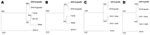
Figure. Phylogenic trees of giraffe herpesvirus and other related viruses. A) Open reading frame (ORF) 30, B) ORF33, C) ORF71, and D) ORF72. EHV-9 giraffe, equine herpesvirus (EHV) type 9 isolated from...
We used PCR to amplify a part of the gB gene of the giraffe herpesvirus, and we used EHV-1 specific primers for sequencing. However, we could not obtain amplicons (data not shown). Therefore, the more conserved gene, ORF30, was sequenced. The sequence of the 1,066-bp segment of the giraffe herpesvirus ORF30 gene was 99.5% identical to EHV-9 and 94.6% identical to EHV-1, which indicates that the giraffe herpesvirus was most closely related to EHV-9. Therefore, EHV-9 ORF33–specific primers were used to amplify the corresponding region of the giraffe herpesvirus. The sequence of the giraffe herpesvirus ORF33 was 98.8% identical to EHV-9 and 95.9% identical to EHV-1. Also, the sequence of the other envelope glycoproteins (ORF71 and ORF72) of the giraffe herpesvirus were 99.8% and 99.6% identical to EHV-9 and 91.6% and 96.3% identical to EHV-1. A phylogenic tree of maximum likelihood showed that EHV-9 and the giraffe virus formed a genetic group that was apparently distinguished from other genetic groups of EHV (Figure).
Herpesviruses have caused clinical disease in zoo animals, including a case of EHV-9 infection in Thomson’s gazelles (3) and a recently described endotheliotropic betaherpesvirus infection in Asian and African elephants (8). The distribution and severity of herpesvirus encephalitis often differ between natural and accidental hosts in terms of enhanced neurovirulence. For example, herpes simplex virus causes a severe and fulminating encephalitis in rabbits but only herpetic stomatitis in humans; herpesvirus B infection is fatal to humans but not to other primates (9). These findings may explain why the giraffe had lesions while the zebras in the same enclosure did not.
Alphaherpesviruses can evade the immune system and become latent within lymphoid tissues, peripheral leukocytes, and trigeminal ganglia; they have the potential for reactivation and shedding after immune suppression or stress (10). Thus, the fact that the zebras were apparently healthy and seropositive for EHV-1 raises the possibility that the virus was reactivated and shed by one of the zebras, resulting in systemic infection and disease in the giraffe (5). This cross-species transmission of equine herpesviruses raises the possibility of latent infection and transmission of the disease from zebras to other animal species kept in zoos; the results could be devastating. Zebras might be EHV-9 carriers in zoos. Cross-species transmission must be considered in terms of screening susceptible animals for subclinical infection in terms of husbandry and housing issues for irreplaceable species.

References
- Rebhun WC, Jenkins DH, Riis RC, Dill SG, Dubovi EJ, Torres A. An epizootic of blindness and encephalitis associated with a herpesvirus indistinguishable from equine herpesvirus I in a herd of alpacas and llamas. J Am Vet Med Assoc. 1988;192:953–6.PubMedGoogle Scholar
- Ibrahim ESM, Kinoh M, Matsumura T, Kennedy M, Allen GP, Yamaguchi T, Genetic relatedness and pathogenicity of equine herpesvirus 1 isolated from onager, zebra and gazelle. Arch Virol. 2007;152:245–55. DOIPubMedGoogle Scholar
- Fukushi H, Tomita T, Tanaiguchi A, Ochiai Y, Kirisawa R, Matsumura T, Gazelle herpesvirus 1: a new neurotropic herpesvirus immunologically related to equine herpesvirus 1. Virology. 1997;227:34–44. DOIPubMedGoogle Scholar
- Borchers K, Wiik H, Frölich K, Ludwig H, East ML. Antibodies against equine herpesviruses and equine arteritis virus in Burchell’s zebras (Equus burchelli) from the Serengeti ecosystem. J Wildl Dis. 2005;41:80–6.PubMedGoogle Scholar
- Hoenerhoff MJ, Janovitz EB, Richman LK, Murphy DA, Butler TC, Kiupel M. Fatal herpesvirus encephalitis in a reticulated giraffe (Giraffa camelopardalis reticulata). Vet Pathol. 2006;43:769–72. DOIPubMedGoogle Scholar
- Yamada S, Matsumura T, Tsujimura K, Yamaguchi T, Ohya K, Fukushi H. Comparison of the growth kinetics of neuropathogenic and nonneuropathogenic equid herpesvirus type 1 (EHV-1) strains in cultured murine neuronal cells and the relevance of the D/N752 coding change in the DNA polymerase gene (ORF30). J Vet Med Sci. 2008;70:505–11. DOIPubMedGoogle Scholar
- Gordon D, Abajian C, Green P. Consed: a graphical tool for sequence finishing. Genome Res. 1998;8:195–202.PubMedGoogle Scholar
- Richman LK, Montali RJ, Garber RL, Kennedy MA, Lehnhardt J, Hildebrandt T, Novel endotheliotropic herpesviruses fatal for Asian and African elephants. Science. 1999;283:1171–6. DOIPubMedGoogle Scholar
- Weigler BJ. Biology of B virus in macaque and human hosts: a review. Clin Infect Dis. 1992;14:555–67.PubMedGoogle Scholar
- Van Maanen C. Equine herpesvirus 1 and 4 infection: an update. Vet Q. 2002;24:58–78.PubMedGoogle Scholar
Figure
Cite This ArticleRelated Links
Table of Contents – Volume 14, Number 12—December 2008
| EID Search Options |
|---|
 Advanced Article Search – Search articles by author and/or keyword.
|
 Articles by Country Search – Search articles by the topic country.
|
 Article Type Search – Search articles by article type and issue.
|
Please use the form below to submit correspondence to the authors or contact them at the following address:
Hideto Fukushi, Laboratory of Veterinary Microbiology, Faculty of Applied Biological Sciences and Department of Applied Veterinary Sciences, United Graduate School of Veterinary Sciences, Gifu University, 1-1 Yanagido, Gifu 501-1193, Japan
Top