Persons using assistive technology might not be able to fully access information in this file. For assistance, please send e-mail to: mmwrq@cdc.gov. Type 508 Accommodation and the title of the report in the subject line of e-mail.
Preventing Tetanus, Diphtheria, and Pertussis Among Adults:
Use of Tetanus Toxoid, Reduced Diphtheria Toxoid and
Acellular Pertussis Vaccine
Recommendations of the Advisory Committee on Immunization
Practices (ACIP) and Recommendation of ACIP, supported by the Healthcare
Infection Control Practices Advisory Committee (HICPAC), for Use of Tdap
Among Health-Care Personnel
Prepared by
Katrina Kretsinger, MD,1,6 Karen R. Broder,
MD,1,6 Margaret M. Cortese,
MD,2,6 M. Patricia Joyce, MD,
1 Ismael Ortega-Sanchez, PhD,2 Grace
M. Lee, MD,3 Tejpratap Tiwari, MD,1
Amanda C. Cohn, MD, 1,5,6 Barbara A. Slade,
MD,1 John K. Iskander,
MD,4,6 Christina M. Mijalski, MPH,1
Kristin H. Brown,1 Trudy V. Murphy,
MD 1
1Division of Bacterial Diseases (proposed)
2Division of Viral Diseases (proposed), National Center for Immunization and Respiratory Diseases (proposed), CDC
3Harvard Medical School, Harvard Pilgrim Health Care & Children's Hospital Boston
4Office of the Chief Science Officer, Office of the Director, CDC
5EIS/Career Development Division, Office of Workforce and Career Development, CDC
6Commissioned Corps of the United States Public Health Service
The material in this report originated in the National Center for Immunization and Respiratory Diseases (proposed), Anne Schuchat, MD,
Director; Division of Bacterial Diseases (proposed), Alison Mawle, PhD, (Acting) Director, and the Office of the Chief Science Officer, Tanja Popovic,
MD, (Acting) Chief Science Officer; and Immunization Safety Office, Robert Davis, MD, Director.
Corresponding preparer: Katrina Kretsinger, MD, National Center for Immunization and Respiratory Diseases (proposed), CDC, 1600 Clifton
Road NE, MS C-25, Atlanta, GA 30333. Telephone: 404-639-8544; Fax: 404-639-8616; Email: kkretsinger@cdc.gov.
Summary
On June 10, 2005, a tetanus toxoid, reduced diphtheria toxoid and acellular pertussis vaccine (Tdap) formulated for use
in adults and adolescents was licensed in the United States for persons aged 11--64 years
(ADACEL®, manufactured by sanofi pasteur, Toronto, Ontario, Canada). Prelicensure studies demonstrated safety and efficacy, inferred through
immunogenicity, against tetanus, diphtheria, and pertussis when Tdap was administered as a single booster dose to adults. To reduce
pertussis morbidity among adults and maintain the standard of care for tetanus and diphtheria prevention and to reduce
the transmission of pertussis to infants and in health-care settings, the Advisory Committee on Immunization Practices
(ACIP) recommends that: 1) adults aged 19--64 years should receive a single dose of Tdap to replace tetanus and diphtheria
toxoids vaccine (Td) for booster immunization against tetanus, diphtheria, and pertussis if they received their last dose of Td
>10 years earlier and they have not previously received Tdap; 2) intervals shorter than 10 years since the last Td may be used
for booster protection against pertussis; 3) adults who have or who anticipate having close contact with an infant aged <12
months (e.g., parents, grandparents aged <65 years, child-care providers, and health-care personnel) should receive a single dose
of Tdap to reduce the risk for transmitting pertussis. An interval as short as 2 years from the last Td is suggested; shorter
intervals can be used. When possible, women should receive Tdap before becoming pregnant. Women who have not previously
received Tdap should receive a dose of Tdap in the immediate postpartum period; 4) health-care personnel who work in hospitals
or ambulatory care settings and have direct patient contact should receive a single dose of Tdap as soon as feasible if they have
not previously received Tdap. An interval as short as 2 years from the last dose of Td is recommended; shorter intervals may
be used. These recommendations for use of Tdap in health-care personnel are supported by the Healthcare Infection
Control Practices Advisory Committee (HICPAC). This statement 1) reviews pertussis, tetanus and diphtheria vaccination policy in
the United States; 2) describes the clinical features and epidemiology of pertussis among adults; 3) summarizes
the immunogenicity, efficacy, and safety data of Tdap; and 4) presents recommendations for the use of Tdap among adults
aged 19--64 years.
Introduction
Pertussis is an acute, infectious cough illness that remains endemic in the United States despite longstanding
routine childhood pertussis vaccination (1). Immunity to pertussis wanes approximately 5--10 years after completion of
childhood vaccination, leaving adolescents and adults susceptible to pertussis
(2--7). Since the 1980s, the number of reported
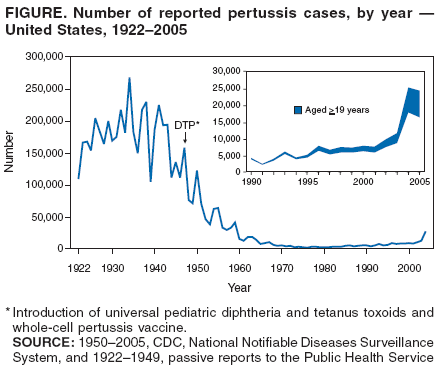
pertussis cases has steadily increased, especially among adolescents and adults (Figure). In 2005, a total of 25,616 cases of
pertussis were reported in the United States
(8). Among the reportable bacterial vaccine-preventable diseases in the United States
for which universal childhood vaccination has been recommended, pertussis is the least well controlled
(9,10).
In 2005, a tetanus toxoid, reduced diphtheria toxoid and acellular pertussis vaccine, adsorbed (Tdap) product
formulated for use in adults and adolescents was licensed in the United States for persons aged 11--64 years
(ADACEL®, sanofi pasteur, Toronto, Ontario, Canada)
(11). The Advisory Committee on Immunization Practices (ACIP) reviewed evidence
and considered the use of Tdap among adults in public meetings during June 2005--February 2006. On October 26, 2005,
ACIP voted to recommend routine use of Tdap among adults aged 19--64 years. For adult contacts of infants, ACIP
recommended Tdap at an interval as short as 2 years since the previous Td. On February 22, 2006, ACIP recommended Tdap for
health-care personnel (HCP), also at an interval as short as 2 years since the last Td. This report summarizes the rationale
and recommendations for use of Tdap among adults in the United States. Recommendations for the use of Tdap
among adolescents are discussed elsewhere (12).
Pertussis Vaccination Policy
In the United States during 1934--1943, an annual average of 200,752 pertussis cases and 4,034 pertussis-related deaths
were reported (13,14; Sirotkin B, CDC, personal
communication,2006). Although whole cell pertussis vaccines became available
in the 1920s (15), they were not routinely recommended for children until the 1940s after they were combined with diphtheria
and tetanus toxoids (DTP) (16,17). The number of reported pertussis cases declined dramatically following introduction of
universal childhood pertussis vaccination
(1).
Pediatric acellular pertussis vaccines (i.e., diphtheria and tetanus toxoids and acellular pertussis antigens [DTaP]),
less reactogenic than the earlier whole-cell vaccines, were first licensed for use in children in 1991
(18,19). ACIP recommended that pediatric DTaP replace all pediatric DTP doses in 1997
(1).
In 2005, two Tdap products were licensed for use in single doses in the United States
(11,20). BOOSTRIX® (GlaxoSmithKline Biologicals, Rixensart, Belgium) is licensed only for adolescents aged 10--18 years.
ADACEL® (sanofi pasteur, Toronto, Ontario, Canada) is licensed for adolescents and adults aged 11--64 years. ACIP has recommended
that adolescents aged 11--18 years receive a single dose of either Tdap product instead of adult tetanus and diphtheria
toxoids (Td) for booster immunization against tetanus, diphtheria, and pertussis if they have completed the recommended
childhood DTP or DTaP vaccination series and have not received Td or Tdap; age 11--12 years is the preferred age for the
adolescent Tdap dose (12).
One of the Tdap vaccines,
ADACEL® (sanofi pasteur) is licensed for use in adults and adolescents
(11). All references to Tdap in this report refer to the sanofi pasteur product unless otherwise indicated. Tdap is licensed for 1-dose
administration (i.e., not for subsequent decennial booster doses or subsequent wound prophylaxis). Prelicensure studies on the safety
or efficacy of subsequent doses were not conducted. No vaccine containing acellular pertussis antigens alone (i.e.,
without tetanus and diphtheria toxoids) is licensed in the United States. Acellular pertussis vaccines formulated with tetanus
and diphtheria toxoids have been available for use among adolescents and adults in other countries, including Canada,
Australia and an increasing number of European countries (e.g., France, Austria and Germany)
(21--27).
The efficacy against pertussis of an adolescent and adult acellular pertussis (ap) vaccine with the same pertussis antigens
as those included in BOOSTRIX® (without tetanus and diphtheria toxoids) was evaluated among 2,781 adolescents and
adults in a prospective, randomized trial in the United States
(28). Persons aged 15--64 years were randomized to receive one dose
of ap vaccine or hepatitis A vaccine
(Havrix®, GlaxoSmithKline Biologicals, Rixensart, Belgium). The primary outcome
measure was confirmed pertussis, defined as a cough illness lasting
>5 days with laboratory evidence of Bordetella
pertussis infection by culture, polymerase chain reaction (PCR), or paired serologic testing results (acute and convalescent). Nine persons in
the hepatitis A vaccine control group and one person in the ap vaccine group had confirmed pertussis during the study
period;
vaccine efficacy against confirmed pertussis was 92% (95% confidence interval [CI] = 32%--99%)
(28). Results of this study were not considered in evaluation of Tdap for licensure in the
United States.
Objectives of Adult Pertussis Vaccination Policy
The availability of Tdap for adults offers an opportunity to reduce the burden of pertussis in the United States.
The primary objective of replacing a dose of Td with Tdap is to protect the vaccinated adult against pertussis. The
secondary objective of adult Tdap vaccination is to reduce the reservoir of pertussis in the population at large, and thereby potentially
1) decrease exposure of persons at increased risk for complicated infection (e.g., infants), and 2) reduce the cost and
disruption of pertussis in health-care facilities and other institutional settings.
Background: Pertussis
General Characteristics
Pertussis is an acute respiratory infection caused by
B. pertussis, a fastidious gram-negative coccobacillus. The
organism elaborates toxins that damage respiratory epithelial tissue and have systemic effects, including promotion of
lymphocytosis (29). Other species of bordetellae, including
B. parapertussis and less commonly B. bronchiseptica
or B. holmseii, are associated with cough illness; the clinical presentation of
B. parapertussis can be similar to that of classic pertussis. Illness caused
by species of bordetellaeother than B.
pertussis is not preventable by available vaccines
(30).
Pertussis is transmitted from person to person through large respiratory droplets generated by coughing or sneezing.
The usual incubation period for pertussis is 7--10 days (range: 5--21 days)
(16,31,32). Patients with pertussis are most
infectious during the catarrhal and early paroxysmal phases of illness and can remain infectious for
>6 weeks (16,31,32). The
infectious period is shorter, usually <21 days, among older children and adults with previous vaccination or infection. Patients
with pertussis are highly infectious; attack rates among exposed, nonimmune household contacts are as high as
80%--90% (16,32,33).
Factors that affect the clinical expression of pertussis include age, residual immunity from previous vaccination or
infection, and use of antibiotics early in the course of the illness before the cough onset
(32). Antibiotic treatment generally does
not modify the course of the illness after the onset of cough but is recommended to prevent transmission of the infection
(34--39). For this reason, vaccination is the most effective strategy for preventing the morbidity of pertussis.
Detailed recommendations on the indications and schedules for antimicrobials are published separately
(34).
Clinical Features and Morbidity Among Adults with Pertussis
B. pertussis infection among adults covers a spectrum from mild cough illness to classic pertussis; infection also can
be asymptomatic in adults with some level of immunity. When the presentation of pertussis is not classic, the cough illness
can be clinically indistinguishable from other respiratory illnesses. Classic pertussis is characterized by three phases of
illness: catarrhal, paroxysmal, and convalescent
(16,32). During the catarrhal phase, generally lasting 1--2 weeks, patients
experience coryza and intermittent cough; high fever is uncommon. The paroxysmal phase lasts 4--6 weeks and is characterized
by spasmodic cough, posttussive vomiting, and inspiratory whoop
(16). Adults with pertussis might experience a
protracted cough illness with complications that can require hospitalization. Symptoms slowly improve during the convalescent
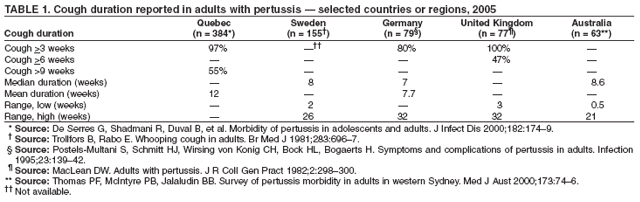
phase, which usually lasts 2--6 weeks, but can last for months (Table 1)
(32).
Prolonged cough is a common feature of pertussis. In studies of adults with pertussis, the majority coughed for
>3 weeks and some coughed for many months (Table 1). Because of the prolonged illness, some adults undergo extensive
medical evaluations by providers in search of a diagnosis, if pertussis is not considered. Adults with pertussis often make
repeated visits for medical care. Of 2,472 Massachusetts adults with pertussis during 1988--2003, a total of 31% had one, 31%
had two, 35% had three or more medical visits during their illness; data were not available for
3%(Massachusetts Department of Public Health, unpublished data, 2005). Similarly, adults in Australia with pertussis reported a mean of 3.7 medical visits
for their illness, and adults in Quebec visited medical providers a mean of 2.5 times
(40,41). Adults with pertussis miss work:
in Massachusetts, 78% of 158 employed adults with pertussis missed work for a mean of 9.8 days (range: 0.1--180 days);
in
Quebec, 67% missed work for a mean of 7 days; in Sweden, 65% missed work and 16% were unable to work for more than
1 month; in Australia, 71% missed work for a mean of 10 days (range: 0--93 days) and 10% of working adults missed
more than 1 month (40--43).
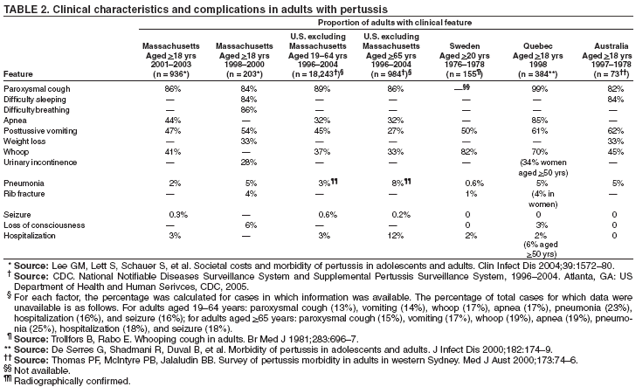
Adults with pertussis can have complications and might require hospitalization. Pneumonia has been reported in up to
5% and rib fracture from paroxysmal coughing in up to 4% (Table 2); up to 3% were hospitalized (12% in older adults). Loss
of consciousness (commonly "cough syncope") has been reported in up to 3% and 6% of adults with pertussis
(41,42). Urinary incontinence was commonly reported among women in studies that inquired about this feature
(41,42). Anecdotal reports from the literature describe other complications associated with pertussis in adults. In addition to rib fracture, cough
syncope, and urinary incontinence, complications arising from high pressure generated during coughing attacks include
pneumothorax (43), aspiration, inguinal hernia
(44), herniated lumbar disc (45), subconjunctival hemorrhage
(44), and one-sided hearing loss (43). One patient was reported to have carotid dissection
(46). In addition to pneumonia, other respiratory
tract complications include sinusitis (41), otitis media
(41,47), and hemoptysis (48). Neurologic and other complications
attributed to pertussis in adults also have been described, such as pertussis encephalopathy (i.e., seizures triggered by only minor
coughing episodes) (49), migraine exacerbation
(50), loss of concentration/memory
(43), sweating attacks (41), angina
(43), and severe weight loss (41).
Whether adults with co-morbid conditions are at higher risk for having pertussis or of suffering its complications
is unknown. Adults with cardiac or pulmonary disease might be at risk for poor outcomes from severe coughing paroxysms
or cough syncope (41,51). Two case reports of pertussis in human immunodeficiency virus (HIV)-infected adults (one
patient with acquired immunodeficiency syndrome [AIDS]) described prolonged cough illnesses and dyspnea in these patients,
but no complications (52,53).
During 1990--2004, five pertussis-associated deaths among U.S. adults were reported to CDC. The patients were aged
49--82 years and all had serious underlying medical conditions (e.g., severe diabetes, severe multiple sclerosis with
asthma, multiple myeloma on immunosuppressive therapy, myelofibrosis, and chronic obstructive pulmonary disease)
(54,55; CDC, unpublished data, 2005). In an outbreak of pertussis among older women in a religious institution in The Netherlands,
four of 75 residents were reported to have suffered pertussis-associated deaths. On the basis of clinical assessments, three of
the four deaths were attributed to intracranial hemorrhage during pertussis cough illnesses that had lasted >100 days
(56).
Infant Pertussis and Transmission to Infants
Infants aged <12 months are more likely to suffer from pertussis and pertussis-related deaths than older age
groups, accounting for approximately 19% of nationally reported pertussis cases and 92% of the pertussis deaths in the United
States during 2000--2004. An average of 2,435 cases of pertussis were reported annually among infants aged <12 months, of
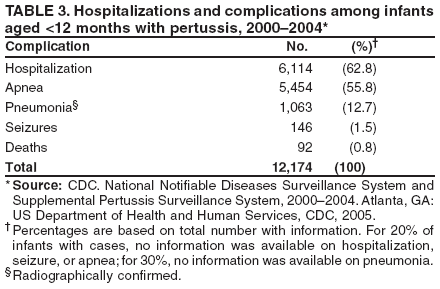
whom 43% were aged <2 months (CDC, unpublished data, 2005). Among infants aged <12 months reported with pertussis
for whom information was available, 63% were hospitalized and 13% had radiographically confirmed pneumonia (Table 3).
Rates of hospitalization and complications increase with decreasing age. Young infants, who can present with symptoms
of apnea and bradycardia without cough, are at highest risk for death from pertussis
(55). Of the 100 deaths from pertussis during 2000--2004, a total of 76 occurred among infants aged 0--1 month at onset of illness, 14 among infants aged
2--3 months, and two among infants aged 4--11 months. The case-fatality ratio among infants aged <2 months was 1.8%. A
study of pertussis deaths in the 1990s suggests that Hispanic infants and infants born at gestational age <37 weeks comprise a
larger proportion of pertussis deaths than would be expected on the basis of population estimates
(54). Two to 3 doses of pediatric DTaP (recommended at ages 2, 4, and 6 months) provide protection against severe pertussis
(55,57).
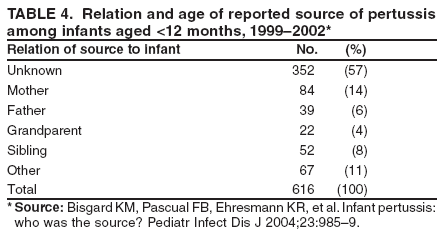
Although the source of pertussis in infants often is unknown, adult close-contacts are an important source when a source
is identified. In a study of infants aged <12 months with pertussis in four states during 1999--2002, parents were asked
about cough illness in persons who had contact with the infant
(58). In 24% of cases, a cough illness in the mother, father,
or grandparent was reported (Table 4).
Pertussis Diagnosis
Pertussis diagnosis is complicated by limitations of diagnostic tests for pertussis. Certain factors affect the
sensitivity, specificity, and interpretation of these tests, including the stage of the disease, antimicrobial administration,
previous
vaccination, the quality of technique used to collect the specimen, transport conditions to the testing laboratory, experience
of the laboratory, contamination of the sample, and use of nonstandardized tests
(59,60). In addition, tests and specimen collection materials might not be readily available to practicing clinicians.
Isolation of B. pertussis by culture is 100% specific; however, sensitivity of culture varies because fastidious
growth requirements make it difficult to transport and isolate the organism. Although the sensitivity of culture can reach
80%--90% under optimal conditions, in practice, sensitivity typically ranges from 30% to 60%
(61). The yield of B. pertussis from culture declines in specimens taken after 2 or more weeks of cough illness, after antimicrobial treatment, or after
previous pertussis vaccination (62). Three weeks after onset of cough, culture is only 1%--3% sensitive
(63). Although B. pertussis can be isolated in culture as early as 72 hours after plating, 1--2 weeks are required before a culture result can definitively be
called negative (64). Culture to isolate
B. pertussis is essential for antimicrobial susceptibility testing, molecular subtyping,
and validation of the results of other laboratory assays.
Direct fluorescent antibody (DFA) tests provide results in hours, but are generally less sensitive (sensitivity:
10%--50%) than culture. With use of monoclonal reagents, the specificity of DFA should be >90%; however, the interpretation of the
test is subjective, and misinterpretation by an inexperienced microbiologist can result in lower specificity
(65). Because of the limitations of DFA testing, CDC does not recommend its use.
Because of increased sensitivity and shorter turn-around-time, DNA amplification (e.g., PCR) is being used
more frequently to detect B. pertussis. When symptoms of classic pertussis are present (e.g., 2 weeks of paroxysmal cough),
PCR typically is 2--3 times more likely than culture to detect
B. pertussis in a positive sample
(59,66,67). The definitive classification of a PCR-positive, culture-negative sample as either a true positive or a false positive might not be possible.
No Food and Drug Administration (FDA)-licensed PCR test kit and no national standardized protocols, reagents, and
reporting formats are available. Approximately 100 different PCR protocols have been reported. These vary by DNA
purification techniques, PCR primers, reaction conditions, and product detection methods
(66). Laboratories must develop and
validate their own PCR tests. As a result, the analytical sensitivity, accuracy, and quality control of PCR-based
B. pertussis tests can vary widely among laboratories. The majority of laboratory validation studies have not sufficiently established the
predictive value of a positive PCR test to diagnose pertussis
(66). Use of PCR tests with low specificity can result in
unnecessary investigation and treatment of persons with false-positive PCR test results and inappropriate chemoprophylaxis of
their contacts (66). CDC/Council of State and Territorial Epidemiologists (CSTE) reporting guidelines support the use of PCR
to confirm the diagnosis of pertussis only when the case also meets the clinical case definition
(>2 weeks of cough with paroxysms, inspiratory "whoop," or posttussive vomiting
(68,69) (Appendix B).
Diagnosis of pertussis by serology generally requires demonstration of a substantial change in titer for pertussis
antigens (usually fourfold) when comparing results from acute
(<2 weeks after cough onset) and convalescent sera
(>4 weeks after the acute sample). The results of serologic tests on paired sera usually become available late in the course of illness. A
single sample serologic assay with age-specific antibody reference values is used as a diagnostic test for adolescents and adults
in Massachusetts but is not available elsewhere
(70). Other single sample serologic assays lack standardization and do not
clearly differentiate immune responses to pertussis antigens following recent disease, from more remote disease, or from
vaccination (30). None of these serologic assays, including the Massachusetts assay, is licensed by FDA for routine diagnostic use in
the United States. For these reasons, CDC guidelines for laboratory confirmation of pertussis cases do not include
serologic testing.
The only pertussis diagnostic tests that the CDC endorses are culture and PCR (when the CDC/CSTE clinical
case definition is also met) (Appendix B). CDC-sponsored studies are under way to evaluate both serology and PCR testing.
CDC guidance on the use of pertussis diagnostics will be updated as results of these studies become available.
Burden of Pertussis Among Adults
National Passive Surveillance
Pertussis has been a reportable disease in the United States since 1922
(71). State health departments report confirmed
and probable cases of pertussis to CDC through the passive National Notifiable Disease Surveillance System
(NNDSS); additional information on reported cases is collected through the Supplemental Pertussis Surveillance System
(SPSS)
(Appendix B) (72,73). National passive reports provide information on the national burden of pertussis and are used
to monitor national trends in pertussis over time.
After the introduction of routine vaccination against pertussis in the late 1940s, the number of national pertussis
reports declined from approximately 200,000 annual cases in the prevaccine era
(13) to a low of 1,010 cases reported in
1976 (Figure). Since then, a steady increase in the number of reported cases has occurred; reports of cases among adults
and adolescents have increased disproportionately
(72,74,75). In 2004, 25,827 cases of pertussis were reported to the CDC
(9), the highest number since 1959. Adults aged 19--64 years
accounted for 7,008 (27%) cases (9). The increase in
nationally reported cases of pertussis during the preceding 15 years might reflect a true increase in the burden of pertussis among adults or
the increasing availability and use of PCR to confirm cases and increasing clinician awareness and reporting of pertussis
(76).
Pertussis activity is cyclical with periodic increases every 3--4 years
(76,77). The typical periodicity has been less evident
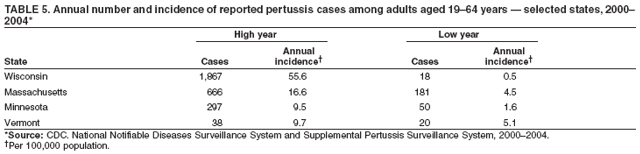
in the last several years. However, during 2000--2004, the annual incidence of pertussis from national reports in different
states varied substantially by year among adults aged 19--64 years (Table 5). The number of reports and the incidence of
pertussis among adults also varied considerably by state, a reflection of prevailing pertussis activity and state surveillance systems
and reporting practices (72).
Serosurveys and Prospective Studies
In contrast to passively reported cases of pertussis, serosurveys and prospective population-based studies demonstrate
that B. pertussis infection is relatively common among adults with acute and prolonged cough illness and is even more
common when asymptomatic infections are considered. These studies documented higher rates of pertussis than those derived
from national passive surveillance reports in part because some diagnostic or confirmatory laboratory tests were available only
in the research setting and because study subjects were tested for pertussis early in the course of their cough illness when
recovery of B. pertussis is more likely. These studies provide evidence that national passive reports of adult pertussis constitute only
a small fraction (approximately 1%--2%) of illness among adults caused by
B. pertussis (78).
During the late 1980s and early 1990s, studies using serologic diagnosis of
B. pertussis infection estimated rates of recent
B. pertussis infection between 8%--26% among adults with cough illness of at least 5 days duration who sought medical
care (79--84). In a serosurvey conducted over a 3-year period among elderly adults, serologically defined episodes of
infection occurred at a rate of 3.3--8.0 per 100 person-years, depending on diagnostic criteria
(85). The prevalence of recent B.
pertussis infection was an estimated 2.9% among participants aged 10--49 years in a nationally representative sample of the
U.S. civilian, noninstitutionalized population
(86). Another study determined infection rates among healthy persons aged
15--65 years to be approximately 1% during 11-month period
(87). The proportion of B. pertussis infections that are symptomatic
in studies was between 10%--70% depending on the setting, the population, and diagnostic criteria employed
(28,87--89).
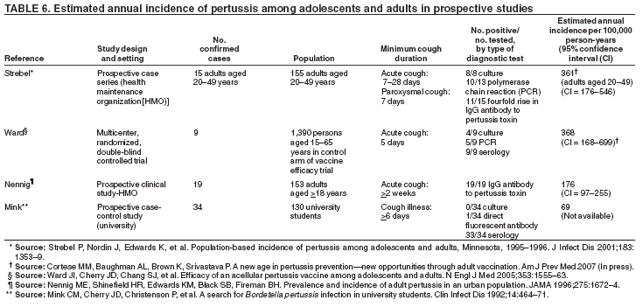
Four prospective, population-based studies estimate the annual incidence of pertussis among adults in the United
States (Table 6). Two were conducted in health maintenance organizations (HMO)
(83,84), one determined the annual incidence
of pertussis among subjects enrolled in the control arm of a clinical trial of acellular pertussis vaccine
(28), and one was conducted among university students
(80). From a reanalysis of the database of the Minnesota HMO study, the
annual incidence of pertussis by decade of age on the basis of 15 laboratory-confirmed cases of pertussis was 229 (CI = 0--540),
375 (CI = 54--695) and 409 (CI = 132--686) per 100,000 population for adults aged 20--29, 30--39, and 40--49
years, respectively (CDC, unpublished data, 2005). When applied to the U.S. population, estimates from the three
prospective studies suggest the number of cases of symptomatic pertussis among adults aged 19--64 years could range from 299,000
to 626,000 cases annually in the United States
(78).
Pertussis Outbreaks Involving Adults
Pertussis outbreaks involving adults occur in the community and the workplace. During an outbreak in Kent
County, Michigan in 1962, the attack rate among adults aged
>20 years in households with at least one case of pertussis was
21%; vulnerability to pertussis appeared unrelated to previous vaccination or history of pertussis in childhood
(3). In a statewide outbreak in Vermont in 1996, a total of 65 (23%) of 280 cases occurred among adults aged
>20 years (90); in a 2003
Illinois outbreak, 64 (42%) of 151 pertussis cases occurred among adults aged
>20 years (91). Pertussis outbreaks are
regularly documented in schools and health-care settings and occasionally in other types of workplaces (e.g., among employees of an
oil refinery [92]). In school outbreaks, the majority of cases occur among students. However, teachers who are exposed
to students with pertussis also are infected
(90,93,94). In a Canadian study, teachers were at approximately a fourfold higher
risk
for pertussis compared with the general population during a period when high rates of pertussis occurred among
adolescents (41).
Background: Tetanus and Diphtheria
Tetanus
Tetanus is unique among diseases for which vaccination is routinely recommended because it is
noncommunicable. Clostridium tetani spores are ubiquitous in the environment and enter the body through nonintact skin. When
inoculated into oxygen-poor sites, such as necrotic tissue that can result from blunt trauma or deep puncture wounds,
C. tetani spores germinate to vegetative bacilli that multiply and elaborate tetanospasmin, a potent neurotoxin. Generalized tetanus
typically presents with trismus (lockjaw), followed by generalized rigidity caused by painful contractions of the skeletal muscles
that can impair respiratory function. Glottic spasm, respiratory failure, and autonomic instability can result in death
(95). During 1998--2000, the case-fatality ratio for reported tetanus was 18% in the United States
(96,97).
Following the introduction and widespread use of tetanus toxoid vaccine in the United States, tetanus became
uncommon. From 1947, when national reporting began, through 1998--2000, the incidence of reported cases declined from 3.9 to
0.16 cases per million population (96,97). Older adults have a disproportionate burden of illness from tetanus. During
1990--2001, a total of 534 cases of tetanus were reported; 301 (56%) cases occurred among adults aged 19--64 years and 201
(38%) among adults aged >65 years (CDC, unpublished data, 2005). Data from a national population-based serosurvey
conducted in the United States during 1988--1994 indicated that the prevalence of immunity to tetanus, defined as a tetanus
antitoxin concentration of >0.15 IU/mL, was >80% among adults aged 20--39 years and declined with increasing age.
Forty-five percent of men and 21% of women aged
>70 years had protective levels of antibody to tetanus
(98). The low prevalence of immunity and high proportion of tetanus cases among older adults might be related to the high proportion of older
adults, especially women, who never received a primary series
(96,97).
Neonatal tetanus usually occurs as a result of
C. tetani infection of the umbilical stump. Susceptible infants are born
to mothers with insufficient maternal tetanus antitoxin concentration to provide passive protection
(95). Neonatal tetanus is rare in the United States. Three cases were reported during 1990--2004 (CDC, unpublished data, 2005). Two of the infants
were born to mothers who had no dose or only one dose of a tetanus toxoid-containing vaccine
(99,100); the vaccination history of the other mother was unknown (CDC, unpublished data, 2005). Well-established evidence supports the
recommendation for tetanus toxoid vaccine during pregnancy for previously unvaccinated women
(33,95,103--105). During 1999, a global maternal and neonatal tetanus elimination goal was adopted by the World Health Organization, the United
Nations Children's Fund, and the United Nations Population Fund
(104).
Diphtheria
Respiratory diphtheria is an acute and communicable infectious illness caused by strains of
Corynebacterium diphtheriae and rarely by other corynebacteria (e.g.,
C. ulcerans) that produce diphtheria toxin; disease caused by
C. diphtheriae and other corynebacteria are preventable through vaccination with diphtheria toxoid-containing vaccines. Respiratory diphtheria
is characterized by a grayish colored, adherent membrane in the pharynx, palate, or nasal mucosa that can obstruct the
airway. Toxin-mediated cardiac and neurologic systemic complications can occur
(105,106).
Reports of respiratory diphtheria are rare in the United States
(107,108). During 1998--2004, seven cases of
respiratory diphtheria were reported to CDC
(9,10). The last culture-confirmed case of respiratory diphtheria caused
by C. diphtheriae in an adult aged
>19 years was reported in 2000
(108). A case of respiratory diphtheria caused by
C. ulcerans in an adult was reported in 2005 (CDC, unpublished data, 2005). Data obtained from the national
population-based serosurvey conducted during 1988--1994 indicated that the prevalence of immunity to diphtheria, defined as a diphtheria antitoxin
concentration of >0.1 IU/mL, progressively decreased with age from 91% at age 6--11 years to approximately 30% by age 60--69 years
(98).
Adherence to the ACIP-recommended schedule of decennial Td boosters in adults is important to prevent sporadic cases
of respiratory diphtheria and to maintain population immunity
(33). Exposure to diphtheria remains possible during travel
to countries in which diphtheria is endemic (information available at www.cdc.gov/travel/diseases/dtp.htm), from
imported
cases, or from rare endemic diphtheria toxin-producing
strains of corynebacteria other than C.
diphtheriae (106). The clinical management of diphtheria, including use of diphtheria antitoxin, and the public health response is reviewed
elsewhere (33,106,109).
Adult Acellular Pertussis Vaccine Combined with Tetanus and
Diphtheria Toxoids
In the United States, one Tdap product is licensed for use in adults and adolescents.
ADACEL® (sanofi pasteur, Toronto, Ontario, Canada) was licensed on June 10, 2005, for use in persons aged 11--64 years as a single dose
active booster vaccination against tetanus, diphtheria, and pertussis
(11). Another Tdap product,
BOOSTRIX® (GlaxoSmithKline,
Rixensart, Belgium), is licensed for use in adolescents but not for use among persons aged
>19 years (20).
ADACEL®
ADACEL® contains the same tetanus toxoid, diphtheria toxoid, and five pertussis antigens as those in
DAPTACEL® (pediatric DTaP), but
ADACEL® is formulated with reduced quantities of diphtheria toxoid and detoxified pertussis
toxin (PT). Each antigen is adsorbed onto aluminum phosphate. Each dose of
ADACEL® (0.5 mL) is formulated to contain 5
Lf [limit of flocculation unit] of tetanus toxoid, 2 Lf diphtheria toxoid, 2.5
µg detoxified PT, 5 µg filamentous
hemagglutinin (FHA), 3 µg pertactin (PRN), and 5
µg fimbriae types 2 and 3 (FIM). Each dose also contains aluminum phosphate
(0.33 mg aluminum) as the adjuvant, <5
µg residual formaldehyde, <50 ng residual glutaraldehyde, and 3.3 mg
2-phenoxyethanol (not as a preservative) per 0.5-mL dose.
ADACEL® contains no thimerosal.
ADACEL® is available in single dose vials
that are latex-free (11).
ADACEL® was licensed for adults on the basis of clinical trials demonstrating immunogenicity not inferior to
U.S.-licensed Td or pediatric DTaP
(DAPTACEL®, made by the same manufacturer) and an overall safety profile
clinically comparable with U.S.-licensed Td
(11,20). In a noninferiority trial, immunogenicity, efficacy, or safety endpoints
are demonstrated when a new product is at least as good as a comparator on the basis of a predefined and narrow margin for
a clinically acceptable difference between the study groups
(110). Adolescents aged 11--17 years also were studied; these
results are reported elsewhere (12,111,112
).
Immunogenicity
A comparative, observer-blinded, multicenter, randomized controlled clinical trial conducted in the United States
evaluated the immunogenicity of the tetanus toxoid, diphtheria toxoid , and pertussis antigens among adults aged 18--64
years (11,111,112). Adults were randomized 3:1 to receive a single dose of
ADACEL® or a single dose of U.S.-licensed
Td (manufactured by sanofi pasteur; contains tetanus toxoid [5 Lf] and
diphtheria toxoid [2 Lf]) (11,111). Sera from a subset
of persons were obtained before and approximately 1 month after vaccination
(11). All assays were performed at the
immunology laboratories of sanofi pasteur in Toronto, Ontario,
Canada, or Swiftwater, Pennsylvania, using validated methods
(111,112).
Adults aged 18--64 years were eligible for enrollment if they were in good health; adults aged
>65 years were not included in prelicensure studies. Completion of the childhood DTP/DTaP vaccination series was not required. Persons were
excluded if they had received a tetanus, diphtheria, or pertussis vaccine within 5 years; had a diagnosis of pertussis within 2 years;
had an allergy or sensitivity to any vaccine component; had a previous reaction to a tetanus, diphtheria, or pertussis
vaccine, including encephalopathy within 7 days or seizures within 3 days of vaccination; had an acute respiratory illness on the day
of enrollment; had any immunodeficiency, substantial underlying disease, or neurologic impairment; had daily use of
oral, nonsteroidal anti-inflammatory drugs; had received blood products or immunoglobulins within 3 months; or were
pregnant (11,112) (sanofi pasteur, unpublished data, 2005).
Tetanus and Diphtheria Toxoids
The efficacy of the tetanus toxoid and the diphtheria toxoid components of
ADACEL® was inferred from the immunogenicity of these antigens using established serologic correlates of protection
(95,105). Immune responses to tetanus and diphtheria antigens were compared between the
ADACEL® and Td groups, with 739--742 and 506--509
persons, respectively. One month postvaccination, the tetanus antitoxin seroprotective
(>0.1 IU/mL) and booster response rates
among
adults who received ADACEL® were noninferior to those who received Td. The seroprotective rate for tetanus was 100%
(CI = 99.5%--100%) in the ADACEL® group and 99.8% (CI = 98.9%--100%) in the
Tdgroup. The booster response rate to tetanus* in the
ADACEL® group was 63.1% (CI = 59.5%--66.6%) and 66.8% (CI = 62.5%--70.9%) in the
Tdgroup (11,111). One month postvaccination the diphtheria antitoxin seroprotective
(>0.1 IU/mL) and booster response rates* among adults who received a single dose of
ADACEL® were noninferior to those who received Td. The
seroprotective rate for diphtheria was 94.1% (CI = 92.1%--95.7%) in the
ADACEL® group and 95.1% (CI = 92.8%--96.8%) in the Td group.
The booster response rate to
diphtheria* in the
ADACEL® group was 87.4% (CI = 84.8%--89.7%) and 83.4% (CI = 79.9%--86.5%)
in the Tdgroup (11,111).
Pertussis Antigens
In contrast to tetanus and diphtheria, no well-accepted serologic or laboratory correlate of protection for pertussis
exists (113). A consensus was reached at a 1997 meeting of the Vaccines and Related Biological Products Advisory
Committee (VRBPAC) that clinical endpoint efficacy studies of acellular pertussis vaccines among adults were not required for
Tdap licensure. Rather, the efficacy of the pertussis components of Tdap administered to adults could be inferred using a
serologic bridge to infants vaccinated with pediatric DTaP during clinical endpoint efficacy trials for pertussis
(114). The efficacy of the pertussis components of
ADACEL® was evaluated by comparing the immune responses (geometric mean
antibody concentration [GMC]) of adults vaccinated with a single dose of
ADACEL® to the immune responses of infants
vaccinated with 3 doses of
DAPTACEL® in a Swedish vaccine efficacy trial during the 1990s
(11,115). ADACEL® and
DAPTACEL® contain the same five pertussis antigens, except
ADACEL® contains one fourth the quantity of detoxified PT
in DAPTACEL® (116). In the Swedish trial, efficacy
of 3 doses of DAPTACEL® against World Health
Organization-defined pertussis (>21 days of paroxysmal cough with confirmation of
B. pertussis infection by culture and serologic testing or
an epidemiologic link to a household member with culture-confirmed pertussis) was 85% (CI = 80%--89%)
(11,115). The percentage of persons with a booster response to vaccine pertussis antigens exceeding a predefined lower limit for
an acceptable booster response also was evaluated. The
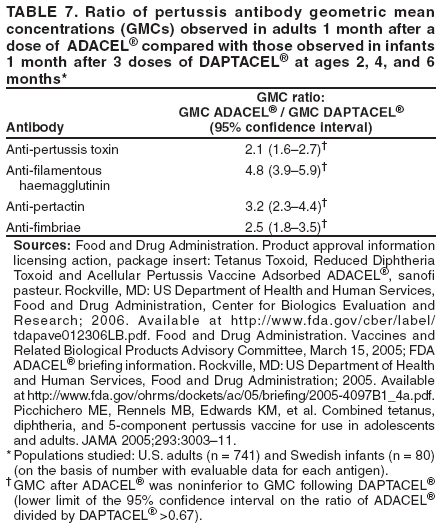
anti-PT, anti-FHA, anti-PRN, and anti-FIM GMCs of adults 1
month after a single dose of ADACEL®
were noninferior to those of infants after 3 doses of
DAPTACEL® (Table 7) (11).
Booster response rates to the pertussis
antigens† contained inADACEL® (anti-PT, anti-FHA, anti-PRN,
and anti-FIM) among 739 adults 1 month following administration of
ADACEL® met prespecified criteria for an acceptable response.
Booster response rates to pertussis antigens were: anti-PT, 84.4% (CI = 81.6%--87.0%); anti-FHA, 82.7% (CI =
79.8%--85.3%); anti-PRN, 93.8% (CI =
91.8%--95.4%); and anti-FIM 85.9% (CI = 83.2%--88.4%)
(11,112).
Safety
The primary adult safety study, conducted in the United States, was a randomized, observer-blinded, controlled study
of 1,752 adults aged 18--64 years who received a single dose of
ADACEL®, and 573 who received Td. Data on solicited
local and systemic adverse events were collected using standardized diaries for the day of vaccination and the next 14
consecutive days (i.e., within 15 days following vaccination)
(11).
Immediate Events
Five adults experienced immediate events within 30 minutes of vaccination
(ADACEL® [four persons] and Td [one]);
all incidents resolved without sequelae. Three of these events were classified under nervous system disorders
(hypoesthesia/paresthesia). No incidents of syncope or anaphylaxis were reported
(111,112,116).
Solicited Local Adverse Events
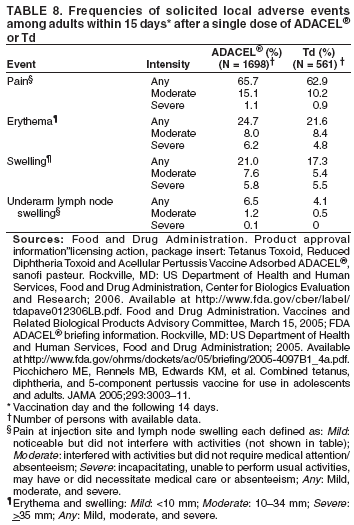
Pain at the injection site was the most frequently reported local adverse event among adults in both vaccination
groups (Table 8). Within 15 days following vaccination, rates of any pain at the injection site were comparable among
adults vaccinated with ADACEL® (65.7%) and
Td(62.9%). The rates of pain, erythema, and swelling were noninferior in
the ADACEL® recipients compared with the Td recipients
(Table 8) (11,111). No case of whole-arm swelling was reported
in either vaccine group (112).
Solicited Systemic Adverse Events
The most frequently reported systemic adverse events during the 15 days following vaccination were headache,
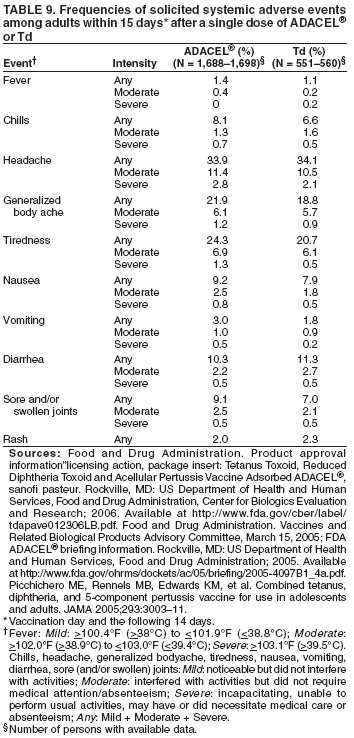
generalized body aches, and tiredness (Table 9). The proportion of adults reporting fever
>100.4°F (38°C) following vaccination
were comparable in the ADACEL® (1.4%) and Td (1.1%) groups, and the noninferiority criterion for
ADACEL® was achieved. The rates of the other solicited systemic adverse events also were comparable between the
ADACEL® and Td groups (11).
Serious Adverse Events
Serious adverse events (SAEs) within 6 months after vaccination were reported among 1.9% of the vaccinated adults: 33
of 1,752 in the ADACEL® group and 11 of the 573 in the Td group
(111,116). Two of these SAEs were neuropathic events
in ADACEL® recipients and were assessed by the investigators as possibly related to vaccination. A woman aged 23 years
was hospitalized for a severe migraine with unilateral facial paralysis 1 day following vaccination. A woman aged 49 years
was hospitalized 12 days after vaccination for symptoms of radiating pain in her neck and left arm (vaccination arm);
nerve compression was diagnosed. In both cases, the symptoms resolved completely over several days
(11,111,112,116). One seizure event occurred in a woman aged 51 years 22 days after
ADACEL® and resolved without sequelae; study
investigators reported this event as unrelated to vaccination
(116). No physician-diagnosed Arthus reaction or case of
Guillian-Barré syndrome was reported in any
ADACEL® recipient, including the 1,184 adolescents in the adolescent primary safety
study (sanofi pasteur, unpublished data, 2005).
Comparison of Immunogenicity and Safety Results Among Age Groups
Immune responses to the antigens in
ADACEL® and Tdin adults (aged 18--64 years) 1 month after vaccination
were comparable to or lower than responses in adolescents (aged 11--17 years) studied in the primary adolescent prelicensure
trial (111). All adults in three age strata (18--28, 29--48, 49--64 years) achieved a seroprotective antibody level for tetanus
afterADACEL®. Seroprotective responses to diphtheria following
ADACEL® were comparable among adolescents (99.8%)
and young adults aged 18--28 years (98.9%) but were lower among adults aged 49--64 years (85.4%)
(111). Generally, adolescents had better immune response to pertussis antigens than adults after receipt
ofADACEL®, although GMCs
in both groups were higher than those of infants vaccinated in the
DAPTACEL® vaccine efficacy trial. Immune response to
PT and FIM decreased with increasing age in adults; no consistent relation between immune responses to FHA or PRN and
age was observed (111).
Overall, local and systemic events after
ADACEL® vaccination were less frequently reported by adults than
adolescents. Pain, the most frequently reported adverse event in the studies, was reported by 77.8% of adolescents and 65.7% of
adults vaccinated withADACEL®. Fever was also reported more frequently by adolescents (5%) than adults (1.4%) vaccinated
with ADACEL® (11,111). In adults, a trend for decreased frequency of local adverse events in the older age groups was observed.
Simultaneous Administration of
ADACEL® with Other Vaccines
Trivalent Inactivated Influenza Vaccine
Safety and immunogenicity of
ADACEL® co-administered with trivalent inactivated influenza vaccine ([TIV]
Fluzone®, sanofi pasteur, Swiftwater, Pennsylvania) was evaluated in adults aged 19--64 years using methods similar to the
primary ADACEL® studies. Adults were randomized into two groups. In one group,
ADACEL® and TIV were administered simultaneously in different arms (N = 359). In the other group, TIV was administered first, followed by
ADACEL® 4--6 weeks later (N = 361).
The antibody responses (assessed 4--6 weeks after vaccination) to diphtheria, three pertussis antigens (PT, FHA, and
FIM), and all influenza antigens§ were noninferior in persons vaccinated simultaneously with
ADACEL® compared with those vaccinated sequentially (TIV first, followed by
ADACEL®).¶ For tetanus, the proportion of persons achieving
a seroprotective antibody level was noninferior in the simultaneous group (99.7%) compared with the sequential
group (98.1%). The booster response rate to tetanus in the simultaneous group (78.8%) was lower than the sequential
group (83.3%), and the noninferiority criterion for simultaneous vaccination was not met. The slightly lower proportion of
persons demonstrating a booster response to tetanus in the simultaneous group is unlikely to be clinically important because >98%
of
subjects in both group groups achieved seroprotective levels. The immune response to PRN pertussis antigen in
the simultaneous group did not meet noninferiority criterion when compared with the immune response in the sequential
group (111). The lower limit of the 90% CI on the ratio of the anti-PRN GMCs (simultaneous vaccination group divided by
the sequential vaccination group) was 0.61, and the noninferiority criterion was >0.67; the clinical importance of this finding
is unclear (111).
Adverse events were solicited only after
ADACEL® (not TIV) vaccination
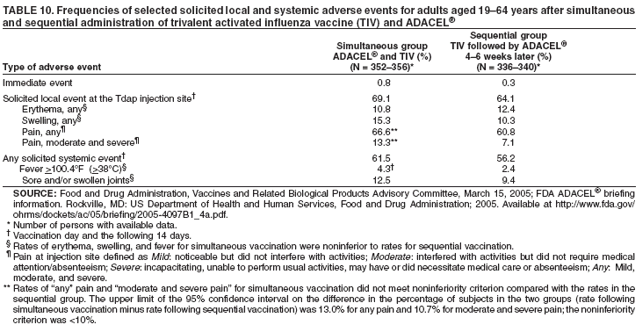
(111). Within 15 days of vaccination, rates
of erythema, swelling, and fever were comparable in both vaccination groups (Table 10). However, the frequency of pain at
the ADACEL® injection site was higher in the simultaneous group (66.6%) than the sequential group (60.8%), and
the noninferiority for simultaneous vaccination was not achieved
(111).
Hepatitis B Vaccine
Safety and immunogenicity of
ADACEL® administered with hepatitis B vaccine was not studied in adults but
was evaluated among adolescents aged 11--14 years using methods similar to the primary
ADACEL® studies. Adolescents were randomized into two groups. In one group,
ADACEL® and hepatitis B vaccine (Recombivax
HB®, Merck and Co., White House Station, New Jersey) were administered simultaneously (N = 206). In the other group,
ADACEL® was administered first, followed by hepatitis B vaccine 4--6 weeks later (N = 204). No interference was observed in the immune responses
to any of the vaccine antigens when
ADACEL® and hepatitis B vaccine were administered simultaneously or sequentially**
(11).
Adverse events were solicited only after
ADACEL® vaccination (not hepatitis B vaccination)
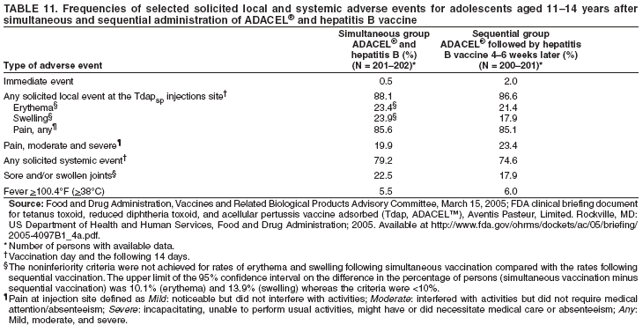
(111). Within 15 days of vaccination, the reported rates of injection site pain (at the
ADACEL® site) and fever were comparable when
ADACEL® and hepatitis B vaccine were administered simultaneously or sequentially (Table 11). However, rates of erythema and swelling
at the ADACEL® injection site were higher in the simultaneous group, and noninferiority for simultaneous vaccination was
not achieved. Swollen and/or sore joints were reported in 22.5% of persons who received simultaneous vaccination, and in
17.9% of persons in the sequential group. The majority of joint complaints were mild in intensity with a mean duration of 1.8
days (11).
Other Vaccines
Safety and immunogenicity of simultaneous administration of
ADACEL® with other vaccines were not evaluated
during prelicensure studies (11).
Safety Considerations for Adult Vaccination with Tdap
Tdap prelicensure studies in adults support the safety of
ADACEL® (11). However, sample sizes were insufficient to
detect rare adverse events. Enrollment criteria excluded persons who had received vaccines containing tetanus toxoid,
diphtheria toxoid, and/or pertussis components during the preceding 5 years
(111,112). Persons with certain neurologic conditions
were excluded from prelicensure studies. Therefore, in making recommendations on the spacing and administration sequence
of vaccines containing tetanus toxoid, diphtheria toxoid, and/or pertussis components and on vaccination of adults with
a history of certain neurologic conditions or previous adverse events after vaccination, ACIP considered data from a range
of pre- and postlicensure studies of Tdap and other vaccines containing these components. Safety data from the Vaccine
Adverse Event Reporting System (VAERS) and postlicensure studies are monitored on an ongoing basis and will facilitate detection
of potential adverse reactions following more widespread use of Tdap in adults.
Spacing and Administration Sequence of Vaccines Containing Tetanus
Toxoid, Diphtheria Toxoid, and Pertussis Antigens
Historically, moderate and severe local reactions following tetanus and diphtheria toxoid-containing vaccines have
been associated with older, less purified vaccines, larger doses of toxoid, and frequent dosing at short intervals
(117--122). In addition, high pre-existing antibody titers to tetanus or diphtheria toxoids in children, adolescents, and adults primed
with these antigens have been associated with increased rates for local reactions to booster doses of tetanus or diphtheria
toxoid-containing vaccines (119,122--124). Two adverse events of particular clinical interest, Arthus reactions and extensive
limb swelling (ELS), have been associated with vaccines containing tetanus toxoid, diphtheria toxoid, and/or pertussis
antigens.
Arthus Reactions
Arthus reactions (type III hypersensitivity reactions) are rarely reported after vaccination and can occur after tetanus
toxoid-containing or diphtheria toxoid-containing vaccines
(33,122,125--129; CDC, unpublished data, 2005). An Arthus reaction
is a local vasculitis associated with deposition of immune complexes and activation of complement. Immune complexes form
in the setting of high local concentration of vaccine antigens and high circulating antibody concentration
(122,125,126,130). Arthus reactions are characterized by severe pain, swelling, induration, edema, hemorrhage, and occasionally by local
necrosis. These symptoms and signs usually develop 4--12 hours after vaccination; by contrast, anaphylaxis (immediate type
I hypersensitivity reactions) usually occur within minutes of vaccination. Arthus reactions usually resolve without
sequelae. ACIP has recommended that persons who experienced an Arthus reaction after a dose of tetanus toxoid-containing
vaccine not receive Td more frequently than every 10 years, even for tetanus prophylaxis as part of wound management
(12,33).
Extensive Limb Swelling
ELS reactions have been described following the fourth or fifth dose of pediatric DTaP
(131--136), and ELS has been reported to VAERS almost as frequently following Td as following pediatric DTaP
(136). ELS is not disabling, is not often brought to medical attention, and resolves without complication within 4--7 days
(137). ELS is not considered a precaution or contraindication for Tdap
(138).
Interval Between Td and Tdap
ACIP has recommended a 10-year interval for routine administration of Td and encourages an interval of at least 5
years between the Td and Tdap dose for adolescents
(12,33). Although administering Td more often than every 10 years (5
years for some tetanus-prone wounds) is not necessary to provide protection against tetanus or diphtheria, administering a dose
of Tdap <5 years after Td could provide a health benefit by protecting against pertussis. Prelicensure clinical trials of
ADACEL® excluded persons who had received doses of a diphtheria or tetanus toxoid-containing vaccine during the preceding 5
years (116).
The safety of administering a dose of Tdap at intervals <5 years after Td or pediatric DTP/DTaP has not been studied
in adults but was evaluated in Canadian children and adolescents
(139). The largest Canadian study was a
nonrandomized, open-label study of 7,001 students aged 7--19 years residing in Prince Edward Island. This study assessed the rates of
adverse events after ADACEL® and compared reactogenicity of
ADACEL® administered at year intervals of 2--9 years
(eight cohorts) versus >10 years after the last tetanus and diphtheria toxoid-containing vaccine (Td, or pediatric DTP or
DTaP). The 2-year interval was defined as >18 months to
<30 months. Vaccination history for type of pertussis vaccine(s)
received (pediatric DTP and DTaP) also was assessed. The number of persons assigned to cohorts ranged from 464 in the
2-year cohort to 925 in the 8-year cohort. Among the persons in the
2-year cohort, 214 (46%) received the last tetanus and
diphtheria toxoid-containing vaccine 18--23 months before
ADACEL®. Adverse event diary cards were returned for 85% of
study participants with a known interval; 90% of persons in the 2-year interval cohort provided safety data
(139).
Four SAEs were reported in the Prince Edward Island study; none were vaccine-related. No Arthus reaction was
reported. Rates of reported severe local adverse reactions, fever, or any pain were not increased in persons who received
ADACEL® at intervals <10 years. Rates of local reactions were not increased among persons who received 5 doses of pediatric DTP, with
or without Td (intervals of 2--3 years or 8--9 years).
Two smaller Canadian postlicensure safety studies in adolescents also showed acceptable safety when
ADACEL® was administered at intervals <5 years after tetanus and diphtheria toxoid-containing vaccines
(140,141). Taken together, these three Canadian studies support the safety of using
ADACEL® after Td at intervals <5 years. The largest study
suggests intervals as short as approximately 2 years are acceptably safe
(139). Because rates of local and systemic reactions after Tdap
in adults were lower than or comparable to rates in adolescents during U.S. prelicensure trials, the safety of using intervals
as short of approximately 2 years between Td and Tdap in adults can be inferred from the Canadian studies
(111).
Simultaneous and Nonsimultaneous Vaccination with Tdap and Diphtheria-Containing MCV4
Tdap and tetravalent meningococcal conjugate vaccine ([MCV4]
Menactra® manufactured by sanofi pasteur,
Swiftwater, Pennsylvania) contain diphtheria toxoid
(142,143). Each of these vaccines is licensed for use in adults, but MCV4 is
not indicated for active vaccination against diphtheria
(143). In MCV4, the diphtheria toxoid (approximately 48
µg) serves as the carrier protein that improves immune responses to meningococcal antigens. Precise comparisons cannot be made between
the
quantity of diphtheria toxoid in the vaccines; however, the amount in a dose of MCV4 is estimated to be comparable to
the average quantity in a dose of pediatric DTaP
(144). No prelicensure studies were conducted of simultaneous or
sequential vaccination with Tdap and MCV4. ACIP has considered the potential for adverse events following simultaneous
and nonsimultaneous vaccination with Tdap and MCV4
(12). ACIP recommends simultaneous vaccination with Tdap
and MCV4 for adolescents when both vaccines are indicated, and any sequence if simultaneous administration is not
feasible (12,138). The same principles apply to adult patients for whom Tdap and MCV4 are indicated.
Neurologic and Systemic Events Associated with Vaccines with
Pertussis Components or Tetanus Toxoid-Containing Vaccines
Vaccines with Pertussis Components
Concerns about the possible role of vaccines with pertussis components in causing neurologic reactions or
exacerbating underlying neurologic conditions in infants and children are long-standing
(16,145). ACIP recommendations to defer pertussis vaccines in infants with suspected or evolving neurological disease, including seizures, have been based primarily
on the assumption that neurologic events after vaccination (with whole cell preparations in particular) might complicate
the subsequent evaluation of infants' neurologic status
(1,145).
In 1991, the Institute of Medicine (IOM) concluded that evidence favored acceptance of a causal relation between
pediatric DTP vaccine and acute encephalopathy; IOM has not evaluated associations between acellular vaccines and neurologic
events for evidence of causality (128).During 1993--2002, active surveillance in Canada failed to ascertain any
acute encephalopathy cases causally related to whole cell or acellular pertussis vaccines among a population administered
6.5 million doses of pertussis-containing vaccines
(146). In children with a history of encephalopathy not attributable to
another identifiable cause occurring within 7 days
aftervaccination, subsequent doses of pediatric DTaP vaccines are
contraindicated (1).
ACIP recommends that children with progressive neurologic conditions not be vaccinated with Tdap until the
condition stabilizes (1). However, progressive neurologic disorders that are chronic and stable (e.g., dementia) are more common
among adults, and the possibility that Tdap would complicate subsequent neurologic evaluation is of less clinical concern. As
a result, chronic progressive neurologic conditions that are stable in adults do not constitute a reason to delay Tdap; this is
in contrast to unstable or evolving neurologic conditions (e.g., cerebrovascular events and acute encephalopathic conditions).
Tetanus Toxoid-Containing Vaccines
ACIP considers Guillain-Barré syndrome
<6 weeks after receipt of a tetanus toxoid-containing vaccine a precaution
for subsequent tetanus toxoid-containing vaccines
(138). IOM concluded that evidence favored acceptance of a causal
relation between tetanus toxoid-containing vaccines and Guillain-Barré syndrome. This decision is based primarily on a single,
well-documented case report (128,147). A subsequent analysis of active surveillance data in both adult and pediatric
populations failed to demonstrate an association between receipt of a tetanus toxoid-containing vaccine and onset of
Guillain-Barré syndrome within 6 weeks following vaccination
(145).
A history of brachial neuritis is not considered by ACIP to be a precaution or contraindication for administration of
tetanus toxoid-containing vaccines
(138,149,150). IOM concluded that evidence from case reports and uncontrolled studies
involving tetanus toxoid-containing vaccines did favor a causal relation between tetanus toxoid-containing vaccines and brachial
neuritis (128); however, brachial neuritis is usually
self-limited. Brachial neuritis is considered to be a compensable event through
the Vaccine Injury Compensation Program (VICP).
Economic Considerations for Adult Tdap Use
Economic Burden
The morbidity and societal cost of pertussis in adults is substantial. A study that retrospectively assessed the
economic burden of pertussis in children and adults in Monroe County, New York, during 1989--1994 indicated that,
although
economic costs were not identified separately by age group, 14 adults incurred an average of 0.8 outpatient visits and
0.2 emergency department visits per case
(151). The mean time to full recovery was 74 days. A prospective study in
Monroe Country, New York, during 1995--1996 identified six adult cases with an average societal cost of $181 per case
(152); one third was attributed to nonmedical costs. The mean time to full recovery was 66 days (range: 3--383 days). A study of
the medical costs associated with hospitalization in four states during 1996--1999 found a mean total cost of $5,310 in
17 adolescents and 44 adults (153). Outpatient costs and nonmedical costs were not considered in this study.
A study in Massachusetts retrospectively assessed medical costs of confirmed pertussis in 936 adults during 1998--2000
and prospectively assessed nonmedical costs in 203 adults during 2001--2003
(42). The mean medical and nonmedical cost
per case was $326 and $447, respectively, for a societal cost of $773. Nonmedical costs constituted 58% of the total cost
in adults. If the cost of antimicrobials to treat contacts and the cost of personal time were included, the societal cost could be
as high as $1,952 per adult case.
Cost-Benefit and Cost-Effectiveness Analyses of Adult Tdap Vaccination
Results of two economic evaluations that examined adult vaccination strategies for pertussis varied. A cost-benefit
analysis in 2004 indicated that adult pertussis vaccination would be cost-saving
(154). A cost-effectiveness analysis in 2005
indicated that adult pertussis vaccination would not be cost-effective
(155). The strategies and assumptions used in the two models
had two major differences. The universal vaccination strategy used in cost-benefit analysis was a one-time adult
booster administered to all adults aged
>20 years; the strategy used in the cost-effectiveness study was for decennial boosters over
the lifetime of adults. The incidence estimates used in the two models also differed. In the cost-benefit study, incidence
ranged from 159 per 100,000 population for adults aged 20--29 years to 448 for adults aged
>40 years. In contrast, the cost-effectiveness study used a conservative incidence estimate of 11 per 100,000 population based on enhanced surveillance
data from Massachusetts. Neither study made adjustments for a decrease in disease severity that might be associated with
increased incidence. Adult strategies might have appeared
cost-effective or cost-saving at high incidence because the distribution of
the severity of disease was assumed to the same regardless of incidence.
To address these discrepancies, the adult vaccination strategy was re-examined using the cost-effectiveness study
model (155,156). The updated analysis estimated the
cost-effectiveness of vaccinating adults aged 20--64 years with a single
Tdap booster and explored the impact of incidence and severity of disease on cost-effectiveness. Costs, health outcomes, and
cost-effectiveness were analyzed for a U.S. cohort of approximately 166 million adults aged 20--64 years over a 10-year
period. The revised analysis assumed an incremental vaccine cost of $20 on the basis of updated price estimates of Td and Tdap
in the private and public sectors, an incidence of adult pertussis ranging from 10--500 per 100,000 population, and
vaccine delivery estimates ranging from 57%--66% among adults on the basis of recently published estimates. Without an
adult vaccination program, the estimated number of adult pertussis cases over a 10-year period ranged from 146,000 at
an incidence of 10 per 100,000 population to 7.1 million at an incidence of 500 per 100,000 population. A one-time
adult vaccination program would prevent approximately 44% of cases over a 10-year period. The number of quality adjusted
life years (QALYs) saved by a vaccination program varied substantially depending on disease incidence. At a rate of 10
per 100,000 population, a vaccination program resulted in net loss of QALYs because of the disutility associated with
vaccine adverse events. As disease incidence increased, the benefits of preventing pertussis far outweighed the risks associated
with vaccine adverse events. The number of QALYs saved by the one-time adult strategy was approximately 104,000
(incidence: 500 per 100,000 population).
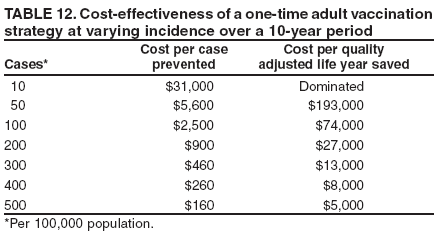
The programmatic cost of a one-time adult vaccination strategy would be $2.1 billion. Overall, the net cost of the
one-time adult vaccination program ranged from $0.5 to $2 billion depending on disease incidence. The cost per case prevented
ranged from $31,000 per case prevented at an incidence of 10 per 100,000 population to $160 per case prevented at an incidence
of 500 per 100,000 (Table 12). The cost per QALY saved ranged from "dominated" (where "No vaccination" is preferred) at
10 per 100,000 population to $5,000 per QALY saved at 500 per 100,000 population. On the basis of a benchmark of
$50,000 per QALY saved (157--159), an adult vaccination program became cost-effective when the incidence exceeded
120per 100,000 population. When adjustments were made for severity of illness at high disease incidence, little impact was
observed on the overall cost-effectiveness of a vaccination program.
Similar results were obtained when program costs and benefits were analyzed over the lifetime of the adult cohort for
the one-time and decennial booster strategies
(156).
Implementation of Adult Tdap Recommendations
Routine Adult Tdap Vaccination
The introduction of Tdap for routine use among adults offers an opportunity to improve adult vaccine coverage and
to offer protection against pertussis, tetanus, and diphtheria. Serologic and survey data indicate that U.S. adults
are undervaccinated against tetanus and diphtheria, and that rates of coverage decline with increasing age
(98,160). Maintaining seroprotection against tetanus and diphtheria through adherence to ACIP-recommended boosters is important for adults
of all ages. ACIP has recommended that adults receive a booster dose of tetanus
toxoid-containing vaccine every 10 years, or as indicated for wound care, to maintain protective
levels of tetanus antitoxin, and that adults with uncertain history of
primary vaccination receive a 3-dose primary series
(33). Every visit of an adult to a health-care provider should be regarded as
an opportunity to assess the patient's vaccination status and, if indicated, to provide protection against tetanus, diphtheria,
and pertussis. Nationwide survey data indicate that although only 68% of family physicians and internists who see adult patients
for outpatient primary care routinely administer Td for health maintenance when indicated, 81% would recommend Tdap for
their adult patients (161).
Vaccination of Adults in Contact with Infants
Vaccinating adults aged <65 years with Tdap who have or who anticipate having close contact with an infant could
decrease the morbidity and mortality of pertussis among infants by preventing pertussis in the adult and thereby
preventing transmission to the infant. Administration of Tdap to adult contacts at least 2 weeks before contact with an infant is
optimal. Near peak antibody responses to pertussis vaccine antigens can be achieved with booster doses by 7 days postvaccination,
as demonstrated in a study in Canadian children after receipt of DTaP-IPV booster
(131).
The strategy of vaccinating contacts of persons at high risk to reduce disease and therefore transmission is used
with influenza. Influenza vaccine is recommended for household contacts and out-of-home caregivers of children aged
0--59 months, particularly infants aged 0--6 months, the pediatric group at greatest risk for influenza-associated
complications (162). A similar strategy for Tdap is likely to be acceptable to physicians. In a 2005 national survey, 62% of
obstetricians surveyed reported that obstetricians and adult primary-care providers should administer Tdap to adults anticipating contact
with an infant, if recommended by ACIP and the American College of Obstetricians and Gynecologists (ACOG)
(163).
Protecting women with Tdap before pregnancy also could reduce the number of mothers who acquire and
transmit pertussis to their infant. ACOG states that preconceptional vaccination of women to prevent disease in the offspring,
when practical, is preferred to vaccination of pregnant women
(164). Because approximately half of all pregnancies in the
United States are unplanned, targeting women of child-bearing age before they become pregnant for a dose of Tdap might be
the most effective strategy (165). Vaccinating susceptible women of childbearing age with measles, mumps, and rubella
vaccine also is recommended to protect the mother and to prevent transmission to the fetus or young infant
(166). Implementing preconception vaccination in general medical offices, gynecology outpatient care centers, and
family-planning clinics is essential to ensure the success of this preventive strategy.
If Tdap vaccine is not administered before pregnancy, immediate postpartum vaccination of new mothers is an
alternative. Rubella vaccination has been successfully administered postpartum. In studies in New Hampshire and other
sites, approximately 65% of rubella-susceptible women who gave birth received MMR postpartum
(167,168). In a nationwide survey, 78% of obstetricians reported that they would recommend Tdap for women during the postpartum hospital stay if
it were recommended (163). Vaccination before discharge from the hospital or birthing center, rather than at a follow-up
visit, has the advantage of decreasing the time when new mothers could acquire and transmit pertussis to their newborn.
Other household members, including fathers, should receive Tdap before the birth of the infant as recommended.
Mathematical modeling can provide useful information about the potential effectiveness of a vaccination strategy
targeting contacts of infants. One model evaluating different vaccine strategies in the United States suggested that
vaccinating household contacts of newborns, in addition to routine adolescent Tdap vaccination, could prevent 76% of cases in
infants aged <3 months (169). A second model from Australia estimated a 38% reduction in cases and deaths among infants
aged <12 months if both parents of the infant were vaccinated before the infant was discharged from the hospital
(170).
Vaccination of Pregnant Women
ACIP has recommended Td routinely for pregnant women who received the last tetanus toxoid-containing vaccine
>10 years earlier to prevent maternal and neonatal tetanus
(33,171). Among women vaccinated against tetanus, passive transfer
of antitetanus antibodies across the placenta during pregnancy protect their newborn from neonatal
tetanus (101,172,173).
As with tetanus, antibodies to pertussis antigens are passively transferred during pregnancy
(174,175); however, serologic correlates of protection against pertussis are not known
(113). Whether passive transfer of maternal antibodies to
pertussis antigens protects neonates against pertussis is not clear
(113,176); whether increased titers of passive antibody to
pertussis vaccine antigens substantially interfere with response to DTaP during infancy remains an important question
(177--179). All licensed Td and Tdap vaccines are categorized as Pregnancy Category
C†† agents by FDA. Pregnant women were
excluded from prelicensure trials, and animal reproduction studies have not been conducted for Td or Tdap
(111,180--183). Td and TT have been used extensively in pregnant women, and no evidence indicates use of tetanus and diphtheria
toxoids administered during pregnancy are teratogenic
(33,184,185).
Pertussis Among Health-Care Personnel
This section has been reviewed by and is supported by the Healthcare Infection Control Practices Advisory
Committee (HICPAC)
Nosocomial spread of pertussis has been documented in various health-care settings, including hospitals and
emergency departments serving pediatric and adult patients
(186--189), out-patient clinics (CDC, unpublished data, 2005), nursing
homes (89), and long-term--care facilities
(190--193). The source case of pertussis has been reported as a patient
(188,194--196), HCP with hospital- or community-acquired pertussis
(192,197,198), or a visitor or family member
(199--201).
Symptoms of early pertussis (catarrhal phase) are indistinguishable from other respiratory infections and conditions.
When pertussis is not considered early in the differential diagnosis of patients with compatible symptoms, HCP and patients
are exposed to pertussis, and inconsistent use of face or nose and mouth protection during evaluation and delay in
isolating patients can occur
(187,188,197,200,202). One study described the diagnosis of pertussis being considered in an
HCP experiencing paroxysmal cough, posttussive emesis, and spontaneous pneumothorax, but only after an infant patient
was diagnosed with pertussis 1 month later and after three other HCP had been infected
(198). Pertussis among HCP and patients can result in substantial morbidity
(187,188,197,200,202). Infants who have nosocomial pertussis are at
substantial risk for severe and, rarely, fatal disease
(187,188,197,200,202).
Risk for Pertussis Among HCP
HCP are at risk for being exposed to pertussis in inpatient and outpatient pediatric facilities
(186--188,194--200,203,204) and in adult health-care facilities and settings including emergency departments
(196,202,205--207). In a survey of
infection-control practitioners from pediatric hospitals, 90% reported HCP exposures to pertussis over a 5-year period; at 11% of
the reporting institutions, a physician contracted the disease
(208). A retrospective study conducted in a Massachusetts
tertiary-care center with medical, surgical, pediatric, and obstetrical services during October
2003--September 2004 documented pertussis in 20 patients and three HCP, and pertussis exposure in approximately 300 HCP
(209). One infected HCP exposed 191 other persons, including co-workers and patients in a postanesthesia care unit. Despite aggressive investigation
and prophylaxis, a patient and the HCP's spouse were infected
(209).
In a California university hospital with pediatric services, 25 patients exposed 27 HCP over a 5-year period
(210). At a North Carolina teaching hospital during 2002--2005, a total of 21 pertussis patients exposed 72 unprotected HCP
(DJ Weber, Hospital Epidemiology and Occupational Health, University of North Carolina Health Care System,
personal communication, 2006). A Philadelphia children's hospital that tracked exposures during September 2003--April
2005 identified seven patients who exposed 355 unprotected HCP
(211). The exposed HCP included 163 nurses, 106
physicians, 42 radiology technicians, 29 respiratory therapists, and 15 others. Recent estimates suggest that up to nine HCP are
exposed on average for each case of pertussis with delayed diagnosis
(203).
Serologic studies among hospital staff suggest
B. pertussis infection among HCP is more frequent than suggested by
the attack rates of clinical disease
(212,213). In one study, annual rates of infection among a group of clerical HCP with
minimal patient contact ranged from 4%--43% depending on the serologic marker used (4%--16% based on anti-PT IgG
antibodies)
(208). The seroprevalence of pertussis agglutinating antibodies among HCPs in one hospital outbreak correlated with
the degree of patient contact. Pediatric house staff and ward nurses were 2--3 times more likely to have
B. pertussis agglutinating antibodies than nurses with administrative responsibilities, 82% and 71% versus 35%, respectively
(197). In another study, the annual incidence
of B. pertussis infection among emergency department staff was approximately three times higher
than among resident physicians (3.6% versus 1.3%, respectively), on the basis of elevated anti-PT IgG titers. Two of five
HCP (40%) with elevated anti-PT IgG titers had clinical signs of pertussis
(213).
The risk for pertussis among HCP relative to the general population was estimated in a Quebec study of adult
and adolescent pertussis. Among the 384 (58%) of 664 eligible cases among adults aged
>18 years (41), HCP accounted for
32 (8%) of the pertussis cases and 5% of the population. Pertussis among HCP was 1.7 times higher than among the
general population. Similar studies have not been conducted in the United States.
Pertussis outbreaks are reported from chronic-care or nursing home facilities and in residential-care institutions; these HCP
might be at increased risk for pertussis. However, the risk for pertussis among HCP in these settings compared with the general
population has not been evaluated (190--193).
Management of Exposed Persons in Settings with Nosocomial Pertussis
Investigation and control measures to prevent pertussis after unprotected exposure in health-care settings are
labor intensive, disruptive, and costly, particularly when the number of exposed contacts is large
(203). Such measures include identifying contacts among HCP and patients, providing postexposure prophylaxis for asymptomatic close contacts,
and evaluating, treating, and placing symptomatic HCP on administrative leave until they have received effective
treatment. Despite the effectiveness of control measures to prevent further transmission of pertussis, one or more cycle of
transmission with exposures and secondary cases can occur before pertussis is recognized. This might occur regardless of whether
the source case is a patient or HCP, the age of the source case, or the setting (e.g., emergency department
[203], postoperative suite or surgical ward
[209,214], nursery [198,215], in-patient ward
[187,194,216], or maternity ambulatory care
[202]). The number of reported outbreak-related secondary cases ranges
from none to approximately 80 per index case and
includes other HCP (205), adults
(209), and pediatric patients (203). Secondary cases among infants have resulted in prolonged
hospital stay, mechanical ventilation (198), or death
(215).
The cost of controlling nosocomial pertussis is high, regardless of the size of the outbreak. The impact of pertussis
on productivity can be substantial, even when no secondary case of pertussis occurs. The hospital costs result from
infection prevention and control/occupational health employee time to identify and notify exposed patients and personnel, to
educate personnel in involved areas, and to communicate with HCP and the public; from providing prophylactic antimicrobial
agents for exposed personnel; laboratory testing and treating symptomatic contacts; placing symptomatic personnel
on administrative leave; and lost time from work for
illness.
Cost-Benefit of Vaccinating Health-Care Personnel with Tdap
By vaccinating HCP with Tdap and reducing the number of cases of pertussis among HCP, hospitals will reduce the
costs associated with resource-intensive hospital investigations and control measures (e.g., case/contact tracking,
postexposure prophylaxis, and treatment of hospital acquired pertussis cases). These costs can be substantial. In four recent
hospital-based pertussis outbreaks, the cost of controlling pertussis ranged from $74,870--$174,327 per outbreak
(203,207). In a Massachusetts hospital providing pediatric, adult, and obstetrical care, a prospective study found that the cost of
managing pertussis exposures over a 12-month period was $84,000--$98,000
(209). Similarly, in a Philadelphia pediatric hospital,
the estimated cost of managing unprotected exposures over a 20-month period was $42,900
(211). Vaccinating HCP could be cost-beneficial
for health-care facilities if vaccination reduces nosocomial infections and outbreaks, decreases
transmission, and prevents secondary cases. These cost savings would be realized even with no change in the guidelines for investigation
and control measures.
A model to estimate the cost of vaccinating HCP and the net return from preventing nosocomial pertussis was
constructed using probabilistic methods and a hypothetical cohort of 1,000 HCP followed for 10 years. Data from the literature
were used to determine baseline assumptions. The annual rate of pertussis infection among HCP was approximately 7% on
the basis of reported serosurveys (212,213); of these, 40% were assumed to be symptomatic
(213). The ratio of identified exposures per HCP case was estimated to be nine
(187,199,202,206), and the cost of infection-control measures per
exposed person was estimated to be $231
(187,203,209). Employment turnover rates were estimated to be 17%
(217,218), mean
vaccine effectiveness was 71% over 10 years
(28,155), vaccine coverage was 66%
(160), the rate of anaphylaxis following vaccination was 0.0001%
(42,219,220), and the costs of vaccine was $30 per dose
(155,221). For each year, the number of nosocomial pertussis exposures requiring investigation and control interventions was calculated for two scenarios: with
or without a vaccination program for HCP having direct patient contact.
In the absence of vaccination, approximately 203 (range: 34--661) nosocomial exposures would occur per 1,000
HCP annually. The vaccination program would prevent 93 (range: 13--310) annual nosocomial pertussis exposures per 1,000
HCP per year. Over a 10-year period, the cost of infection control without vaccination would be $388,000; with a
Tdap vaccination program, the cost of infection control would be $213,000. The Tdap vaccination program for a stable
population of 1,000 HCP population over the same period would be $69,000. Introduction of a vaccination program would result in
an estimated median net savings of $95,000 and a benefit-cost ratio of 2.38 (range: 0.4--10.9) (i.e., for every dollar spent on
the vaccination program, the hospital would save $2.38 on control measures).
Implementing a Hospital Tdap Program
Infrastructure for screening, administering, and tracking vaccinations exists at occupational health or infection
prevention and control departments in most hospitals and is expected to provide the infrastructure to implement Tdap
vaccination programs. New personnel can be screened and vaccinated with Tdap when they begin employment. As Tdap
vaccination coverage in the general population increases, many new HCP will have already received a dose of Tdap.
To achieve optimal Tdap coverage among personnel in health-care settings, health-care facilities are encouraged to
use strategies that have enhanced HCP participation in other hospital vaccination campaigns. Successful strategies for
hospital influenza vaccine campaigns have included strong proactive educational programs designed at appropriate educational
and language levels for the targeted HCP, vaccination clinics in areas convenient to HCP, vaccination at worksites, and
provision of vaccine at no cost to the HCP
(222--224). Some health-care institutions might favor a tiered approach to
Tdap vaccination, with priority given to HCP who have contact with infants aged <12 months and other vulnerable groups
of patients.
Purchase and administration of Tdap for HCP is an added financial and operational burden for health-care facilities.
A cost-benefit model suggests that the cost of a Tdap vaccination program for HCP is offset by reductions in investigation
and control measures for pertussis exposures from HCP, in addition to the anticipated enhancement of HCP and patient
safety (203).
Pertussis Exposures Among HCP Previously Vaccinated with Tdap
Health-care facilities could realize substantial
cost-saving if exposed HCP who are already vaccinated against pertussis
with Tdap were exempt from control interventions
(225). The guidelines for control of pertussis in health-care settings
were developed before pertussis vaccine (Tdap) was available for adults
(68,226). Studies are needed to evaluate the effectiveness
of Tdap to prevent pertussis in vaccinated HCP, the duration of protection, and the effectiveness of Tdap in preventing
infected vaccinated HCP from transmitting B.
pertussis to patients and other HCP. Until studies define the optimal management
of exposed vaccinated HCP or a consensus of experts is developed, health-care facilities should continue
postexposure prophylaxis for vaccinated HCP who have unprotected exposure to pertussis.
Alternatively, each health-care facility can determine an appropriate strategy for managing exposed vaccinated HCP on
the basis of available human and fiscal resources and whether the patient population served is at risk for severe pertussis
if transmission were to occur from an unrecognized case in a vaccinated HCP. Some health-care facilities might
have infrastructure to provide daily monitoring of exposed vaccinated HCP for early symptoms of pertussis and for
instituting prompt assessment, treatment, and administrative leave if early signs or symptoms of pertussis develop. Daily monitoring
of HCP 21--28 days before beginning each work shift has been successful for vaccinated workers exposed to varicella
(227,228) and for monitoring the site of vaccinia (smallpox vaccine) inoculation
(229,230). Daily monitoring of pertussis-exposed
HCP who received Tdap might be a reasonable strategy for postexposure management, because the incubation period
ofpertussisis up to 21 days and the minimal risk for transmission before the onset of signs and symptoms of pertussis. In considering
this approach, hospitals should maximize efforts to prevent transmission of
B. pertussis to infants or other groups of
vulnerable persons. Additional study is needed to determine the effectiveness of this control
strategy.
Recommendations
The following recommendations for the use of Tdap
(ADACEL®) are intended for adults aged 19--64 years who have
not already received a dose of Tdap. Tdap is licensed for a single use only; prelicensure studies on the safety or efficacy
of subsequent doses were not conducted. After receipt of a single dose of Tdap, subsequent doses of tetanus- and
diphtheria toxoid-containing vaccines should follow guidance from previously published recommendations for the use of Td and
TT (33). Adults should receive a decennial booster with Td beginning 10 years after receipt of Tdap
(33). Recommendations for the use of Tdap
(ADACEL® and
BOOSTRIX®) among adolescents are described elsewhere
(12). BOOSTRIX® is not licensed for use in adults.
1. Routine Tdap Vaccination
1-A. Recommendations for Use
1) Routine use: Adults aged 19--64 years should receive a single dose of Tdap to replace a single dose of Td
for active booster vaccination against tetanus, diphtheria, and pertussis if they received their last dose of Td
>10 years earlier. Replacing 1 dose of Td with Tdap will reduce the morbidity associated with pertussis in adults
and might reduce the risk for transmitting pertussis to persons at increased risk for pertussis and its complications.
2) Short interval between Td and Tdap: Intervals <10 years since the last Td may be used to protect
against pertussis. Particularly in settings with increased risk for pertussis or its complications, the benefit of using
a single dose of Tdap at an interval <10 years to protect against pertussis generally outweighs the risk for local
and systemic reactions after vaccination. The safety of an interval as short as approximately 2 years between Td
and Tdap is supported by a Canadian study; shorter intervals may be used (see Safety Considerations for
Adult Vaccination with Tdap).
For adults who require tetanus toxoid-containing vaccine as part of wound management, a single dose of
Tdap is preferred to Td if they have not previously received Tdap (see Tetanus Prophylaxis in Wound Management).
3) Prevention of pertussis among infants aged <12 months by vaccinating their adult contacts: Adults who have
or who anticipate having close contact with an infant aged <12 months (e.g., parents, grandparents aged <65
years, child-care providers, and HCP) should receive a single dose of Tdap at intervals <10 years since the last Td
to protect against pertussis if they have not previously received Tdap. Ideally, these adults should receive Tdap
at least 2 weeks before beginning close contact with the infant. An interval as short as 2 years from the last dose
of Td is suggested to reduce the risk for local and systemic reactions after vaccination; shorter intervals may
be used.
Infants aged <12 months are at highest risk for pertussis-related complications and hospitalizations
compared with older age groups. Young infants have the highest risk for death. Vaccinating adult contacts might
reduce the risk for transmitting pertussis to these infants (see Infant Pertussis and Transmission to Infants).
Infants should be vaccinated on-time with pediatric DTaP
(1,231).
When possible, women should receive Tdap before becoming pregnant. Approximately half of all pregnancies
in the United States are unplanned (165). Any woman of childbearing age who might become pregnant
is encouraged to receive a single dose of Tdap if she has not previously received Tdap (see Vaccination
During Pregnancy).
Women, including those who are breastfeeding, should receive a dose of Tdap in the immediate
postpartum period if they have not previously received Tdap. The postpartum Tdap should be administered
before discharge from the hospital or birthing center. If Tdap cannot be administered before discharge, it should
be administered as soon as feasible.
4) Health-Care
Personnel§§:HCP in hospitals or ambulatory care
settings¶¶ who have direct patient
contact should receive a single dose of Tdap as soon as feasible if they have not previously received Tdap. Although
Td booster doses are routinely recommended at an interval of 10 years, an interval as short as 2 years from the
last dose of Td is recommended for the Tdap dose among these HCP. These HCP include but are not limited
to
physicians, other primary-care providers, nurses, aides, respiratory therapists, radiology technicians,
students (e.g., medical, nursing, and other), dentists, social workers, chaplains, volunteers, and dietary and
clerical workers.
Other HCP (i.e., not in hospitals or ambulatory care settings or without direct patient contact) should receive
a single dose of Tdap to replace the next scheduled Td according to the routine recommendation at an interval
no greater than 10 years since the last Td. They are encouraged to receive the Tdap dose at an interval as short as
2 years following the last Td.
Vaccinating HCP with Tdap will protect them against pertussis and is expected to reduce transmission
to patients, other HCP, household members, and persons in the community. Priority should be given
to vaccination of HCP who have direct contact with infants aged <12 months (see Prevention of Pertussis
Among Infants Aged <12 Months by Vaccinating their Adult Contacts).
Hospitals and ambulatory-care facilities should provide Tdap for HCP and use approaches that
maximize vaccination rates (e.g., education about the benefits of vaccination, convenient access, and the provision of
Tdap at no charge) (see Implementing a Hospital Tdap Program).
Tdap is not licensed for multiple administrations. After receipt of Tdap, HCP should receive Td or TT
for booster immunization against tetanus and diphtheria according to previously published
guidelines (33).
Routine adult Tdap vaccination recommendations are supported by evidence from randomized controlled
clinical trials, a nonrandomized open-label trial, observational studies, and expert opinion
(Table 13).
1-B. Dosage and Administration
The dose of Tdap is 0.5 mL, administered intramuscularly (IM), preferably into the deltoid muscle.
1-C. Simultaneous Vaccination with Tdap and Other Vaccines
If two or more vaccines are indicated, they should be administered during the same visit (i.e.,
simultaneous vaccination). Each vaccine should be administered using a separate syringe at a different anatomic site.
Certain experts recommend administering no more than two injections per muscle, separated by at least 1
inch. Administering all indicated vaccines during a single visit increases the likelihood that adults will
receive recommended vaccinations (138).
1-D. Preventing Adverse Events
The potential for administration errors involving tetanus toxoid-containing vaccines and other vaccines is
well documented (232--234). Pediatric DTaP vaccine formulations should not be administered to adults. Attention
to proper vaccination technique, including use of an appropriate needle length and standard routes of
administration (i.e., IM for Tdap) might minimize the risk for adverse events
(138).
1-E. Record Keeping
Health-care providers who administer vaccines are required to keep permanent vaccination records of
vaccines covered under the National Childhood Vaccine Injury Compensation Act; ACIP has recommended that
this practice include all vaccines (138). Encouraging adults to maintain a personal vaccination record is important
to minimize administration of unnecessary vaccinations. Vaccine providers can record the type of the
vaccine, manufacturer, anatomic site, route, and date of administration and name of the administering facility on
the personal record.
2. Contraindications and Precautions for Use of Tdap
2-A. Contraindications
Tdap is contraindicated for persons with a history of serious allergic reaction (i.e., anaphylaxis) to any
component of the vaccine. Because of the importance of tetanus vaccination, persons with a history of anaphylaxis
to components included in any Tdap or Td vaccines should be referred to an allergist to determine whether they
have a specific allergy to tetanus toxoid and can safely receive tetanus toxoid (TT) vaccinations.
Tdap is contraindicated for adults with a history of encephalopathy (e.g., coma or prolonged seizures)
not attributable to an identifiable cause within 7 days of administration of a vaccine with pertussis components.
This contraindication is for the pertussis components, and these persons should receive Td instead of Tdap.
2-B. Precautions and Reasons to Defer Tdap
A precaution is a condition in a vaccine recipient that might increase the risk for a serious adverse reaction
(138). The following are precautions for Tdap administration. In these situations, vaccine providers should evaluate
the risks for and benefits of administering Tdap.
Guillain-Barré syndrome
<6 weeks after previous dose of a tetanus toxoid-containing vaccine. If a decision is
made to continue vaccination with tetanus toxoid, Tdap is preferred to Td if otherwise indicated.
Tdap vaccination should generally be deferred during the following situations:
--- Moderate or severe acute illness with or without fever. Defer Tdap vaccination until the acute illness resolves.
--- Unstable neurologic condition (e.g., cerebrovascular events and acute encephalopathic conditions) (see
Safety Considerations for Adult Vaccination with Tdap for a discussion of neurological
conditions).***
--- History of an Arthus reaction following a previous dose of a tetanus toxoid-containing and/or
diphtheria toxoid-containing vaccine, including MCV4 (see Safety Considerations for Adult Vaccination with Tdap
for description of Arthus reaction). Vaccine providers should review the patient's medical history to verify
the diagnosis of Arthus reaction and can consult with an allergist or immunologist. If an Arthus reaction was
likely, vaccine providers should consider deferring Tdap vaccination until at least 10 years have elapsed since the
last tetanus toxoid-containing and/or diphtheria toxoid-containing vaccine was received. If the Arthus reaction
was associated with a vaccine that contained diphtheria toxoid without tetanus toxoid (e.g., MCV4), deferring
Tdap or Td might leave the adult inadequately protected against tetanus. In this situation, if the last tetanus
toxoid-containing vaccine was administered
>10 years earlier, vaccine providers can obtain a serum tetanus
antitoxin level to evaluate the need for tetanus vaccination (tetanus antitoxin levels
>0.1 IU/mL are considered protective) or administer TT.
2-C. Not Contraindications or Precautions for Tdap
The following conditions are not contraindications or precautions for Tdap, and adults with these conditions
may receive a dose of Tdap if otherwise indicated. The conditions in italics are precautions for pediatric DTP/DTaP
but are not contraindications or precautions for Tdap vaccination in adults
(1).
Temperature >105°F
(>40.5°C) within 48 hours after pediatric DTP/DTaP not attributable to another cause;
Collapse or shock-like state (hypotonic hyporesponsive episode) within 48 hours after pediatric DTP/DTaP;
Persistent crying lasting
>3 hours, occurring within 48 hours after pediatric DTP/DTaP;
Convulsions with or without fever, occurring within 3 days after pediatric DTP/DTaP;
Stable neurologic disorder, including well-controlled seizures, a history of seizure disorder that has resolved,
and cerebral palsy (See section, Safety Considerations for Adult Vaccination with Tdap);
Brachial neuritis;
Immunosuppression, including persons with human immunodeficiency virus (HIV). The immunogenicity of
Tdap in persons with immunosuppression has not been studied and could be suboptimal;
Breastfeeding;
Intercurrent minor illness;
Use of antimicrobials;
History of an extensive limb swelling reaction following pediatric DTP/DTaP or Td that was not an
Arthus hypersensitivity reaction (see Safety Considerations for Adult Vaccination with Td section for descriptions of
ELS and Arthus reactions).
3. Special Situations for Tdap Use
3-A. Pertussis Outbreaks and Other Settings with Increased Risk for Pertussis or its Complications
During periods of increased community pertussis activity or during pertussis outbreaks, vaccine providers
might consider administering Tdap to adults at an interval <10 years since the last Td or TT if Tdap was not
previously received (see Spacing and Sequencing of Vaccines Containing Tetanus Toxoid, Diphtheria Toxoid, and
Pertussis Antigens). Postexposure chemoprophylaxis and other pertussis control guidelines, including guidelines for HCP,
are described elsewhere (see Management of Exposed Persons in Settings with Nosocomial Pertussis)
(168,226,235). The benefit of using a short interval also might be increased for adults with co-morbid medical conditions
(see Clinical Features and Morbidity Among Adults with Pertussis).
3-B. History of Pertussis
Adults who have a history of pertussis generally should receive Tdap according to the routine
recommendation. This practice is preferred because the duration of protection induced by pertussis is unknown (waning might
begin as early as 7 years after infection
[7]) and because the diagnosis of pertussis can be difficult to confirm,
particularly with tests other than culture for B.
pertussis. Administering pertussis vaccine to persons with a history of
pertussis presents no theoretical safety concern.
3-C. Tetanus Prophylaxis in Wound Management
ACIP has recommended administering tetanus toxoid-containing vaccine and tetanus immune globulin (TIG)
as part of standard wound management to prevent tetanus (Table 14)
(33). Tdap is preferred to Td for adults vaccinated
>5 years earlier who require a tetanus toxoid-containing vaccine as part of wound management and
who have not previously received Tdap. For adults previously vaccinated with Tdap, Td should be used if a
tetanus toxoid-containing vaccine is indicated for wound care. Adults who have completed the 3-dose primary
tetanus vaccination series and have received a tetanus toxoid-containing vaccine <5 years earlier are protected
against tetanus and do not require a tetanus toxoid-containing vaccine as part of wound management.
An attempt must be made to determine whether a patient has completed the 3-dose primary tetanus
vaccination series. Persons with unknown or uncertain previous tetanus vaccination histories should be considered to have
had no previous tetanus toxoid-containing vaccine. Persons who have not completed the primary series might
require tetanus toxoid and passive vaccination with TIG at the time of wound management (Table 14). When both
TIG and a tetanus toxoid-containing vaccine are indicated, each product should be administered using a separate
syringe at different anatomic sites.
Adults with a history of Arthus reaction following a previous dose of a tetanus toxoid-containing vaccine should
not receive a tetanus toxoid-containing vaccine until >10 years after the most recent dose, even if they have a
wound that is neither clean nor minor. If the Arthus reaction was associated with a vaccine that contained
diphtheria toxoid without tetanus toxoid (e.g., MCV4), deferring Tdap or Td might leave the adult inadequately
protected against tetanus, and TT should be administered (see precautions for management options). In all circumstances,
the decision to administer TIG is based on the primary vaccination history for tetanus
(Table 14).
3-D. Adults with History of Incomplete or Unknown Tetanus, Diphtheria, or Pertussis Vaccination
Adults who have never been vaccinated against tetanus, diphtheria, or pertussis (no dose of pediatric
DTP/DTaP/DT or Td) should receive a series of three vaccinations containing tetanus and diphtheria toxoids. The
preferred schedule is a single dose of Tdap, followed by a dose of Td >4 weeks after Tdap and another dose of Td
6--12 months later (171). However, Tdap can substitute for any one of the doses of Td in the 3-dose primary
series. Alternatively, in situations in which the adult probably received vaccination against tetanus and diphtheria
but cannot produce a record, vaccine providers may consider serologic testing for antibodies to tetanus and
diphtheria toxin to avoid unnecessary vaccination. If tetanus and diphtheria antitoxin levels are each
>0.1 IU/mL, previous vaccination with tetanus and diphtheria toxoid vaccine is presumed, and a single dose of Tdap is indicated.
Adults who received other incomplete vaccination series against tetanus and diphtheria should be vaccinated
with Tdap and/or Td to complete a 3-dose primary series of tetanus and diphtheria toxoid-containing vaccines. A
single dose of Tdap can be used in the series.
3-E. Nonsimultaneous Vaccination with Tdap and Other Vaccines, Including MCV4
Inactivated vaccines may be administered at any time before or after a different inactivated or live vaccine, unless
a contraindication exists (138). Simultaneous administration of Tdap (or Td) and MCV4 (which all
contain diphtheria toxoid) during the same visit is preferred when both Tdap (or Td) and MCV4 vaccines are
indicated (12). If simultaneous vaccination is not feasible (e.g., a vaccine is not available), MCV4 and Tdap (or Td) can
be administered using any sequence. It is possible that persons who recently received one diphtheria
toxoid-containing vaccine might have increased rates for adverse reactions after a subsequent diphtheria-containing vaccine
when diphtheria toxoid antibody titers remain elevated from the previous vaccination (see Safety Considerations for
Adult Vaccination with Tdap).
3-F. Inadvertent Administration of Tdap
(BOOSTRIX®) or Pediatric DTaP
Of two licensed Tdap products, only
ADACEL® is licensed and recommended for use in adults.
BOOSTRIX® is licensed for persons aged 10--18 years and should not be administered to persons aged
>19 years. Pediatric DTaP is not indicated for persons aged >7 years. To help prevent inadvertent administration of
BOOSTRIX® or pediatric DTaP when
ADACEL® is indicated, vaccine providers should review product labels before administering
these vaccines; the packaging might appear similar. If
BOOSTRIX® or pediatric DTaP is administered to an adult
aged >19 years, this dose should count as the Tdap dose and the patient should not receive an additional dose of
Tdap (ADACEL®). The patient should be informed of any inadvertent vaccine administration.
Both Tdap products are licensed for active booster immunization as a single dose; neither are licensed for
multiple administrations. After receipt of Tdap, persons should receive Td for booster immunization against tetanus
and diphtheria, according to previously published guidelines
(33). If a dose of Tdap is administered to a person who
has previously received Tdap, this dose should count as the next dose of tetanus toxoid-containing vaccine.
3-G. Vaccination during Pregnancy
Recommendations for pregnant women will be published separately
(236). As with other inactivated vaccines
and toxoids, pregnancy is not considered a contraindication for Tdap vaccination
(138). Pregnant women who received the last tetanus toxoid-containing vaccine during the preceding 10 years and who have not previously received
Tdap generally should receive Tdap after delivery. In situations in which booster protection against tetanus and
diphtheria is indicated in pregnant women, the ACIP generally recommends Td. Providers should refer to
recommendations for pregnant women for further information
(138,236).
Because of lack of data on the use of Tdap in pregnant women, sanofi pasteur has established a pregnancy
registry. Health-care providers are encouraged to report Tdap
(ADACEL®) vaccination during pregnancy, regardless
of trimester, to sanofi pasteur (telephone: 800-822-2463).
3-H. Adults Aged >65 Years
Tdap is not licensed for use among adults aged >65 years. The safety and immunogenicity of Tdap among
adults aged >65 years were not studied during U.S. pre-licensure trials. Adults aged
>65 years should receive a dose of Td every 10 years for protection against tetanus and diphtheria and as indicated for wound management
(33).
Research on the immunogenicity and safety of Tdap among adults aged
>65 years is needed. Recommendations for use of Tdap in adults aged
>65 years will be updated as new data become available.
Reporting of Adverse Events After Vaccination
As with any newly licensed vaccine, surveillance for rare adverse events associated with administration of Tdap is
important for assessing its safety in large-scale use. The National Childhood Vaccine Injury Act of 1986 requires health-care providers
to report specific adverse events that follow tetanus, diphtheria, or pertussis vaccination
(http://vaers.hhs.gov/reportable.htm). All clinically significant adverse events should be reported to VAERS, even if causal relation to vaccination is not
apparent. VAERS reporting forms and information are available electronically at
http://www.vaers.org or by telephone
(800-822-7967). Web-based reporting is available and providers are encouraged to report electronically at
https://secure.vaers.org/VaersDataEntryintro.htm to promote better timeliness and quality of safety data.
Vaccine Injury Compensation
VICP, established by the National Childhood Vaccine Injury Act of 1986, is a system under which compensation can
be paid on behalf of a person thought to have been injured or to have died as a result of receiving a vaccine covered by
the program. The program is intended as an alternative to civil litigation under the traditional tort system because
negligence need not be proven.
The Act establishes 1) a Vaccine Injury Compensation Table that lists the vaccines covered by the program; 2) the
injuries, disabilities, and conditions (including death) for which compensation can be paid without proof of causation; and 3)
the period after vaccination during which the first symptom or substantial aggravation of the injury must appear. Persons can
be compensated for an injury listed in the established table or one that can be demonstrated to result from administration of
a listed vaccine. All tetanus toxoid-containing vaccines and vaccines with pertussis components (e.g., Tdap) are covered
under the act. Additional information about the program is available at
http://www.hrsa.gov/osp/vicp or by telephone
(800-338-2382).
Areas of Future Research Related to Tdap and Adults
With recent licensure and introduction of Tdap for adults, close monitoring of pertussis trends and vaccine safety will
be priorities for public health organizations and health-care providers. Active surveillance sites in Massachusetts and
Minnesota, supported by CDC, are being established to provide additional data on the burden of pertussis among adults and the
impact of adult Tdap vaccination policy. Postlicensure studies and surveillance activities are planned or underway to evaluate
changes in the incidence of pertussis, the uptake of
Tdap, and the duration and effectiveness of Tdap vaccine. Further research is
needed to establish the safety and immunogencity of Tdap among adults aged >65 years and among pregnant women and their
infants; to evaluate the effectiveness of deferring prophylaxis among recently vaccinated health-care personnel exposed to pertussis;
to assess the safety, effectiveness and duration of protection of repeated Tdap doses; to develop improved diagnostic tests
for pertussis; and to evaluate and define immunologic correlates of protection for pertussis.
Acknowledgments
This report was prepared in collaboration with the Advisory Committee on Immunization Practices Pertussis Working Group.
We acknowledge our U.S. Food and Drug Administration colleagues, Theresa Finn, PhD, and Ann T. Schwartz, MD, for their review of
the Tdap product information, and our Massachusetts Department of Public Health colleagues, Susan M. Lett, MD and Arquimedes
Areche, MPH, for use of unpublished data. We also acknowledge the contributions of the following consultants who provided technical
expertise used in this report: William Atkinson, MD, Michael Decker, MD, Steve Gordon, MD, Scott Halperin, MD, Kashif Iqbal, MPH,
David Johnson, MD, Preeta Kutty, MD, Leonard Mermel, DO, Michele Pearson, MD, Mark Russi, MD, Pamela Srivastava, MS,
Larry Pickering, MD, Nancy Rosenstein Messonnier, MD, Benjamin Schwartz, MD, Sue Sebazco, David Weber, MD, Sandra Fitzler,
and Janice Zalen, MPA.
Jenkinson D. Duration of effectiveness of pertussis vaccine: evidence from a 10 year community study. BMJ 1988;296:612--4.
Lambert H. Epidemiology of a small pertussis outbreak in Kent County, Michigan. Public Health Rep 1965;80:365--9.
Liese JG, Stojanov S, Peters A, et al. Duration of efficacy after primary immunization with biken acellular pertussis vaccine.[Abstract G-2050].
In: Programs and Abstracts of the 43rd Interscience Conference on Antimicrobial Agents and Chemotherapy, Chicago, IL, September 14--17, 2003.
Olin P, Gustafsson L, Barreto L, et al. Declining pertussis incidence in Sweden following the introduction of acellular pertussis vaccine.
Vaccine 2003;21:2015--21.
Salmaso S, Mastrantonio P, Tozzi AE, et al. Sustained efficacy during the first 6 years of life of 3-component acellular pertussis
vaccines administered in infancy: The Italian experience. Pediatrics 2001;108:81.
Wendelboe AM, Van Rie A, Salmaso S, Englund JA. Duration of immunity against pertussis after natural infection or vaccination. Pediatr
Infect Dis J 2005;24:S58--S61.
Food and Drug Administration. Product approval
information---licensing action, package insert: Tetanus Toxoid, Reduced Diphtheria Toxoid
and Acellular Pertussis Vaccine Adsorbed ADACEL™. sanofi pasteur. Rockville, MD: US Department of Health and Human Services, Food and
Drug Administration, Center for Biologics Evaluation and Research; 2005. Available at
http://www.fda.gov/cber/label/tdapave012306LB.pdf.
CDC. Annual summary 1979: reported morbidity and mortality in the United States. MMWR 1980;28:12--7.
US Department of Health Education and Welfare. Vital statistics rates in the United States, 1900--1940 and 1940--1960; Vital Statistics Rates
in the United States; Washington DC: Public Health Service, National Center for Health Statistics, 1968. Public Health Service publication
no. 1677.
Lapin LH. Whooping cough. 1st ed. Springfield, IL: Charles C Thomas; 1943.
Gordon J, Hood R. Whooping cough and its epidemiological anomalies. Am J Med Sci 1951;222:333--61.
American Academy of Pediatrics. In: Toomey J, ed. Report of the Committee on Therapeutic Procedures for Acute Infectious Diseases and
on Biologicals of the American Academy of Pediatrics. Evanstown, Il: American Academy of Pediatrics; 1947.
Food and Drug Administration. Product approval information---licensing action, package insert: BOOSTRIX®. Tetanus Toxoid, Reduced Diptheria Toxoid and Acellular Pertussis Vaccine, Adsorbed. GlaxoSmithKline Biologicals. Rockville, MD: US Department of Health and
Human Services, Food and Drug Administration, Center for Biologics Evaluation and Research; 2005. Available at
http://www.fda.gov/cber/label/tdapgla122905LB.pdf.
Gilberg S, Njamkepo E, Du CIP, et al. Evidence of Bordetella pertussis infection in adults presenting with persistent cough in a French area
with very high whole-cell vaccine coverage. J Infect Dis 2002;186:415--8.
Halperin SA. Canadian experience with implementation of an acellular pertussis vaccine booster-dose program in adolescents: implications for
the United States. Pediatr Infect Dis J. 2005;24:S141--S6.
Tan T, Halperin S, Cherry JD, et al. Pertussis immunization in the Global Pertussis Initiative North American Region: recommended
strategies and implementation considerations. Pediatr Infect Dis J 2005;24:S83--S6.
Von Konig C, Campins-Marti M, Finn A, Guiso N, Mertsola J, Liese JG. Pertussis immunization in the Global Pertussis Initiative
European Region: recommended strategies and implementation considerations. Pediatr Infect Dis J 2005;24:S87--S92.
Public Health Agency of Canada. An Advisory Committee statement
(ACS), National Advisory Committee on Immunization (NACI):
Prevention of pertussis in adolescents and adults. Canada Communicable Disease Report 2003;29(No. ACS-5).
Tan T, Trindade E, Skowronski D. Epidemiology of pertussis. Pediatr Infect Dis J 2005;24:S10--S8.
National Health and Medical Research Council. The Australian Immunization Handbook. 8th ed. Canberra: Australian Government
Publishing Service; 2003.
Ward JI, Cherry JD, Chang SJ, et al. Efficacy of an acellular pertussis vaccine among adolescents and adults. N Engl J Med 2005;353:1555--63.
Hewlett EL. A commentary on the pathogenesis of pertussis. Clin Infect Dis 1999;28:S94--S8.
Mattoo S, Cherry JD. Molecular pathogenesis, epidemiology, and clinical manifestations of respiratory infections due to
Bordetella pertussis and other Bordetella
subspecies. Clin Microbiol Rev 2005;18:326--82.
Cherry JD. Epidemiological, clinical, and laboratory aspects of pertussis in adults. Clin Infect Dis 1999;28:S112--S117.
Bortolussi R, Miller B, Ledwiht M, et al. Clinical course of pertussis in immunized children. Pediatr Infect Dis J 1995;14:870--4.
Biellik RJ, Patriarca PA, Mullen JR, et al. Risk factors for community- and household-acquired pertussis during a large-scale outbreak in
central Wisconsin. J Infect Dis 1988;157:1134--41.
Garner J, Hospital Infection Control Practices Advisory Committee. Guideline for isolation precautions in hospitals. Infect Control
Hosp Epidemiol 1996;17:53--80.
Sprauer MA, Cochi SL, Zell ER, et al. Prevention of secondary transmission of pertussis in households with early use of erythromycin. Am J
Dis Child 1992;146:177--81.
Steketee RW, Wassilak SG, Adkins SGF, et al. Evidence of a high attack rate and efficacy of erythromycin prophylaxis in a pertussis outbreak in
a facility for developmentally disabled. J Infect Dis 1988;157:434--40.
Thomas PF, McIntyre PB, Jalaludin BB. Survey of pertussis morbidity in adults in western Sydney. Med J Aust 2000;173:74--6.
De Serres G, Shadmani R, Duval B, et al. Morbidity of pertussis in adolescents and adults. J Infect Dis 2000;182:174--9.
Lee GM, Lett S, Schauer S, et al. Societal costs and morbidity of pertussis in adolescents and adults. Clin Infect Dis 2004;39:1572--80.
Trollfors B, Rabo E. Whooping cough in adults. BMJ 1981;283:696--7.
Wright SW. Pertussis infection in adults. South Med J 1998;91:702--8.
Shvartzman P, Mader R, Stopler T. Herniated lumbar disc associated with pertussis. J Fam Pract 1989;224--5.
Skowronski DM, Buxton JA, Hestrin M, Keyes RD, Lynch K, Halperin SA. Carotid artery dissection as a possible severe complication of
pertussis in an adult: clinical case report and review. Clin Infect Dis 2003;36:1--4.
Postels-Multani S, Schmitt HJ, Wirsing von Konig CH, Bock HL, Bogaerts H. Symptoms and complications of pertussis in adults.
Infection 1995;23:139--42.
MacLean DW. Adults with pertussis. JR Coll Gen Pract 1982;32:298--300.
Halperin SA, Marrie TJ. Pertussis encephalopathy in an adult: case report and review. Rev Infect Dis 1991;13:1043--7.
Eidlitz-Markus T, Zeharia A. Bordetella
pertussis as a trigger of migraine without aura. Pediatr Neurol 2005;33:283--4.
Schellekens J, von Konig CH, Gardner P. Pertussis sources of infection and routes of transmission in the vaccination era. Pediatr Infect Dis
J 2005;24:S19--S24.
Colebunders R, Vael C, Blot K, Van MJ, Van den EJ, Ieven M. Bordetella pertussis as a cause of chronic respiratory infection in an AIDS
patient. Eur J Clin Microbiol Infect Dis 1994;13:313--5.
Doebbeling BN, Feilmeier ML, Herwaldt LA. Pertussis in an adult man infected with the human immunodeficiency virus. J Infect
Dis 1990;161:1296--8.
Vitek CR, Pascual FB, Baughman AL, Murphy TV. Increase in deaths from pertussis among young infants in the United States in the
1990s. Pediatr Infect Dis J 2003;22:628--34.
Mertens PL, Stals FS, Schellekens JF, Houben AW, Huisman J. An epidemic of pertussis among elderly people in a religious institution in
The Netherlands. Eur J Clin Microbiol Infect Dis 1999;18:242--7.
Preziosi M, Halloran M. Effects of pertussis vaccination on disease: vaccine efficacy in reducing clinical severity. Clin Infect Dis 2003;37:772--9.
Bisgard KM, Pascual FB, Ehresmann KR, et al. Infant pertussis: who was the source? Pediatr Infect Dis J 2004;23:985--9.
Lind-Brandberg L, Welinder-Olsson C, Laggergard T, Taranger J, Trollfors B, Zackrisson G. Evaluation of PCR for diagnosis of
Bordetella pertussis and Bordetella
parapertussis infections. J Clin Microbiol 1998;36:679--83.
Cherry JD, Grimprel E, Guiso N, Heininger U, Mertsola J. Defining pertussis epidemiology: clinical, microbiologic and serologic
perspectives. Pediatr Infect Dis J 2005;24:S25--S34.
Young S, Anderson G, Mitchell P. Laboratory observations during an outbreak of pertussis. Clinical Microbiology Newsletter 1987;9:176--9.
Van der Zee A, Agterberg C, Peeters M, Mooi F, Schellekens J. A clinical validation of
Bordetella pertussis and Bordetella
parapertussis polymerase chain reaction: comparison with culture and serology using samples from patients with suspected whooping cough from a highly
immunized population. J Infect Dis 1996;174:89--96.
Viljanen MK, Ruuskanen O, Granberg C, Salmi T. Serological diagnosis of pertussis: IgM, IgA and IgG antibodies against
Bordetella pertussis measured by enzyme-linked Immunosorbent Assay (ELISA). Scand J Infect Dis 1982;14:117--22.
Hallander HO. Microbiological and serological diagnosis of pertussis. Clin Infect Dis 1999;28:S99--S106.
Loeffelholz MJ, Thompson CJ, Long KS, Gilchrist MJR. Comparison of PCR, culture, and direct fluorescent-antibody testing for detection
of Bordetella pertussis. J Clin Microbiol 1999;37:2872--6.
Lievano FA, Reynolds MA, Waring AL, et al. Issues associated with and recommendations for using PCR to detect outbreaks of pertussis. J
Clin Microbiol 2002;40:2801--5.
He Q, Viljanen MK, Arvilommi H, Aittanen B, Mertsola J. Whooping cough caused by
Bordetella pertussis and Bordetella
parapertussis in an immunized population. JAMA 1998;280:635--7.
CDC. Guidelines for the control of pertussis outbreaks. Atlanta, GA: US Department of Health and Human Services, CDC; 2000.
Council of State and Territorial Epidemiologists. CSTE Position Statement 1997-ID-9: Public health surveillance, control and prevention
of pertussis. Atlanta, GA: Council of State and Territorial Epidemiologists, 1997.
Marchant CD, Loughlin AM, Lett SM, et al. Pertussis in Massachusetts, 1981--1991: incidence, serologic diagnosis, and vaccine effectiveness.
J Infect Dis 1994;169:1297--305.
Roush S, Birkhead G, Koo D, Cobb A, Fleming D. Mandatory reporting of diseases and conditions by health care professionals and
laboratories. JAMA 1999;282:164--70.
Tanaka M, Vitek CR, Pascual FB, Bisgard KM, Tate JE, Murphy TV. Trends in pertussis among infants in the United States, 1980--1999.
JAMA 2003;290:2968--75.
Guris D, Strebel PM, Bardenheier B, et al. Changing epidemiology of pertussis in the United States: increasing reported incidence among
adolescents and adults, 1990--1996. Clin Infect Dis 1999;28:1230--7.
Farizo KM, Cochi SL, Zell ER, Brink EW, Wassilak SG, Patriarca PA. Epidemiological features of pertussis in the United States, 1980--1989.
Clin Infect Dis 1992;14:708--19.
Cherry JD. The science and fiction of the "resurgence" of pertussis. Pediatrics 2003;112:405--6.
Broutin H, Guegan JF, Elguero E, Simondon F, Cazelles B. Large-scale comparative analysis of pertussis population dynamics:
periodicity, synchrony, and impact of vaccination. Am J Epidemiol 2005;161:1159--67.
Cortese MM, Baughman AL, Brown K, Srivastava P. A new age in pertussis prevention---new opportunities through adult vaccination. Am J
Prev Med 2007 (In press).
Jackson LA, Cherry JD, Wang SP, Grayston JT. Frequency of serological evidence of
Bordetella infections and mixed infections with
other respiratory pathogens in university students with cough illnesses. Clin Infect Dis 2000;31:3--6.
Mink CM, Cherry JD, Christenson P, et al. A search for Bordetella pertussis infection in university students. Clin Infect Dis 1992;14:464--71.
Rosenthal S, Strebel P, Cassiday P, Sanden G, Brusuelas K, Wharton M. Pertussis infection among adults during the 1993 outbreak in Chicago.
J Infect Dis 1995;171:1650--2.
Jansen DL, Gray GC, Putnam SD, Lynn F, Meade BD. Evaluation of pertussis in U.S. Marine Corps trainees. Clin Infect Dis 1997;25:1099--107.
Nennig ME, Shinefield HR, Edwards KM, Black SB, Fireman BH. Prevalence and incidence of adult pertussis in an urban population.
JAMA 1996 5;275:1672--4.
Strebel P, Nordin J, Edwards K, et al. Population-based incidence of pertussis among adolescents and adults, Minnesota, 1995--1996. J Infect
Dis 2001;183:1353--9.
Hodder SL, Cherry JD, Mortimer Jr EA, Ford AB, Gornbein J, Papp K. Antibody responses to Bordetella pertussis antigens and
clinical correlations in elderly community residents. Clin Infect Dis 2000;31:7--14.
Baughman AL, Bisgard KM, Edwards KM, et al. Establishment of diagnostic cutoff points for levels of serum antibodies to pertussis toxin,
filamentous hemagglutinin, and fimbriae in adolescents and adults in the United States. Clin Diagn Lab Immunol 2004;11:1045--53.
Ward JI, Cherry JD, Chang SJ, et al. Bordetella pertussis infections in vaccinated and unvaccinated adolescents and adults, as assessed in a
national prospective randomized acellular pertussis vaccine trial (APERT). Clin Infect Dis 2006;43:151--7.
Long SS, Welkon CJ, Clark JL. Widespread silent transmission of pertussis in families: antibody correlates of infection and symptomatology.
J Infect Dis 1990;161:480--6.
Addiss DG, Davis JP, Meade BD, et al. A pertussis outbreak in a Wisconsin nursing home. J Infect Dis 1991;164:104--110.
Dworkin MS. An outbreak of pertussis demonstrating a substantial proportion of cases with post-tussive vomiting and whooping in
adolescents and adults. Boston, MA: Infectious Disease Society of America, 42nd Meeting September 30--October 3, 2004.
Srivastava P, Brown K, Chen J, Kretsinger K, Roper M.H. Trends in tetanus epidemiology in the United States, 1972--2001. Workshop 27.
39th National Immunization Conference, Washington, DC. March 21--24, 2005.
McQuillan G, Kruszon-Moran D, Deforest A, Chu S, Wharton M. Serologic immunity to diphtheria and tetanus in the United States. Ann
Intern Med 2002;136:660--6.
Craig A, Reed G, Mohon R, et al. Neonatal tetanus in the United States: a sentinel event in the foreign-born. Pediatr Infect Dis J 1997;16:955--9.
Newell KW, Duenas LA, LeBlanc DR, Garces Osorio N. The use of toxoid for the prevention of tetanus neonatorum: final report of a
double-blind controlled field trial. Bull World Health Organ 1966;35:863--71.
Newell KW, LeBlanc DR, Edsall G, et al. The serological assessment of a tetanus toxoid field trial. Bull World Health Organ 1971;45:773--85.
Galazka A. The immunological basis for immunization series---module 4: pertussis. Geneva, Switzerland: World Health Organization;
1993. WHO/EPI/GEN/93.14.
World Health Organization. Maternal and neonatal tetanus elimination by 2005: strategies for achieving and maintaining elimination
Geneva: World Health Organization, UNICEF, UNFPA; 2000.
Food and Drug Administration. International Conference on Harmonization: Guidance on Statistical Principles for Clinical Trials. Federal
Register 1998;63:1--16.
Food and Drug Administration. Vaccines and Related Biological Products Advisory Committee, March 15, 2005: FDA clinical briefing
document for tetanus toxoid, reduced diphtheria toxoid and acellular pertussis vaccine adsorbed (Tdap, ADACEL™), Aventis Pasteur, Limited.
Rockville, MD: US Department of Health and Human Services, Food and Drug Administration; 2005. Available at
http://www.fda.gov/ohrms/dockets/ac/05/briefing/2005-4097B1_4a.pdf.
Pichichero ME, Rennels MB, Edwards KM, et al. Combined tetanus, diphtheria, and 5-component pertussis vaccine for use in adolescents
and adults. JAMA 2005;293:3003--11.
Cherry J, Gornbein J, Heininger U, Stehr K. A search for seologic correlates of immunity to
Bordetella pertussis cough illnesses.
Vaccine 1998;16:1901--6.
Gustafsson L, Hallander HO, Olin P, Reizenstein E, Storsaeter J. A controlled trial of a two-component acellular, a five- component acellular, and a
whole-cell pertussis vaccine. N Engl J Med 1996;334:349--55.
Food and Drug Administration. sanofi pasteur. ADACEL briefing document. Bethesda, MD: US Department of Health and Human
Services, Food and Drug Administration, Center for Biologic Evaluation and Research; March 15, 2005. Available at
http://www.fda.gov/ohrms/dockets/ac/05/briefing/2005-4097B1_6.pdf.
Bjorkholm B, Granstrom M, Wahl M, Hedstrom CE, Hagberg L. Adverse reactions and immunogenicity in adults to regular and increased
dosage of diphtheria vaccine. Eur J Clin Microbiol 1987;6:637--40.
Edsall G, Altman JS, Gaspar AJ. Combined tetanus-diphtheria immunization of adults: use of small doses of diphtheria toxoid. Am J
Public Health 1954;44:1537--45.
Edsall G, Elliott MW, Peebles TC, Eldred MC. Excessive use of tetanus toxoid boosters. JAMA 1967;202:111--3.
Galazka AM, Robertson SE. Immunization against diphtheria with special emphasis on immunization of adults. Vaccine 1996;14:845--57.
Pappernheimer A Jr, Edsall G, Lawrence H, Banton H. A study of reactions following administration of crude and purified diphtheria toxoid in
an adult population. Am J Hyg 1950;52:353--70.
Relyveld EH, Bizzini B, Gupta RK. Rational approaches to reduce adverse reactions in man to vaccines containing tetanus and diphtheria
toxoids. Vaccine 1998;16:1016--23.
James G, Longshore W Jr, Hendry J. Diphtheria immunization studies of students in an urban high school. Am J Hyg 1951;53:178--201.
Lloyd JC, Haber P, Mootrey GT, Braun MM, Rhodes PH, Chen RT. Adverse event reporting rates following tetanus-diphtheria and tetanus
toxoid vaccinations: data from the Vaccine Adverse Event Reporting System (VAERS), 1991--1997. Vaccine 2003;21:3746--50.
Froehlich H, Verma R. Arthus reaction to recombinant hepatitis B virus vaccine. Clin Infect Dis 2001;33:906--8.
Moylett EH, Hanson IC. Mechanistic actions of the risks and adverse events associated with vaccine administration. J Allergy Clin
Immunol 2004;114:1010--20.
Nikkels A, Nikkels-Tassoudji N, Pierard G. Cutaneous adverse reactions following anti-infective vaccinations. Am J Clin Dermatol 2005;6:79--87.
Stratton KR, Howe CJ, Johnston RB Jr. Adverse events associated with childhood vaccines other than pertussis and rubella: summary of a
report from the Institute of Medicine. JAMA 1994;271:1602--5.
Terr AI. Immune-complex allergic diseases. In: Parslow TG, Stites DP, Terr AI, et al., eds. Medical Immunology. 10 ed. New York, NY: Lange
Medical Books/McGraw-Hill Medical Publications Division; 2001.
Ponvert C, Scheinmann P. Vaccine allergy and pseudo-allergy. Eur J Dermatol 2003;13:10--5.
Halperin SA, Scheifele D, Mills E, et al. Nature, evolution, and appraisal of adverse events and antibody response associated with the
fifth consecutive dose of a five-component acellular pertussis-based combination vaccine. Vaccine 2003;21:2298--306.
Liese JG, Stojanov S, Zink TH, et al. Safety and immunogenicity of Biken acellular pertussis vaccine in combination with diphtheria and
tetanus toxoid as a fifth dose at four to six years of age. Pediatr Infect Dis J 2001;20:981--8.
Scheifele DW, Halperin SA, Ferguson AC. Assessment of injection site reactions to an acellular pertussis-based combination vaccine,
including novel use of skin tests with vaccine antigens. Vaccine 2001;19:4720--6.
Rennels MB, Deloria MA, Pichichero ME, et al. Extensive limb swelling after booster doses of acellular pertussis-tetanus-diphtheria
vaccine. Pediatrics 2000;105:12.
Halperin S, Sweet L, Baxendale D. How soon after a prior tetanus-diphtheria vaccination can one give adult formulation
tetanus-diphtheria-acellular pertussis vaccine? Pediatr Infect Dis J 2006;25:195--200.
David ST, Hemsley C, Pasquali PE, Larke B, Buxton JA, Lior LY. Enhanced surveillance for vaccine-associated adverse events: dtap catch-up
of high school students in Yukon. Can Commun Dis Rep 2005;31:117--26.
Public Health Agency of Canada. An advisory committee statement
(ACS), National Advisory Committee on Immunization (NACI): statement
on adult/adolescent formulation of combined acellular pertussis, tetanus, and diphtheria vaccine. Can Commun Dis Rep 2000;26(No. ACS-1).
Food and Drug Administration. Product approval information---licensing action, package insert: Meningococcal (Groups A,C,Y, and
W-135) Polysaccharide Diphtheria Toxoid Conjugate Vaccine Menactra. Aventis Pasteur. Rockville, MD: US Department of Health and Human
Services, Food and Drug Administration, Center for Biologics Evaluation and Research; 2004. Available at
http://www.fda.gov/cber/label/mpdtave011405LB.pdf.
Food and Drug Administration. Aventis Pasteur. Menactra briefing document. Bethesda, MD: US Department of Health and Human
Services, Center for Biologic Evaluation and Research; September 22, 2004. Available at
http://www.fda.gov/ohrms/dockets/ac/04/briefing/4072B1_1.pdf.
Moore DL, Le Saux N, Scheifele D, Halperin SA. Lack of evidence of encephalopathy related to pertussis vaccine: active surveillance by
IMPACT, Canada, 1993--2002. Pediatr Infect Dis J 2004;23:568--71.
Pollard JD, Selby G. Relapsing neuropathy due to tetanus toxoid: report of a case. J Neurol Sci 1978;37:113--25.
Tuttle J, Chen RT, Rantala H, Cherry JD, Rhodes PH, Hadler S. The risk of Guillain-Barre syndrome after tetanus-toxoid-containing vaccines
in adults and children in the United States. Am J Public Health 1997;87:2045--8.
CDC. Guide to contraindications to vaccination. Atlanta, GA: US Department of Health and Human Services, CDC; 2003.
Fenichel G. Assessment: neurologic risk of immunization: report of the Therapeutics and Technology Assessment Subcommittee of the
American Academy of Neurology. Neurology 1999;52:1546--52.
Pichichero ME, Treanor J. Economic impact of pertussis. Arch Pediatr Adolesc Med 1997;151:35--40.
Lee LH, Pichichero ME. Costs of illness due to Bordetella pertussis in families. Arch Fam Med 2000;9:989--96.
O'Brien JA, Caro JJ. Hospitalization for pertussis: profiles and case costs by age. BMC Infect Dis 2005;5:57.
Purdy KW, Hay JW, Botteman MF, Ward JI. Evaluation of strategies for use of acellular pertussis vaccine in adolescents and adults: a
cost-benefit analysis. Clin Infect Dis 2004;39:20--8.
Lee GM, LeBaron C, Murphy TV, Lett S, Schauer S, Lieu TA. Pertussis in adolescents and adults: should we vaccinate? Pediatrics
2005;115:1675--84.
Lee GM, Murphy TV, Lett S, et al. Cost-effectiveness of pertussis vaccination in adults. Am J Prev Med 2007(In press).
Chapman RH, Stone PW, Sandberg EA, Bell C, Neumann PJ. A comprehensive league table of cost-utility ratios and a sub-table of
"panel-worthy" studies. Med Decis Making 2000;20:451--67.
Stone PW, Teutsch S, Chapman RH, Bell C, Goldie SJ, Neumann PJ. Cost-utility analyses of clinical preventive services: published ratios,
1976--1997. Am J Prev Med 2000;19:15--23.
Winkelmayer WC, Weinstein MC, Mittleman MA, Glynn RJ, Pliskin JS. Health economic evaluations: the special case of end-stage renal
disease treatment. Med Decis Making 2002;22:417--30.
CDC. Percentage of persons aged >18 years who reported receiving influenza or pneumococcal vaccine or tetanus toxoid, by age and
selected characteristics---National Health Interview Survey, United States, 1999. Available at
http://www.cdc.gov/nip/coverage/NHIS/tables/general-99.pd.
Clark SJ, Adolphe S, Davis MM, Cowan AE, Kretsinger K. Attitudes of U.S. obstetricians toward a combined
tetanus-diphtheria-acellular pertussis vaccine for adults. Infect Dis Obstet 2006;87:1--5.
American College of Obstetrics and Gynecology. Immunization during pregnancy. ACOG Committee Opinion 2003;282:1--6.
Henshaw SK. Unintended pregnancy in the United States. Fam Plann Perspect 1998;30:24--30.
Bascom S, Miller S, Greenblatt J. Assessment of perinatal hepatitis B and rubella prevention in New Hampshire delivery hospitals.
Pediatrics 2005;115:594--9.
Schrag SJ, Fiore AE, Gonik B, et al. Vaccination and perinatal infection prevention practices among obstetrician-gynecologists. Obstet
Gynecol 2003;101:704--10.
Van Rie A, Hethcote HW. Adolescent and adult pertussis vaccination: computer simulations of five new strategies. Vaccine 2004;22:3154--65.
Maclennan R, Schofield FD, Pittman M, Hardegree MC, Barile MF. Immunization against neonatal tetanus in New Guinea: antitoxin response
of pregnant women to adjuvant and plain toxoids. Bull World Health Organ 1965;32:683--97.
Schofield F, Tucker V, Westbrook G. Neonatal tetanus in New Guinea: effect of active immunization in pregnancy. BMJ 1961;5255:785--9.
Healy CM, Munoz FM, Rench MA, Halasa NB, Edwards KM, Baker CJ. Prevalence of pertussis antibodies in maternal delivery, cord, and
infant serum. J Infect Dis 2004;190:335--40.
Van Savage J, Decker MD, Edwards KM, Sell SH, Karzon DT. Natural history of pertussis antibody in the infant and effect on vaccine response.
J Infect Dis 1990;161:487--92.
Van Rie A, Wendelboe AM, Englund JA. Role of maternal pertussis antibodies in infants. Pediatr Infect Dis J 2005;24:S62--S5.
Englund JA, Anderson EL, Reed GF, et al. The effect of maternal antibody on the serologic response and the incidence of adverse reactions
after primary immunization with acellular and whole-cell pertussis vaccines combined with diphtheria and tetanus toxoids. Pediatrics 1995;96:580--4.
Halsey N, Galazka A. The efficacy of DPT and oral poliomyelitis immunization schedules initiated from birth to 12 weeks of age. Bull
World Health Organ 1985;63:1151--69.
Siegrist CA. Mechanisms by which maternal antibodies influence infant vaccine responses: review of hypotheses and definition of
main determinants. Vaccine 2003;21:3406--12.
Food and Drug Administration. Product approval
information---licensing action, package insert: Td. Tetanus and Diphtheria Toxoids
Adsorbed For Adult Use. Massachusetts Public Health Biologic Laboratories. Rockville, MD: US Department of Health and Human Services, Food
and Drug Administration, Center for Biologics Evaluation and Research; 2000.
Food and Drug Administration. Product approval
information---licensing action, package insert: Td. Tetanus and Diphtheria Toxoids
Adsorbed For Adult Use. sanofi pasteur. Rockville, MD: US Department of Health and Human Services, Food and Drug Administration, Center
for Biologics Evaluation and Research; 2003.
Food and Drug Administration. Product approval
information---licensing action, package insert: DECAVACTM. Tetanus and Diphtheria
Toxoids Adsorbed For Adult Use. sanofi pasteur. Rockville, MD: US Department of Health and Human Services, Food and Drug Administration, Center
for Biologics Evaluation and Research; 2004.
Food and Drug Administration. Product approval
information---licensing action, package insert: TENIVACTM. Tetanus and Diphtheria
Toxoids Adsorbed For Adult Use. sanofi pasteur. Rockville, MD: US Department of Health and Human Services, Food and Drug Administration, Center
for Biologics Evaluation and Research; 2005.
Czeizel A, Rockenbauer M. Tetanus toxoid and congenital abnomalities. Int J Gynaecol Obstet 1999;64:253--8.
Silveira CM, Caceres VM, Dutra MG, Lopes-Camelo J, Castilla EE. Safety of tetanus toxoid in pregnant women: a hospital-based
case-control study of congenital anomalies. Bull World Health Organ 1995;73:605--8.
Altemeir WA, Ayoub EM. Erythromycin prophylaxis for pertussis. Pediatrics 1977;59:623--5.
Christie CD, Glover AM, Willke MJ, Marx ML, Reising SF, Hutchinson NM. Containment of pertussis in the regional pediatric hospital
during the Greater Cincinnati epidemic of 1993. Infect Control Hosp Epidemiol 1995;16:556--63.
Kurt TL, Yeager AS, Guenette S, Dunlop S. Spread of pertussis by hospital staff. JAMA 1972;221:264--7.
Shefer A, Dales L, Nelson M, Werner B, Baron R, Jackson R. Use and safety of acellular pertussis vaccine among adult hospital staff during
an outbreak of pertussis. J Infect Dis 1995;171:1053--6.
Fisher MC, Long SS, McGowan KL, Kaselis E, Smith DG. Outbreak of pertussis in a residential facility for handicapped people. J
Pediatr 1989;114:934--9.
Partiarca PA, Steketee RW, Biellik RJ, et al. Outbreaks of pertussis in the United States: the Wisconsin experience. Tokai J Exp.Clin
Med 1988;13:117--23.
Steketee RW, Burstyn DG, Wassilak SG, et al. A comparison of laboratory and clinical methods for diagnosing pertussis in an outbreak in a
facility for the developmentally disabled. J Infect Dis 1988;157:441--9.
Tanaka Y, Fujinaga K, Goto A, et al. Outbreak of pertussis in a residential facility for handicapped people. Developments in
Biological Standardization 1991;73:329--32.
Halsey NA, Welling MA, Lehman RM. Nosocomial pertussis: a failure of erythromycin treatment and prophylaxis. American Journal of
Diseases of Children 1980;134:521--2.
Matlow AG, Nelson S, Wray R, Cox P. Nosocomial acquisition of pertussis diagnosed by polymerase chain reaction. Infect Control
Hosp Epidemiol 1997;18:715--6.
Linnemann CC Jr, Ramundo N, Perlstein PH, Minton SD, Englender GS. Use of pertussis vaccine in an epidemic involving hospital staff.
Lancet 1975;2:540--3.
Bryant KA, Humbaugh K, Brothers K. Measures to control an outbreak of pertussis in a neonatal intermediate care nursery after exposure to
a healthcare worker. Infect Control and Hosp Epidemiol 2006;27:6--12.
Spearing NM, Horvath RL, McCormack JG. Pertussis: adults as a source in healthcare settings. Med J Aust 2002;177:568--9.
Valenti WM, Pincus PH, Messner MK. Nosocomial pertussis: possible spread by a hospital visitor. Am J Dis Child 1980;134:520--1.
Bamberger E, Starets-Haham O, Greenberg D, et al. Adult pertussis is hazardous for the newborn. Infect Control Hosp Epidemiol
2006;27:623--5.
McCall BJ, Tilse M, Burt B, Watt P, Barnett M, McCormack JG. Infection control and public health aspects of a case of pertussis infection in
a maternity health care worker. Commun Dis Intell 2002;26:584--6.
Calugar A, Ortega-Sanchez IR, Tiwari T, Oakes L, Jahre JA, Murphy TV. Nosocomial pertussis: costs of an outbreak and benefits of
vaccinating health care workers. Clin Infect Dis 2006;42:981--8.
Gehanno JF, Pestel-Caron M, Nouvellon M, Caillard JF. Nosocomial pertussis in healthcare workers from a pediatric emergency unit in
France. Infect Control Hosp Epidemiol 199;20:549--52.
Boulay BR, Murray CJ, Ptak J, Kirkland KB, Montero J, Talbot EA. An outbreak of pertussis in a hematology-oncology care unit: implications
for adult vaccination policy. Infect Control Hosp Epidemiol 2006;27:92--5.
Ward A, Caro J, Bassinet L, Housset B, O'Brien JA, Guiso N. Health and economic consequences of an outbreak of pertussis among
healthcare workers in a hospital in France. Infect Control Hosp Epidemiol 2005;26:288--92.
Baggett HC, Duchin JS, Shelton W, et al. Two nosocomial pertussis outbreaks and their associated costs---King County, Washington, 2004.
Infect Control and Hosp Epidemiol (In press).
Lane NE, Paul RI, Bratcher DF, Stover BH. A survey of policies at children's hospitals regarding immunity of healthcare workers: are
physicians protected? Infect Control Hosp Epidemiol 1997;18:400--4.
Zivna I, Bergin D, Casavant J, et al. Impact of Bordetella pertussis exposures on a Massachusetts tertiary care medical system, FY 2004.
Infect Control Hosp Epidemiol 2007(In press).
Haiduven DJ, Hench CP, Simpkins SM, Stevens DA. Standardized management of patients and employees exposed to pertussis. Infect
Control Hosp Epidemiol 1998;19:861--4.
Daskalaki I, Hennesey P, Hubler R, Long SS. Exposure of pediatric HCWs to pertussis is unavoidable and management is resource
intensive [Abstract no. 1173]. 43rd Meeting of the Infectious Disease Society of America, 2005.
Deville JG, Cherry JD, Christenson PD, et al. Frequency of unrecognized
Bordetella pertussis infections in adults. Clin Infect Dis
1995;21:639--42.
Wright SW, Decker MD, Edwards KM. Incidence of pertussis infection in healthcare workers. Infect Control Hosp Epidemiol 1999;20:120--3.
Pascual FB, McCall CL, McMurtray A, Payton T, Smith F, Bisgard KM. Outbreak of pertussis among healthcare workers in a hospital
surgical unit. Infect Control Hosp Epidemiol 2006;27:546--52.
Alles SJ WB. Role of health care workers in a pertussis outbreak in a neonatal intensive care unit [Abstract # 0804]. The First
International Neonatal Vaccination Workshop, March 2--4, 2004, McLean, VA, 2006.
Giugliani C, Vidal-Trecan G, Troare S, et al. Feasibility of azithromycin prophylaxis during a pertussis outbreak among healthcare workers in
a university hospital in Paris. Infect Control and Hosp Epidemiol 2006;27:626--9.
Misra-Hebert AD, Kay R, Stoller JK. A review of physician turnover: rates, causes, and consequences. Am J Med Qual 2004;19:56--66.
Ruhe M, Gotler RS, Goodwin MA, Stange KC. Physician and staff turnover in community primary care practice. J Ambul Care
Manage 2004;27:242--8.
Bohlke K, Davis RL, Marcy SM, et al. Risk of anaphylaxis after vaccination of children and adolescents. Pediatrics 2003;112:815--20.
Zhou F, Reef S, Massoudi M, et al. An economic analysis of the current universal 2-dose measles-mumps-rubella vaccination program in
the United States. J Infect Dis 2004;189:S131--S45.
Talbot TR, Bradley SE, Cosgrove SE, Ruef C, Siegel JD, Weber DJ. Influenza vaccination of healthcare workers and vaccine allocation
for healthcare workers during vaccine shortages. Infect Control Hosp Epidemiol 2005;26:882--90.
King WA. Brief report: influenza vaccination and health care workers in the United States. J Gen Int Med 2006;21:1--4.
Edwards KM, Talbot TR. The challenges of pertussis outbreaks in healthcare facilities: is there a light at the end of the tunnel? Infect
Control Hosp Epidemiol 2006;27:537--40.
Haiduven DJ, Hench CP, Simpkins SM, Scott KE, Stevens DA. Management of varicella-vaccinated patients and employees exposed to varicella
in the healthcare setting. Infect Control Hosp Epidemiol 2003;24:538--43.
Josephson A, Karanfil L, Gombert ME. Strategies for the management of varicella-susceptible healthcare workers after a known exposure.
Infect Control Hosp Epidemiol 1990;11:309--13.
Klevens RM, Kupronis BA, Lawton R, et al. Monitoring health care workers after smallpox vaccination: findings from the Hospital
Smallpox Vaccination-Monitoring System. Am J Infect Control 2005;33:315--9.
Graham DR, Dan BB, Bertagnoll P, Dixon RE. Cutaneous inflammation caused by inadvertent intradermal administration of DTP instead
of PPD. Am J Public Health 1981;71:1040--3.
Institute for Safe Medication Practices. Hazard alert! Confusion between tetanus diptheria toxoid (Td) and tuberculin purified protein
derivative (PPD) led to unnecessary treatment. Huntingdon Valley, PA: Institute for Safe Medication Practices. Available at
http://ismp.org/hazardalerts/confusion.asp.
American Academy of Pediatrics. Pertussis. In: Pickering LK, ed. Red Book: 2006 Report of the Committee on Infectious Diseases. 26 ed.
Elk Grove Village, IL: American Academy of Pediatrics; 2006.
* Booster response defined as a fourfold rise in antibody concentration if the prevaccination concentration was equal to or below the cutoff value and a
twofold rise in antibody concentration if the prevaccination concentration was above the cutoff value. The cutoff value for tetanus was 2.7 IU/mL. The cutoff
value for diphtheria was 2.56 IU/mL.
† A booster response for each antigen was defined as a fourfold rise in antibody concentration if the prevaccination concentration was equal to or below
the cutoff value and a twofold rise in antibody concentration if the prevaccination concentration was above the cutoff value. The cutoff values for
pertussis antigens were 85 EU/mL for PT, 170 EU/mL for FHA, 115 EU/mL for PRN, and 285 EU/mL for FIM.
§ A hemagglutinin inhibition titer >1:40 IU/mL for each influenza antigen was considered seropositive.
¶ The noninferiority criterion was met if the upper limit of the 95% confidence interval on the difference in the percentage of subjects in the two groups
(rate following simultaneous vaccination minus rate following sequential vaccination) was <10%.
** An antihepatitis B surface antigen of >10 mIU/mL was considered seroprotective.
†† U.S. Food and Drug Administration Pregnancy Category C. Animal studies have documented an adverse effect, and no adequate and
well-controlled studies in pregnant women have been conducted or no animal studies and no adequate and well-controlled studies in pregnant women have been conducted.
§§ Recommendations for use of Tdap among HCP were reviewed and are supported by the members of HICPAC.
¶¶ Hospitals, as defined by the Joint Commission on Accreditation of Healthcare Organizations, do not include long-term--care facilities such
as nursing homes, skilled-nursing facilities, or rehabilitation and convalescent-care facilities. Ambulatory-care settings include all outpatient and
walk-in facilities.
***For adolescents, any progressive neurologic disorder (including progressive encephalopathy) is considered a precaution for receipt of Tdap. For
adults, progressive neurologic disorders are considered precautions only if the condition is unstable (CDC. Preventing tetanus, diphtheria, and pertussis
among adolescents: use of tetanus toxoid, reduced diphtheria toxoid and acellular pertussis vaccines: recommendations of the Advisory Committee on
Immunization Practices [ACIP]. MMWR 2006;55[No. RR-3]).
Advisory Committee on Immunization Practices Pertussis Working Group
Chairman: Dale Morse, MD,Albany, New York.
Members: Dennis Brooks, MD, Baltimore, Maryland; Karen R. Broder, MD, Atlanta, Georgia; James Cherry, MD, Los Angeles, California;
Allison Christ, MD, Washington, District of Columbia; Richard Clover, MD, Louisville, Kentucky; James Cheek, MD, Albuquerque, New Mexico;
Amanda Cohn, MD, Atlanta, Georgia; Margaret M. Cortese, MD, Atlanta, Georgia; Shelley Deeks, MD, Toronto, Ontario, Canada; Lorraine Kay
Duncan, Portland, Oregon; Geoffrey S. Evans, MD, Rockville, Maryland; Theresa Finn, PhD, Rockville, Maryland; Stanley A. Gall, MD, Louisville,
Kentucky; Andrea Gelzer, MD, Hartford, Connecticut; Steve Gordon, MD, Cleveland, Ohio; Janet Gilsdorf, MD, Ann Arbor, Michigan; John Iskander,
MD, Atlanta, Georgia; M. Patricia Joyce, MD, Atlanta, Georgia; David Klein, PhD, Bethesda, Maryland; Katrina Kretsinger, MD, Atlanta, Georgia;
Grace Lee, MD, Boston, Massachusetts; Susan Lett, MD, Boston, Massachusetts; Sarah Long, MD, Philadelphia, Pennsylvania; Bruce Meade, PhD,
Rockville, Maryland; Christina Mijalski, MPH, Altanta, Georgia; Julie Morita, MD, Chicago, Illinois; Trudy V. Murphy, MD, Atlanta, Georgia; Kathleen
Neuzil, MD, Seattle, Washington; Greg Poland, MD, Rochester, Minnesota; William Schaffner, MD, Nashville, Tennessee; Ann T. Schwartz, MD,
Rockville, Maryland; Jane Siegal, MD, Dallas, Texas; Barbara Slade, MD, Atlanta, Georgia; Raymond Strikas, MD, Atlanta, Georgia; Tejpratap Tiwari,
MD, Atlanta, Georgia; Gregory Wallace, MD, Atlanta, Georgia; Patricia Whitley-Williams, MD, Washington, District of Columbia.
Advisory Committee on Immunization Practices
Membership List, October 2005
Chairman: Jon Abramson, MD, Wake Forest University School of Medicine, Winston-Salem, North Carolina.
Executive Secretary: Larry K. Pickering, MD, Senior Advisor to the Director, National Center for Immunizations and Respiratory Diseases
(proposed), CDC, Atlanta, Georgia.
Members: Jon S. Abramson, MD, Wake Forest University School of Medicine, Winston-Salem, North Carolina; Ban Mishu Allos, MD,
Vanderbilt University School of Medicine, Nashville, Tennessee; Robert Beck, Community Representative, Palmyra, Virginia; Judith Campbell, MD,
Baylor College of Medicine, Houston, Texas; Reginald Finger, MD, Focus on the Family, Colorado Springs, Colorado; Janet R. Gilsdorf, MD, University
of Michigan, Ann Arbor, Michigan; Harry Hull, MD, Minnesota Department of Health, Minneapolis, Minnesota; Tracy Lieu, MD, Harvard
Pilgram Healthcare and Harvard Medical School, Boston, Massachusetts; Edgar K. Marcuse, MD, Children's Hospital and Regional Medical Center,
Seattle, Washington; Julie Morita, MD, Chicago Department of Public Health, Chicago, Illinois; Dale Morse, MD, New York State Department of
Health, Albany, New York; Gregory A. Poland, MD, Mayo Medical School, Rochester, Minnesota; Patricia Stinchfield, Children's Hospitals and Clinics,
St. Paul, Minnesota; John J. Treanor, MD, University of Rochester School of Medicine and Dentistry, Rochester, New York; and Robin J. Womeodu,
MD, University of Tennessee Health Sciences Center, Memphis, Tennessee.
Ex-Officio Members: James E. Cheek, MD, Indian Health Service, Albuquerque, New Mexico; Wayne Hachey, DO, Department of Defense,
Falls Church, Virginia; Geoffrey S. Evans, MD, Health Resources and Services Administration, Rockville, Maryland; Bruce Gellin, MD, National
Vaccine Program Office, Washington, DC; Linda Murphy, Centers for Medicare and Medicaid Services, Baltimore, Maryland; George T. Curlin, MD,
National Institutes of Health, Bethesda, Maryland; Norman Baylor, PhD, Office of Vaccines Research Review, Rockville, Maryland; and Kristin Lee
Nichol, MD, Department of Veterans Affairs, Minneapolis, Minnesota.
Liaison Representatives: American Academy of Family Physicians, Jonathan Temte, MD, Madison, Wisconsin, and Doug Campos-Outcalt,
MD, Phoenix, Arizona; American Academy of Pediatrics, Keith Powell, MD, Akron, Ohio, and Carol Baker, MD, Houston, Texas; America's
Health Insurance Plans, Andrea Gelzer, MD, Hartford, Connecticut; American College Health Association, James C. Turner, MD, Charlottesville,
Virginia; American College of Obstetricians and Gynecologists, Stanley Gall, MD, Louisville, Kentucky; American College of Physicians, Kathleen M.
Neuzil, MD, Seattle, Washington; American Medical Association, Litjen Tan, PhD, Chicago, Illinois; American Pharmacists Association, Stephan L.
Foster, PharmD, Memphis, Tennessee; Association of Teachers of Preventive Medicine, W. Paul McKinney, MD, Louisville, Kentucky; Biotechnology
Industry Organization, Clement Lewin, PhD, Orange, Connecticut; Canadian National Advisory Committee on Immunization, Monica Naus, MD,
Vancouver, British Columbia, Canada; Healthcare Infection Control Practices Advisory Committee, Steve Gordon, MD, Cleveland, Ohio; Infectious
Diseases Society of America, Samuel L. Katz, MD, Durham, North Carolina; London Department of Health, David M. Salisbury, MD, London,
United Kingdom; National Association of County and City Health Officials, Nancy Bennett, MD, Rochester, New York; National Coalition for
Adult Immunization, David A. Neumann, PhD, Alexandria, Virginia; National Foundation for Infectious Diseases, William Schaffner, MD,
Nashville, Tennessee; National Immunization Council and Child Health Program, Mexico, Romeo Rodriguez, Mexico City, Mexico; National
Medical Association, Patricia Whitley-Williams, MD, New Brunswick, New Jersey; National Vaccine Advisory Committee, Charles Helms, MD, Iowa
City, Iowa; Pharmaceutical Research and Manufacturers of America, Damian A. Braga, MBA, Swiftwater, Pennsylvania, and Peter Paradiso,
PhD, Collegeville, Pennsylvania; and Society for Adolescent Medicine, Amy B. Middleman, MD, Houston, Texas.
Healthcare Infection Control Practices Advisory Committee
Membership List, April 2006
Chairman: Patrick J. Brennan, MD, University of Pennsylvania School of Medicine, Philadelphia, Pennsylvania.
Executive Secretary (Acting): Michael Bell, MD, CDC, Atlanta, Georgia.
Members: Vicki L. Brinsko, Vanderbilt University Medical Center, Nashville, Tennessee; E. Patchen Dellinger, MD, University of Washington
School of Medicine, Seattle, Washington; Jeffrey Engel, MD, Head General Communicable Disease Control Branch, North Carolina State
Epidemiologist, Raleigh, North Carolina; Steven M. Gordon, MD, Cleveland Clinic Foundation, Cleveland, Ohio; Lizzie J. Harrell, PhD, Duke University
Medical Center, Durham, North Carolina; Carol O'Boyle, PhD, University of Minnesota, Minneapolis, Minnesota; David Alexander Pegues, MD,
David Geffen School of Medicine at UCLA, Los Angeles, California; Dennis M. Perrotta, PhD, Univ of Texas School of Public Health Department of
Health, Texas A&M Univ School of Rural Public Health, Smithville, Texas; Harriett M. Pitt, Director, Epidemiology, Long Beach Memorial Medical
Center, Los Angeles, California; Keith M. Ramsey, MD, Brody School of Medicine at East Carolina University, Greenville, North Carolina; Nalini Singh,
MD, George Washington University, Children's National Medical Center, Washington, District of Columbia; Philip W. Smith, MD, University of
Nebraska Medical Center, Omaha, Nebraska; Kurt Brown Stevenson, MD, Ohio State University Medical Center, Columbus, Ohio.
Use of trade names and commercial sources is for identification only and does not imply endorsement by the U.S. Department of
Health and Human Services.References to non-CDC sites on the Internet are
provided as a service to MMWR readers and do not constitute or imply
endorsement of these organizations or their programs by CDC or the U.S.
Department of Health and Human Services. CDC is not responsible for the content
of pages found at these sites. URL addresses listed in MMWR were current as of
the date of publication.
Disclaimer
All MMWR HTML versions of articles are electronic conversions from ASCII text
into HTML. This conversion may have resulted in character translation or format errors in the HTML version.
Users should not rely on this HTML document, but are referred to the electronic PDF version and/or
the original MMWR paper copy for the official text, figures, and tables.
An original paper copy of this issue can be obtained from the Superintendent of Documents,
U.S. Government Printing Office (GPO), Washington, DC 20402-9371; telephone: (202) 512-1800.
Contact GPO for current prices.
**Questions or messages regarding errors in formatting should be addressed to
mmwrq@cdc.gov.